22 November 2010

Part I: Blindness


This is part 1 of a multi-part post. See also: Appendix to Part I, Part II.


corneal abrasion


The following is from a letter sent by Voltaire to the Marquise du Deffand, who had gone blind shortly before.
Colmar, March 3, 1754
Your letter, madam, touched me more deeply than you can imagine, and I assure you my eyes were wet when I read what had happened to yours. I had gathered, from M. de Formont's letter, that you were, so to speak, in the dusk but not in complete darkness...

Therefore, dear madam, I only regretted that your eyes had lost their beauty: and I was sure you were enough of a philosopher to console yourself for that: but, if you have lost your sight, I pity you very deeply...I agree with you that life is not worth much: we only endure it from an almost invincible instinct which nature has planted in us: to this instinct she has added the bottom of Pandora's box--hope.

Only when hope is absolutely lacking, or when an unbearable depression settles down upon us, do we triumph over the natural impulse to hug the chains that bind us to life: and gather courage to leave an ill-built house which we can never hope to repair. Two people in the country where I now am have elected to do this.
One of these two philosophers is a girl of eighteen, whose brain had been turned by the Jesuits, and who, to rid herself of them, set out for the next world. That is a thing I shall not do, or at any rate not yet, for I am in receipt of annuities from two potentates, and I should be inconsolable if by my death I enriched two crowned heads.

If you, madam, have a pension from the King, be exceedingly careful of yourself, eat little, go to bed early, and live to be a hundred.
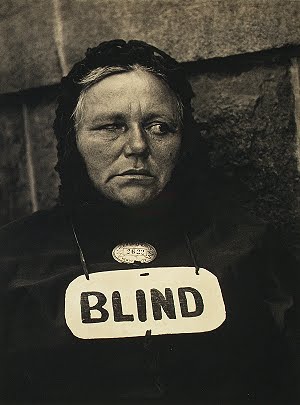


Paul Strand, 'Blind', 1916When I consider how my light is spent
Ere half my days, in this dark world and wide,
And that one Talent which is death to hide,
Lodged with me useless, though my Soul more bent
To serve therewith my Maker, and present
My true account, least he returning chide,
Doth God exact day-labour, light denied,
I fondly ask; But patience to prevent
That murmur, soon replies, God doth not need
Either man's work or his own gifts, who best
Bear his mild yoke, they serve him best, his State
Is Kingly. Thousands at his bidding speed
And post o're Land and Ocean without rest:
They also serve who only stand and wait.

-John Milton, "On His Blindness," 1655

Image: "Blindness" by Paul Strand, 1916


From Diderot's Letter on the Blind, 1749. Diderot describes an interview with a blind man from Puiseaux [emphasis added]:

He asked us if only persons who were called naturalists could see with the microscope, and if only astronomers could see with the telescope; if the instrument for enlarging objects were bigger than that for diminishing them; if that which brings them nearer were shorter than that for removing them farther off. But what puzzled him was that the other self, which according to him the mirror represents in relief, should not be tactile.

"So this little instrument," said he, "sets two senses to contradict one another; a more perfect instrument would perhaps reconcile these contradictions, without the object being ever more real for that, and perhaps a third instrument, still more perfect and less illusory, would cause these contradictions to disappear and show us our error."

the 400 blows / les quatrecents coups / 400 batow / polish movie poster 1959
Polish poster for Francois Truffaut's The 400 Blows, 1959
Designed by Waldemar Swierzy

10 November 2010

30,000 feet

GOOSE, n. A bird that supplies quills for writing. These, by some occult process of nature, are penetrated and suffused with various degrees of the bird's intellectual energies and emotional character, so that when inked and drawn mechanically across paper by a person called an "author," there results a very fair and accurate transcript of the fowl's thought and feeling. The difference in geese, as discovered by this ingenious method, is considerable: many are found to have only trivial and insignificant powers, but some are seen to be very great geese indeed.
-Ambrose Bierce, The Devil's Dictionary


Bar-Headed Geese

21 October 2010

Nuestro Señor de La Mancha

In honor of the Festival Internacional Cervantino, currently in its 38th year, and in honor of Miguel de Cervantes Saavedra, whose celebration needs no occasion, the following:


Detail of sculpture in Alcalá de Henares, Cervantes' birthplace. [Source]


If by chance these gentlemen should wish to know who is the valorous one that served them so, let your worship tell them that it is the famous Don Quixote of La Mancha, who is otherwise called the Knight of the Rueful Figure.


Don Quixote and Sancho Panza, Alcalá de Henares


Madrid, 1979 [Source]


Detail of the above.


Don Quixote of Havana


Detail of above.


Don Quixote, relief by Anna Hyatt Huntington, Audubon Terrace, New York


Guanajuato, Mexico, home of Cervantino. (The full sculpture includes Sancho Panza, but there seems to exist no good photo of the entire thing online.)

28 September 2010

On Scholarship

Albrecht Dürer, Saint Jerome in his Study, 1514

A Graduate Record Examination (GRE) "Issue task" matching game. The test takers were to present their perspectives on the following issue:

It is unfortunate that today's educators place so much emphasis on finding out what students want to include in the curriculum and then giving it to them. It is the educator's duty to determine the curriculum and the students' duty to study what is presented to them.

Below, sample phrases come from essays that received scores of 5 and 6 (6 is the highest possible score). Five of the comments relate to those two essays, and one comment relates to a third essay, which received a score of 1 (the lowest).

Phrase from sample essay
Grader's comment
1. As an elementary educator, I believe this stance is extremist. Educators and the public must come to a middle road.
A. The discussion is generally confusing and barely addresses the central issue presented in the topic.
2. Hard work must be lauded, while freeloaders are punished.
B. This is an insightful, well-articulated discussion of curricular responsibility and the larger issue of academic responsibility.
3. Content and performance standards (i.e. curricula) need to be developed by the district's educators as a map for teachers. When educators provide students with choices WITHIN the map of curriculum, students relish in the freedom and take ownership for their learning.
C. Language use is generally precise and effective, and sentence structure is well controlled.
4. Of course, any school in which the students decide "what goes" is bound to have problems controlling students. Once the educators, be they administrators or teachers, are under the control of students, even a democratic situation would be like holding royalty acountable to the mob.
D. The examples are varied and used effectively to further support the writer's position.
5. Presently, students hear for hours that they should not forget to use a condom in the heat of the moment, and educators think the message gets through, while half the kids can't even remember to bring a pencil to class.
E. The careful choice of words and carefully structured paragraphs help unify the structure of the argument.
6. I do NOT think it is unfortunate that today's educators emphasize students' interests. It IS our duty, however, to provide the parameters for their education.
F. This response presents a well-developed analysis of the issue and displays strong control of the elements of writing.

Answers:
Essay 1 (scored 6): 2, 4, 5, & B, C, D
Essay 2 (scored 5): 1, 3, 6, & E, F
Essay 3 (scored 1): A


The young scholar was praised by friends and acquaintances as one of the clearest, most powerful, and most incisive writers living. It was inexplicable, therefore, that he continued to receive low scores on the writing sections of the Examination, and all the more so given that his scores on the verbal and quantitative multiple choice sections were among the highest achievable. Tragically, there was no way to circumvent the Examination, and the young scholar was barred from living the life he had imagined for himself. Settling for a life of intellectual isolation, he took up a manual craft, which provided a meager existence and afforded some time for private study. The scholar died, when, soon afterward, his lungs began to turn to glass. When he drew his last breath, the glass shattered, leaving no part of him intact for scrutiny.

Johannes Hevelius, Foot-powered Lathe, from Selenographia, sive Lunae descriptio, 1647

07 September 2010

Here am I shedding one of my life-skins, and all they will say is, 'Bernard is spending ten days in Rome.'

Painting: Virginia Woolf by Vanessa Bell, 1912
"Now I sit on a stone seat in these gardens surveying the eternal city, and the little man who was shaving in London five days ago looks already like a heap of old clothes. [...] I sit here like a convalescent, like a very simple man who knows only words of one syllable. 'The sun is hot,' I say. 'The wind is cold.' I feel myself carried round like an insect on top of the earth and could swear that, sitting here, I feel its hardness, its turning movement. I have no desire to go the opposite way from the earth. Could I prolong this sense another six inches I have a foreboding that I should touch some queer territory. But I have a very limited proboscis. I never wish to prolong these states of detachment; I dislike them; I also despise them. I do not wish to be a man who sits for fifty years on the same spot thinking of his navel. I wish to be harnessed to a cart, a vegetable-cart that rattles over the cobbles."

- Virginia Woolf, The Waves
Image: "Virginia Woolf" by Vanessa Bell, c. 1912

I expose myself to that risk voluntarily.

I have but one passion: to enlighten those who have been kept in the dark, in the name of humanity which has suffered so much and is entitled to happiness. My fiery protest is simply the cry of my very soul. Let them dare, then, to bring me before a court of law and let the enquiry take place in broad daylight! I am waiting.

- Émile Zola, J'accuse!


Painting: The Prisoner by Nikolai Alexandrovich Yaroshenko, 1878
"The Prisoner" by Nikolai Alexandrovich Yaroshenko, 1878 [1]


A man cannot live intensely except at the cost of the self. Now the bourgeois treasures nothing more highly than the self (rudimentary as his may be). And so at the cost of intensity he achieves his own preservation and security. His harvest is a quiet mind which he prefers to being possessed by God, as he does comfort to pleasure, convenience to liberty, and a pleasant temperature to that deathly inner consuming fire.

- Hermann Hesse, Steppenwolf


Painting: Zola Insulted by Henry de Groux
"Zola Insulted" by Henry de Groux, date unknown [2]


It appears to be an inborn and imperative need of all men to regard the self as a unit. However often and however grievously this illusion is shattered, it always mends again. The judge who sits over the murderer and looks into his face, and at one moment recognizes all the emotions and potentialities of the murderer in his own soul and hears the murderer's voice as his own, is at the next moment one and indivisible as the judge, and scuttles back into the shell of his cultivated self and does his duty and condemns the murderer to death. And if ever the suspicion of their manifold being dawns upon men of unusual powers and of unusually delicate perceptions, so that, as all genius must, they break through the illusion of the unity of the personality and perceive that the self is made up of a bundle of selves, they have only to say so and at once the majority puts them under lock and key, calls science to aid, establishes schizomania and protects humanity from the necessity of hearing the cry of truth from the lips of these unfortunate persons.

- Hermann Hesse, Steppenwolf


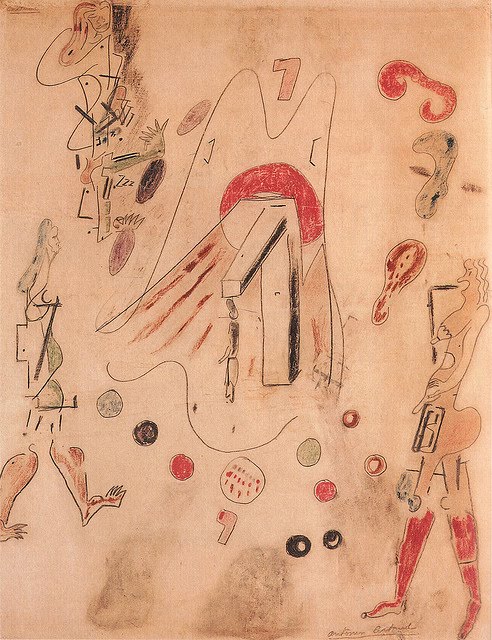
Antonin Artaud, La Pendue (The Hanged), 1945
"La Pendue" ("The Hanged") by Antonin Artaud, 1945 [3]


[1] Image taken from this page, where an oddly-phrased comment is good for a laugh: "[Yaroshenko's] genre paintings depict torture, struggles, fruit, bathing suits, and other hardships faced in Russia."

[2] From Dreyfus Rehabilitated: "painting by Henri Degroux depicting the hatred of the masses, a present to the writer from his admirers".

[3] Image taken from an excellent blog called A Journey Round My Skull; includes a link to a larger version of the image.