Showing posts with label experimental blogging. Show all posts

26 April 2012

First Works

WikiPaintings allows visitors to view all works by a given artist in chronological order.  The Salvador Dalí "collection" includes paintings dating from 1910, when the artist was 6 years old.  Moving forward in time, Dalí's predecessors show their faces one after another.  This leads to the invention of a game: begin at the beginning and move forward until you come across a work in which you can perceive nothing but the artist's own style.  Call this the First Work.

Salvador Dalí, The Station at Figueras, 1926
Salvador Dalí, The Station at Figueras, 1926, age 22

(The shadows, the shadowy figures, the desolate landscape of unexplained shapes, the trees obviously preparing for The Persistence of Memory.  If, in the application of paint, there is not yet Dalí, neither is there anyone else in particular [so far as is evident from the picture].)
Of course, there can be no winning this game.  Disputation can only lead further discovery.  If you, readers, decide to play this game, comment here with your findings.  I will perhaps post them, and more of my own, in future posts.

Another suggestion:
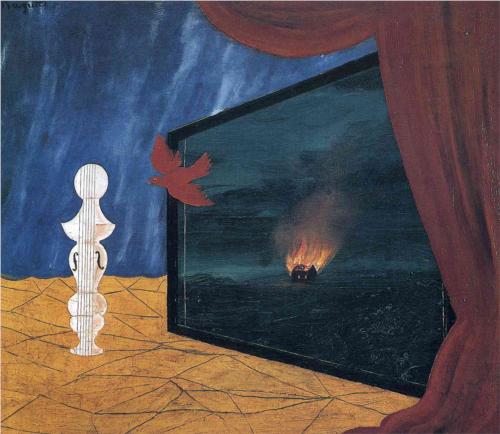
René Magritte, Nocturne, 1925
René Magritte, Nocturne, 1925, age 27

26 January 2012

Fragments II: Symbol


blood flight by Jenny Hval


[The Parnassians] still treat their subjects as the old philosophers and orators did: that is, present things directly, whereas I think that they should be presented allusively. Poetry lies in the contemplation of tings, in the image emanating from the reveries which things arouse in us. They take something in its entirety and simply exhibit it; in so doing, they fall short of mystery; they fail to give our minds that exquisite joy which consists in believing that we are creating something. To name an object is largely to destroy poetic enjoyment, which comes from gradual divination. The ideal is to suggest the object. It is the perfect use of this mystery which constitutes symbol. An object must be gradually evoked in order to show a state of soul; or else, choose an object and from it elicit a state of soul by means of a series of decodings.

Attributed to Stéphane Mallarmé.


bridal veil stinkhorn fungus


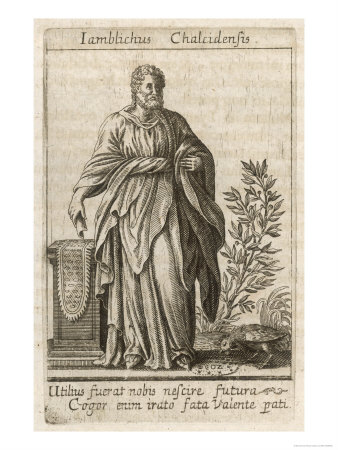
Iamblichus:
Iamblichus Chalcidensis, Neoplatonic philosopher
Granting, then, that ignorance and deception are faulty and impious, it does not follow that the offerings made to the gods and divine works are invalid, for it is not pure thought that unites theurgists to the gods. Indeed, what then would hinder those who are theoretical philosophers from enjoying a theurgic union with the gods? But the situation is not so: it is the accomplishment of acts not to be divulged and beyond all conception, and the power of unutterable symbols, understood solely by the gods that establishes theurgic union. For this reason, we do not bring about these things by thinking alone. If we did, their efficacy would be intellectual, and dependent on us. But neither assumption is true. For even when we are not engaged in thinking, the symbols themselves, by themselves, perform their appropriate work, and the ineffable power of the gods, to whom these symbols relate, itself recognizes the proper images of itself, not through being aroused by our thought.

05 April 2009

Non-fiction

Note: This post must be viewed directly at Altarpiece, (click here), rather than through an RSS reader, because such applications often do not render background images.

Please be patient with the large images in this post. After some deliberation I opted to embed high-quality versions rather. I think the result is worthwhile.


The images below were captured in Google Earth from panoramas taken by the Opportunity and Spirit Mars rovers. Experiencing the panoramas in Google Earth has the advantage of better-simulated reality; the viewer can move dynamically through the picture in such a way that the true-color photographs of Mars have a more startling impact than can be achieved in these static images. One gets a sense of how wonderfully strange it would be to move around beneath a sky like dust and skin and olives, of how untouched the planet is, of how real it is as a location, and of how (somehow) absurd it is to stand there and snap a picture.

The text accompanying the images consists of excerpts from Rainer Maria Rilke's Letters to a Young Poet, which can be read online in its entirety at Scribd.com. The sterility of Mars on the one hand, and the virility of Rilke's thoughts on the other... perhaps posting these two things together will mute them both, but the juxtaposition seemed so unlikely, even ridiculous and impossible, as to be somehow necessary.


Loving does not at first mean merging, surrendering, and uniting with another person (for what would a union be of two people who are unclarified, unfinished, and still incoherent - ?), it is a high inducement for the individual to ripen, to become something in himself, to become world, to become world in himself for the sake of another person; it is a great, demanding claim on him, something that chooses him and calls him to vast distances. Only in this sense, as the task of working on themselves ("to hearken and to hammer day and night"), may young people use the love that is given to them. Merging and surrendering and every kind of communion is not for them (who must still, for a long, long time, save and gather themselves); it is the ultimate, is perhaps that for which human lives are as yet barely large enough.

Click for larger image.


Bodily delight is a sensory experience, not any different from pure looking or the feeling with which a beautiful fruit fills the tongue; it is a great, an infinite learning that is given to us, a knowledge of the world, the fullness and the splendor of all knowledge. And it is not our acceptance of it that is bad; what is bad is that most people misuse this learning and squander it and apply it as a stimulant on the tired places of their lives and as a distraction rather than as a way of gathering themselves for their highest moments.... If only they could be more reverent toward their own fruitfulness, which is essentially one, whether it is manifested as mental or physical; for mental creation too arises from the physical, is of one nature with it and only like a softer, more enraptured and more eternal repetition of bodily delight.
Click for larger image.


Richard Dehmel: ... You have characterized him quite well with the phrase: "living and writing in heat." - And in fact the artist's experience lies so unbelievably close to the sexual, to its pain and its pleasure, that the two phenomena are really just different forms of one and the same longing and bliss. And if instead of "heat" one could say "sex" - sex in the great, pure sense of the word, free of any sin attached to it by the Church - then his art would be very great and infinitely important. His poetic power is great and as strong as a primal instinct; it has its own relentless rhythms in itself and explodes from him like a volcano.

Click for larger image.


Whoever looks seriously will find that neither for death, which is difficult, nor for difficult love has any clarification, any solution, any hint of a path been perceived; and for both these tasks, which we carry wrapped up and hand on without opening, there is not general, agreed-upon rule that can be discovered. But in the same measure in which we begin to test life as individuals, these great Things will come to meet us, the individuals, with greater intimacy. The claims that the difficult work of love makes upon our development are greater than life, and we, as beginners, are not equal to them. But if we nevertheless endure and take this love upon us as burden and apprenticeship, instead of losing ourselves in the whole easy and frivolous game behind which people have hidden from the most solemn solemnity of their being, - then a small advance and a lightening will perhaps be perceptible to those who come long after us. That would be much.
Click for larger image.


We must accept our reality as vastly as we possibly can; everything, even the unprecedented, must be possible within it. This is in the end the only kind of courage that is required of us: the courage to face the strangest, most unusual, most inexplicable experiences that can meet us. The fact that people have in this sense been cowardly has done infinite harm to life; the experiences that are called "apparitions," the whole so-called "spirit world," death, all these Things that are so closely related to us, have through our daily defensiveness been so entirely pushed out of life that the senses with which we might have been able to grasp them have atrophied. To say nothing of God. But the fear of the inexplicable has not only impoverished the reality of the individual; it has also narrowed the relationship between one human being and another, which has as it were been lifted out of the riverbed of infinite possibilities and set down in a fallow place on the bank, where nothing happens. For it is not only indolence that causes human relationships to be repeated from case to case with such unspeakable monotony and boredom; it is timidity before any new, inconceivable experience, which we don't think we can deal with. but only someone who is ready for everything, who doesn't exclude any experience, even the most incomprehensible, will live the relationship with another person as something alive and will himself sound the depths of his own being.

Click for larger image.

14 December 2008

Wind

Note: If you are seeing this in an RSS reader, you will miss the full effect. Please view the piece normally by clicking here.


Night falls early. If you are in a windowless room, you become aware of the darkening subconsciously, as the lights inside seem somehow to change in color or intensity. Gradually you become filled with a feeling that you are in the wrong place. The clock on the wall reads 4:23, and you know this to be true. Still, in your mind it is much later than this. You should be home now, surrounded by the warm lights you are accustomed to, surrounded by your familiar things, safe and stationary until tomorrow. This spectral feeling fidgets around inside you, breaking your concentration. You glance at the clock more often than you would like to, struggling to stay interested in what you are doing. Your back is turned toward the door.
From behind you comes a noise unlike anything you have heard before. It is the sound of the sun setting; the sound of a holy wind; the sound of an air duct falling apart; the sound of smooth thunder; the sound thunder aspires to; the sound you would have heard if the light had not killed you. Your eyes widen. You are paralyzed until the sound passes, and you realize it was a sound that could not have occurred under any other circumstances. As you begin to recover, you look breathlessly at the others in the room. They did not hear it. They wait impatiently for the day to end.

24 November 2008

I.

Instructions:

Read the items in the list one at a time. Close your eyes and picture each one vividly as you can. Imagine it in whatever context comes to you. Picture it with every feeling it brings with it. When your picture is complete, count to ten. Then move on to the next thing on the list.


snow

dark night sky

red brick

a silhouette in a window

white lights on a marble theatre

copper-green statues

shadows on the wall
II.


This is an experiment in showing you the inside of my head. It is an explanation, but not the kind you find in books. Dreams are an explanation of your mind. This is something like a dream I have had every day for the last week.

It is not poetry unless the inside of my head is poetry.


Imagine asking for directions in a country where no one speaks your language. You have to communicate somehow. When you open your mouth, sounds come out. You disassociate from yourself because you are too embarrassed to take responsibility for what you are saying. You watch yourself as if from the outside. You gesture wildly. It is raining. There is no time to think about it. You speak from your gut. Somehow, you make yourself understood.