Showing posts with label film. Show all posts

27 June 2009

Becoming Nothing


Art creates, alters, and reinforces certain aspects of human nature. This fact destroys the notion of art as apolitical. Politics is a lame substitution for art.


times and winds/bes vakit still


Susan Sontag
I have several times applied to the work of art the metaphor of a mode of nourishment. To become involved with a work of art entails, to be sure, the experience of detaching oneself from the world. But the work of art itself is also a vibrant, magical, and exemplary object which returns us to the world in some way more open and enriched.


times and winds/bes vakit still


We are working now to dissolve human nature through art. To achieve an aesthetic experience that does not remove us from ourselves but annuls the self, allowing us to become empty and to merge seamlessly with everything else so that we are everything else.


Robert Musil:
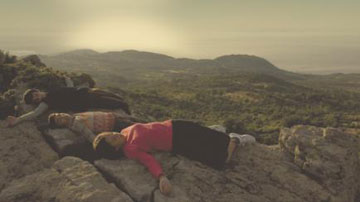
And so, whatever the relationship may be between objects and feeling in the civilized person's mature view of the world, everyone surely knows those ecstatic moments in which a split has not yet occurred, as though water and land had not yet been divided and the waves of feeling still shared the same horizon as the hills and valleys that form the shape of things.


times and winds/bes vakit still


Andrei Tarkovsky:
The allotted function of art is not, as is often assumed, to put across ideas, to propagate thoughts, to serve as example. The aim of art is to prepare a person for death, to plough and harrow his soul, rendering it capable of turning to good.


times and winds/bes vakit still


The pinnacle of human nature is Nature.


[1] [2] [3]

24 May 2009

a bird which died advised me to / commit flight to memory.

Forough Farrokhzad's short documentary The House is Black can be viewed at UbuWeb.

Leprosy is chronic and contagious. Leprosy is not hereditary. Leprosy can be anywhere or everywhere. Leprosy goes with poverty. Upon attacking the body it deepens and enlarges wrinkles, eats away the tissues, covers the nerves with a dry shield, dulls sensitivity to heat and touch, causes blindness, destroys the nasal septum, it finds its way to the liver and bone marrow, withers the fingers, it clears the way for other diseases.

Leprosy is not incurable. Taking care of lepers stops the disease from spreading. Wherever lepers have been adequately cared for, the disease has vanished. When the leper is cared for early, he can be treated completely. Leprosy is not incurable.


The filmmaker, Forough Farrokhzad, is considered one of the most accomplished modern Iranian poets. Though her mastery of poetic form in Persian is probably difficult to translate into English, free translations capture something of the spirit.

Two excerpts from "Another Brith" (click here to read the whole thing):

Life is perhaps
a rope with which a man hangs himself from a branch
life is perhaps a child returning home from school.

...

I will plant my hands in the garden
I will grow I know I know I know and
swallows will lay eggs
in the hollow of my ink-stained hands.


"The Couple":

Night comes
and after night, darkness
and after darkness
eyes
hands
and breathing and more breathing
and the sound of water
which drips drips drips
from the faucet.

then two red points
from two lighted cigarettes
the clock's tick-tock
and two heads
and two lonelinesses.
Much more of Forough's poetry, occasionally with Persian audio of the poems available, can be read at http://www.forughfarrokhzad.org/.

"I believe in being a poet in all moments of life. Being a poet means being human. I know some poets whose daily behavior has nothing to do with their poetry. In other words, they are only poets when they wrote poetry. Then it is finished and they turn into greedy, indulgent, oppressive, shortsighted, miserable, and envious people. Well, I cannot believe their poems. I value the realities of life and when I find these gentlemen making fists and claims--that is, in their poems and essays--I get disgusted, and I doubt their honesty. I say to myself: Perhaps it is only for a plate of rice that they are screaming. "

26 April 2009

Attrition


YouTube videoNumber of views
The Seashell and the Clergyman, Part 136,496 views
The Seashell and the Clergyman, Part 27,992 views
The Seashell and the Clergyman, Part 35,330 views


For more information about the film, see this post at Documents.

17 March 2009

Harun Farocki's documentary Images of the World and the Inscription of War is available in English on YouTube in 8 parts. (Click here for part 1). Two highlights:


The idea of obtaining measurement through photography came to [the inventor of the technique] after he was suspended between life and death. That means, it is dangerous to hold out physically on the spot... safer to take a picture.
...
Arduous and dangerous to hold out physically on the spot. Safer to take a picture and evaluate it later protected from the elements at one's desk.
***


[On the examination of aerial photographs of concentration camps in the 1960s and 1970s:]
The snow on the roofs of the neighboring barracks is already melting, which means that they are still inhabited. The evaluators verify, that means they establish the verity, of the existence of the camp down to the last detail, and they do this with relish for their role as specialists.
Although the film is about many things, it is basically about the Holocaust. In this regard and in others, it is the same color as W. G. Sebald's book The Rings of Saturn, which, although it never mentions the Holocaust directly, is basically "about" the Holocaust in the sense of "around".


In China, the placating of the elements has always been intimately connected with the ceremonial rites which surrounded the ruler on the dragon throne and which governed everything from affairs of state down to daily ablutions, rituals that also served to legitimize and immortalize the immense profane power that was focused in the person of the emperor. At any moment of the day or night, the members of the imperial household, which numbered more than six thousand and consisted exclusively of eunuchs and women, would be circling, on precisely defined orbits, the sole male inhabitant of the Forbidden City that lay concealed behind purple-coloured walls. In the latter half of the nineteenth century, the ritualization of imperial power was at its most elaborate: at the same time, that power itself was by now almost completely hollowed out. While all court appointments, rigidly controlled as they were by an immutable hierarchy, continued to be made according to rules that had been perfected down to the last detail, the empire in its entirety was on the brink of collapse, owing to mounting pressure from enemies both within and without.
I read this book some months ago, but I didn't realize that it was about the Holocaust at all until I heard a radio interview with the author in which he explains it. Originally I was unimpressed, since I don't like puzzles that can't be figured out and I don't like art that can't stand alone. With time, though, I've come to the conclusion that the Holocaust serves in both these cases as a horizon against which concepts can be set. It's not necessary to understand the horizon in order to use it as a new way of linking concepts, a new way of thinking. The point, rather, is that historical events create interpretive possibilities, possible routes to the truth, that did not exist before. And the method is an innocent one because the truth always stands alone.

Brief clips of many of Harun Farocki's other excellent documentaries (most of them are not feature length) can be found on YouTube and here.

26 February 2009

confession continued

Note: If you see this in an RSS reader, you will miss the full effect. Please click here to view the piece normally.

It is many years now that I have had only myself as object of my thoughts, that I have been examining and studying only myself; and if I study anything else, it is in order promptly to apply it to myself, or rather within myself.

-Michel de Montaigne


is baseball holy? is everything holy? is aligators holy? is the world holy? is the basketball holy? is the organ of man holy?

are holy flowers holy? is the world holy? is glasses holy? is time holy? is all the white moonlight holy?

empty rooms are holy? neal holy? toy holy? byzantine holy? mark holy? is the american flag holy? is girl holy? is your sister holy? what is holy?

and car holy? and light holy? is holy holy? are you holy?


(Adapted from Pull My Daisy, the first video on the linked page. The second video is also worth watching, but I wouldn't recommend reading the essay underneath.)


27 November 2008

On boiling

"I show you light now. It burns bright forever.
No more blue tomorrows. You’re on high now, love."


People overthink all sorts of things. The truth boils underneath like an underground lake.

Art causes the soul to boil. Interpreting and reading and thinking about this boiling is a way of turning the heat down. "Cinema is a language that can say abstractions."