Showing posts with label Antonin Artaud. Show all posts

11 February 2012

The Faces of Alexei Korzukhin

Alexei Korzukhin, Russian realist painter, 1835–1894. Wikipedia styles his portraits as "generally accepted as masterpieces of Russian portrait painting." Some highlights from a timeline on rusartnet:

  • Born to a family of gold panners at Uktussky Zavod near Ekaterinburg (1835).
  • One of the rebellious fourteen students who refused to paint the set topic in the competition for a major gold medal and resigned from the Imperial Academy of Arts with the title of second-class artist (1863).
[It isn't clear what the "set topic" was, but it seems the group was protesting the strict guidelines and divisions between high and low art that the Imperial Academy endorsed. They wanted to make art more accessible to the masses, and after leaving the Imperial Academy of Arts founded a collective called the Peredvizhniki, or The Wanderers, which later became the Society for Travelling Art Exhibitions. Evidently Korzukhin was a member of the society but did not participate in the exhibitions. More here, and, of course, here.]
  • Suffered from nervous shock and poor health after witnessing the assassination of Tsar Alexander II on the Ekaterinburg Canal in St Petersburg (1881).
Master of portraiture thought Korzukhin may be, the extent of his mastery is more clearly evident in his portrayal of faces in action. Examples below, with details. Click on the full paintings for large versions.


Separation, 1872


Alexei Korzukhin, Separation, 1872

Alexei Korzukhin, Separation, 1872, detail


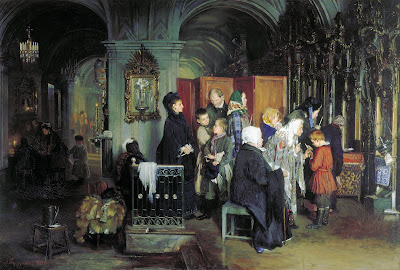
Before Confession, 1877


Alexei Korzukhin, Before confession, 1877

Alexei Korzukhin, Before confession, 1877, deatil

Alexei Korzukhin, Before confession, 1877, deatil


Peasant Girls in a Forest, 1878


Alexei Korzukhin, Peasant Girls in a Forest, 1878

Alexei Korzukhin, Peasant Girls in a Forest, 1878, detail


In a Monastic Hotel, 1882


Alexei Korzukhin, In a Monastic Hotel, 1882

Alexei Korzukhin, In a Monastic Hotel, 1882, detail


The Sunday, 1884


Alexei Korzukhin, The Sunday, 1884

Alexei Korzukhin, The Sunday, 1884, detail


There Goes Petrushka, 1888


Alexei Korzukhin, There Goes Petrushka, 1888

Alexei Korzukhin, There Goes Petrushka, 1888, detail

15 October 2011

Sterility, mental and physical

I apologize to the readers of altarpiece for its state of disrepair. I have begun a Ph.D. program in philosophy, so I spend most of my time thinking about things that are not suitable for presentation here. I'll try to keep posting as I can, but really altarpiece-style posts will probably become more rare (if that's possible).

Yesterday I went to Pittsburgh's Andy Warhol Museum. Here is the only image I've been able to find online of my favorite piece there:

Andy Warhol - Jean-Michel Basquiat, 1984Jean-Michel Basquiat. Andy Warhol, 1984.

In reality it's about 8 feet tall. Each limb section has a different grain, a different texture. The color is reminiscent of x-ray images.

I was captivated by this, and stood looking at it for an embarrassingly long time, from different parts of the room. Basquiat's left arm in two positions gives the impression of a captured movement, is also reminiscent of da Vinci's Vitruvian Man. The pose is Michaelangelo's David.


The x-ray quality combined with the pasted together panels gives the impression of resurrection.

I asked myself whether I would have been so interested in the portrait if it hadn't been Basquiat. The head is the most awkwardly attached limb. The contrast is starker, the seam is more exact and thus more distracting. It's only the head the objects to its positioning. The tension between the head and the body reminds me of the tension between life and self. But it doesn't detract from the beauty of the human body, which doesn't seem to be the least bit disturbed by being cut up and put back together.

07 September 2010

I expose myself to that risk voluntarily.

I have but one passion: to enlighten those who have been kept in the dark, in the name of humanity which has suffered so much and is entitled to happiness. My fiery protest is simply the cry of my very soul. Let them dare, then, to bring me before a court of law and let the enquiry take place in broad daylight! I am waiting.

- Émile Zola, J'accuse!


Painting: The Prisoner by Nikolai Alexandrovich Yaroshenko, 1878
"The Prisoner" by Nikolai Alexandrovich Yaroshenko, 1878 [1]


A man cannot live intensely except at the cost of the self. Now the bourgeois treasures nothing more highly than the self (rudimentary as his may be). And so at the cost of intensity he achieves his own preservation and security. His harvest is a quiet mind which he prefers to being possessed by God, as he does comfort to pleasure, convenience to liberty, and a pleasant temperature to that deathly inner consuming fire.

- Hermann Hesse, Steppenwolf


Painting: Zola Insulted by Henry de Groux
"Zola Insulted" by Henry de Groux, date unknown [2]


It appears to be an inborn and imperative need of all men to regard the self as a unit. However often and however grievously this illusion is shattered, it always mends again. The judge who sits over the murderer and looks into his face, and at one moment recognizes all the emotions and potentialities of the murderer in his own soul and hears the murderer's voice as his own, is at the next moment one and indivisible as the judge, and scuttles back into the shell of his cultivated self and does his duty and condemns the murderer to death. And if ever the suspicion of their manifold being dawns upon men of unusual powers and of unusually delicate perceptions, so that, as all genius must, they break through the illusion of the unity of the personality and perceive that the self is made up of a bundle of selves, they have only to say so and at once the majority puts them under lock and key, calls science to aid, establishes schizomania and protects humanity from the necessity of hearing the cry of truth from the lips of these unfortunate persons.

- Hermann Hesse, Steppenwolf


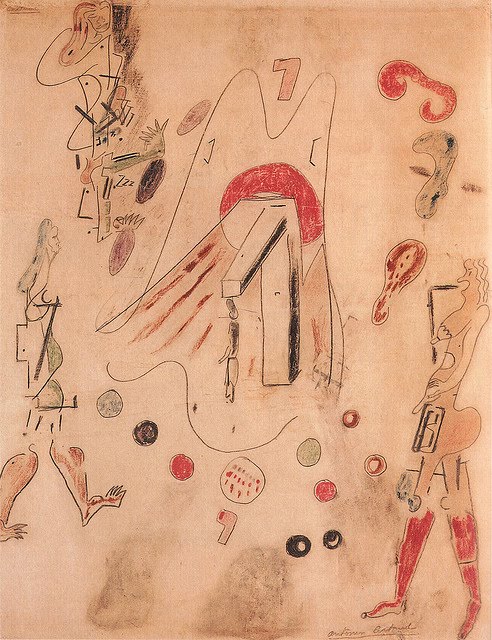
Antonin Artaud, La Pendue (The Hanged), 1945
"La Pendue" ("The Hanged") by Antonin Artaud, 1945 [3]


[1] Image taken from this page, where an oddly-phrased comment is good for a laugh: "[Yaroshenko's] genre paintings depict torture, struggles, fruit, bathing suits, and other hardships faced in Russia."

[2] From Dreyfus Rehabilitated: "painting by Henri Degroux depicting the hatred of the masses, a present to the writer from his admirers".

[3] Image taken from an excellent blog called A Journey Round My Skull; includes a link to a larger version of the image.

01 May 2009

Spiders' Legs


A person steps into the shower, adjusts the shower curtain. A large spider is seen to scramble in every direction away from the falling water. The person's face displays mild surprise at the spider's appearance. While performing routine activities of the shower, the person uses one big toe to deflate air bubbles in the clear bath mat. The toe deflates bubbles only in places where black specks, the decaying corpses of previously deceased spiders, can be clearly seen. The person's face registers mild irony as the now half-dead spider finds a small opening through which to crawl under the bath mat. As water impedes the spider's progress on all sides, the person uses the toe to help the spider through the rubber doorway. These words are spoken: "There's no hope for you."


An alternate title for this post:
ungeheuren Ungeziefer

For some reason, the tall, empty room where [Gregor Samsa] was forced to remain made him feel uneasy as he lay there flat on the floor, even though he had been living in it for five years. Hardly aware of what he was doing other than a slight feeling of shame, he hurried under the couch. It pressed down on his back a little, and he was no longer able to lift his head, but he nonetheless felt immediately at ease and his only regret was that his body was too broad to get it all underneath.
*****
Hiding places there are innumerable, escape is only one, but possibilities for escape, again, are as many as hiding places.


How blest am I
In my just censure! in my true opinion!
Alack, for lesser knowledge! how accurs'd
In being so blest! There may be in the cup
A spider steep'd, and one may drink; depart,
And yet partake no venom (for his knowledge
Is not infected), but if one present
Th' abhorr'd ingredient to his eye, make known
How he hath drunk, he cracks his gorge, his sides,
With violent hefts. I have drunk, and seen the spider.
(The Winter's Tale, II.i.36-45)


For more on this topic, see Story from North America by Kristen Lepore and Garrett Davis.


(Kristen Lepore's other films are available for viewing on her website.
)

26 April 2009

Attrition


YouTube videoNumber of views
The Seashell and the Clergyman, Part 136,496 views
The Seashell and the Clergyman, Part 27,992 views
The Seashell and the Clergyman, Part 35,330 views


For more information about the film, see this post at Documents.