Showing posts with label nature. Show all posts

26 January 2012

Fragments II: Symbol


blood flight by Jenny Hval


[The Parnassians] still treat their subjects as the old philosophers and orators did: that is, present things directly, whereas I think that they should be presented allusively. Poetry lies in the contemplation of tings, in the image emanating from the reveries which things arouse in us. They take something in its entirety and simply exhibit it; in so doing, they fall short of mystery; they fail to give our minds that exquisite joy which consists in believing that we are creating something. To name an object is largely to destroy poetic enjoyment, which comes from gradual divination. The ideal is to suggest the object. It is the perfect use of this mystery which constitutes symbol. An object must be gradually evoked in order to show a state of soul; or else, choose an object and from it elicit a state of soul by means of a series of decodings.

Attributed to Stéphane Mallarmé.


bridal veil stinkhorn fungus


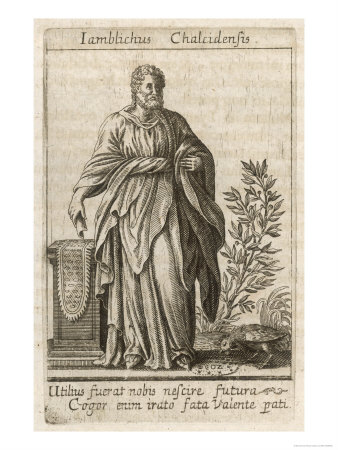
Iamblichus:
Iamblichus Chalcidensis, Neoplatonic philosopher
Granting, then, that ignorance and deception are faulty and impious, it does not follow that the offerings made to the gods and divine works are invalid, for it is not pure thought that unites theurgists to the gods. Indeed, what then would hinder those who are theoretical philosophers from enjoying a theurgic union with the gods? But the situation is not so: it is the accomplishment of acts not to be divulged and beyond all conception, and the power of unutterable symbols, understood solely by the gods that establishes theurgic union. For this reason, we do not bring about these things by thinking alone. If we did, their efficacy would be intellectual, and dependent on us. But neither assumption is true. For even when we are not engaged in thinking, the symbols themselves, by themselves, perform their appropriate work, and the ineffable power of the gods, to whom these symbols relate, itself recognizes the proper images of itself, not through being aroused by our thought.

28 July 2011

Hogs is hogs

Charles Jacque - Le Retour du BergerLe Retour du Berger, Charles Jacque (1879-1959)

A scene of uncommon hilarity from Cormac McCarthy in Outer Dark:

On a good spring day he paused to rest at the side of the road. He had been walking for a long time and he had been hearing them for a long time before he knew what the sound was, a faint murmurous droning portending multitudes, locusts, the advent of primitive armies. He rose and went on until he reached the gap in the ridge and before long he could see the first of them coming along the road below him and then suddenly the entire valley was filled with hogs, a weltering sea of them that came smoking over the dusty plain and flowed undiminished into the narrows of the cut, fanning on the slopes in ragged shoals like the harried outer guard of schooled fish and here and there upright and cursing among them and laboring with poles the drovers, gaunt and fever-eyed with incredible rag costumes and wild hair.
     Holme left the road and clambered up the rocky slope to give them leeway. The first of the drovers was beating his way obliquely across the herd toward him, the hogs flaring and squealing and closing behind him again like syrup. When he gained the open ground he came along easily, smiling up to where Holme sat on a rock with his feet dangling and looking down with no little wonder at this spectacle. hog drovers
     Howdy neighbor, called out the drover. Sweet day, ain't she?
     It is, he said. Whereabouts are ye headed with them hogs if you don't care for me astin?
     Crost the mountain to Charlestown.
     Holme shook his head reverently. That there is the damndest sight of hogs ever I seen, he said. How many ye got?
     The drover had come about the base of the rock and was now standing looking down with Holme at the passing hogs. God hisself don't know, he said solemnly.
     Well it's a bunch.
     They Lord, said the drover, they just now commencin to come in sight. He passed his stave from the crook of one arm to the other and cocked one foot on the ledge of rock, his sparse whiskers fluttering in the mountain wind, leaning forward and watching the howling polychrome tide of hogs that glutted the valley from wall to wall as might any chance traveler a thing of interest.
     They's more than one mulefoot in that lot, he said.
     What?
     Mulefoot. I calculate they's several hunnerd head of them alone and they ain't no common hog to come upon.
     What's a mulefoot? Holme said.
     The drover squinted professionally. Mountain hog from north of here. You ain't never seen one?
     No.
     Got a foot like a mule.
     You mean they ain't got a split hoof?
     Nary split to it.
     I ain't never seen no such hog as that, Holme said.
     I ain't surprised, the drover said. But ye can see one here if you've a mind to.
     I'd admire to, Holme said.
     The drover shifted his stave again. Seems like that don't agree with the bible, what would you say?
     About what?
     About them hogs. Bein unclean on account of they got a split foot.
     I ain't never heard that, Holme said.
     I heard it preached in a sermon one time. Feller knowed right smart about the subject. Said the devil had a foot like a hog's. He laid claim it was in the bible so I reckon it's so.
     I reckon.
     He said a jew wouldn't eat hogmeat on account of it.
     What's a jew?
     That's one of them old-timey people from in the bible. But that still don't say nothin about a mulefoot hog does it? What about him?
     I don't know, Holme said. What about him?
     Well is he a hog or ain't he? Accordin to the bible.
     I'd say a hog was a hog if he didn't have nary feet a-tall.
     I might do it myself, the drover said, because if he was to have feet you'd look for em to be hog's feet. Like if ye had a hog didn't have no head you'd know it for a hog anyways. But if ye seen one walkin around with a mule's head on him ye might be puzzled.
     That's true, Holme allowed.
     Yessir. Makes ye wonder some about the bible and about hogs too, don't it?
     Yes, Holme said.
     I've studied it a good deal and I cain't come to no conclusions about it one way or the other.
     No.
     The drover stroked his whiskers and nodded his head. Hogs is a mystery by theyselves, he said. What can a feller know about one? Not a whole lot. I've run with hogs since I was just a shirttail and I ain't never come to no real understandin of em. and I don't doubt but what other folks has had the same experience. A hog is a hog. Pure and simple. And that's about all ye can say about him. And smart, don't think they ain't. Smart as the devil. And don't be fooled by one that ain't got nary clove foot cause he's devilish too.
     I guess hogs is hogs, Holme said.
     The drover spat and nodded. That's what I've always maintained, he said.


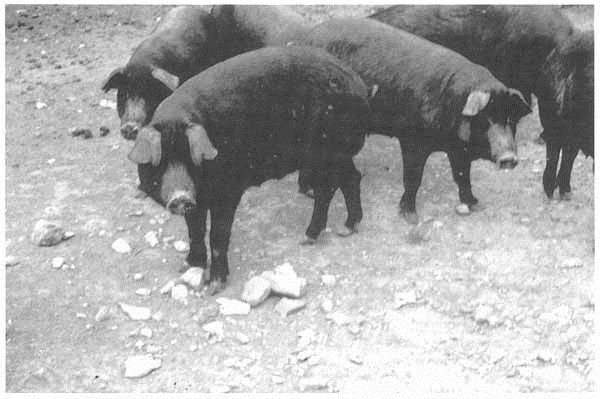
mulefoot hogs “The last remaining herd of Mulefoot Hogs in the USA has been conserved by an individual farmer.” [source]


“Hog Drovers” as sung by Ollie Gilbert, Mountain View, Arkansas on October 28, 1969. [source] [see also]


Charles Joshua Chaplin - Le porcher Le Porcher, Charles Joshua Chaplin (1825-1891)

10 November 2010

30,000 feet

GOOSE, n. A bird that supplies quills for writing. These, by some occult process of nature, are penetrated and suffused with various degrees of the bird's intellectual energies and emotional character, so that when inked and drawn mechanically across paper by a person called an "author," there results a very fair and accurate transcript of the fowl's thought and feeling. The difference in geese, as discovered by this ingenious method, is considerable: many are found to have only trivial and insignificant powers, but some are seen to be very great geese indeed.
-Ambrose Bierce, The Devil's Dictionary


Bar-Headed Geese

13 July 2010

Thy Real Friend and Loving Neighbour

Note: If you view this only in an RSS reader, you will miss the full effect. Please view the piece normally by clicking here.

There is nothing of which we are apt to be so lavish as Time, and about which we ought to be more solicitous; since without it we can do nothing in this World. Time is what we want most, but what, alas! we use worst; and for which God will certainly most strictly reckon with us, when Time shall be no more.

- William Penn
::::::::::::::::


Susquehanna River, Pennsylvania, Cumberland Valley Railroad Bridge, 1855, Postcard
1855

::::::::::::::::

Pittsburgh, Pennsylvania, PA
2009

::::::::::::::::


Fireflies
----

27 June 2009

Becoming Nothing


Art creates, alters, and reinforces certain aspects of human nature. This fact destroys the notion of art as apolitical. Politics is a lame substitution for art.


times and winds/bes vakit still


Susan Sontag
I have several times applied to the work of art the metaphor of a mode of nourishment. To become involved with a work of art entails, to be sure, the experience of detaching oneself from the world. But the work of art itself is also a vibrant, magical, and exemplary object which returns us to the world in some way more open and enriched.


times and winds/bes vakit still


We are working now to dissolve human nature through art. To achieve an aesthetic experience that does not remove us from ourselves but annuls the self, allowing us to become empty and to merge seamlessly with everything else so that we are everything else.


Robert Musil:
And so, whatever the relationship may be between objects and feeling in the civilized person's mature view of the world, everyone surely knows those ecstatic moments in which a split has not yet occurred, as though water and land had not yet been divided and the waves of feeling still shared the same horizon as the hills and valleys that form the shape of things.


times and winds/bes vakit still


Andrei Tarkovsky:
The allotted function of art is not, as is often assumed, to put across ideas, to propagate thoughts, to serve as example. The aim of art is to prepare a person for death, to plough and harrow his soul, rendering it capable of turning to good.


times and winds/bes vakit still


The pinnacle of human nature is Nature.


[1] [2] [3]

07 May 2009

Cordyceps

From a Planet Earth segment (imperative to watch in HQ):
Its infected brain directs this ant upwards. Then, utterly disorientated, it grips the stem with its mandibles. Those afflicted that are discovered by the workers are quickly taken away and dumped far away from the colony.


The fungus is so virulent, it can wipe out whole colonies of ants. There are literally thousands of different types of cordyceps fungi, and, remarkably, each specializes on just one species.
Cordyceps sinesis, for example, specializes on the caterpillar of a type of ghost moth found in some parts of China. Other types of ghost moth, susceptible to other types of cordyceps, are found in Tibet, where their medicinal use may have originated.

Photo by David Gerrard
According to Wikipedia, the Chinese name for caterpillar fungus means "winter worm, summer grass." The medicinal use of the fungus became well-known in connection with the success of Chinese athletes at the 1993 Beijing Olympic Games.
Today the most common way to prepare the caterpillar fungus is to stuff a duck with the caterpillar fungus then after boiling the duck in hot water, patients drink the liquid. It sounds unpleasant, but Vivian reports the aroma is pleasant and the broth tastes sweet. The caterpillar fungus is reported to have many benefits as a traditional medicine. Some consider the benefits to be similar to those of another valuable Chinese tonic, ginseng. Traditional Chinese medicines like the caterpillar fungus and ginseng are bought in Chinese drug stores. The price varies from $27 to $53 a pound depending on quality. The fungus fruiting body has been removed in the most expensive grade. Caterpillar fungi are also used as gifts. A large gift box costs about $400. [As of 1998.]
In addition to its aesthetic, medicinal, and shock values, cordyceps has a considerable metaphorical value, which is explicated by Arthur Schopenhauer (whose aphorisms are available to read in their entirety online) by way of another example:
The brain may be regarded as a kind of parasite of the organism, a pensioner, as it were, who dwells with the body: and leisure, that is, the time one has for the free enjoyment of one's consciousness or individuality, is the fruit or produce of the rest of existence, which is in general only labor and effort. But what does most people's leisure yield?—boredom and dullness; except, of course, when it is occupied with sensual pleasure or folly. How little such leisure is worth may be seen in the way in which it is spent: and, as Ariosto observes,how miserable are the idle hours of ignorant men!—ozio lungo d'uomini ignoranti. ...And if there is nothing else to be done, a man will twirl his thumbs or beat the devil's tattoo; or a cigar may be a welcome substitute for exercising his brains. Hence, in all countries the chief occupation of society is card-playing, and it is the gauge of its value, and an outward sign that it is bankrupt in thought. Because people have no thoughts to deal in, they deal cards, and try and win one another's money. Idiots! But I do not wish to be unjust; so let me remark that it may certainly be said in defence of cardplaying that it is a preparation for the world and for business life, because one learns thereby how to make a clever use of fortuitous but unalterable circumstances (cards, in this case), and to get as much out of them as one can: and to do this a man must learn a little dissimulation, and how to put a good face upon a bad business. But, on the other hand, it is exactly for this reason that card-playing is so demoralizing, since the whole object of it is to employ every kind of trick and machination in order to win what belongs to another. And a habit of this sort, learnt at the card-table, strikes root and pushes its way into practical life; and in theaffairs of every day a man gradually comes to regard meum and tuum in much the same light as cards, and to consider that he may use to the utmost whatever advantages he possesses, so long as he does not come within the arm of the law.
Twelve-foot high wax busts of Schopenhauer afflicted by several varieties of cordyceps fungus, which fungus he termed the Will, can be viewed in an upcoming conceptual exhibition.

01 May 2009

Spiders' Legs


A person steps into the shower, adjusts the shower curtain. A large spider is seen to scramble in every direction away from the falling water. The person's face displays mild surprise at the spider's appearance. While performing routine activities of the shower, the person uses one big toe to deflate air bubbles in the clear bath mat. The toe deflates bubbles only in places where black specks, the decaying corpses of previously deceased spiders, can be clearly seen. The person's face registers mild irony as the now half-dead spider finds a small opening through which to crawl under the bath mat. As water impedes the spider's progress on all sides, the person uses the toe to help the spider through the rubber doorway. These words are spoken: "There's no hope for you."


An alternate title for this post:
ungeheuren Ungeziefer

For some reason, the tall, empty room where [Gregor Samsa] was forced to remain made him feel uneasy as he lay there flat on the floor, even though he had been living in it for five years. Hardly aware of what he was doing other than a slight feeling of shame, he hurried under the couch. It pressed down on his back a little, and he was no longer able to lift his head, but he nonetheless felt immediately at ease and his only regret was that his body was too broad to get it all underneath.
*****
Hiding places there are innumerable, escape is only one, but possibilities for escape, again, are as many as hiding places.


How blest am I
In my just censure! in my true opinion!
Alack, for lesser knowledge! how accurs'd
In being so blest! There may be in the cup
A spider steep'd, and one may drink; depart,
And yet partake no venom (for his knowledge
Is not infected), but if one present
Th' abhorr'd ingredient to his eye, make known
How he hath drunk, he cracks his gorge, his sides,
With violent hefts. I have drunk, and seen the spider.
(The Winter's Tale, II.i.36-45)


For more on this topic, see Story from North America by Kristen Lepore and Garrett Davis.


(Kristen Lepore's other films are available for viewing on her website.
)

05 April 2009

Non-fiction

Note: This post must be viewed directly at Altarpiece, (click here), rather than through an RSS reader, because such applications often do not render background images.

Please be patient with the large images in this post. After some deliberation I opted to embed high-quality versions rather. I think the result is worthwhile.


The images below were captured in Google Earth from panoramas taken by the Opportunity and Spirit Mars rovers. Experiencing the panoramas in Google Earth has the advantage of better-simulated reality; the viewer can move dynamically through the picture in such a way that the true-color photographs of Mars have a more startling impact than can be achieved in these static images. One gets a sense of how wonderfully strange it would be to move around beneath a sky like dust and skin and olives, of how untouched the planet is, of how real it is as a location, and of how (somehow) absurd it is to stand there and snap a picture.

The text accompanying the images consists of excerpts from Rainer Maria Rilke's Letters to a Young Poet, which can be read online in its entirety at Scribd.com. The sterility of Mars on the one hand, and the virility of Rilke's thoughts on the other... perhaps posting these two things together will mute them both, but the juxtaposition seemed so unlikely, even ridiculous and impossible, as to be somehow necessary.


Loving does not at first mean merging, surrendering, and uniting with another person (for what would a union be of two people who are unclarified, unfinished, and still incoherent - ?), it is a high inducement for the individual to ripen, to become something in himself, to become world, to become world in himself for the sake of another person; it is a great, demanding claim on him, something that chooses him and calls him to vast distances. Only in this sense, as the task of working on themselves ("to hearken and to hammer day and night"), may young people use the love that is given to them. Merging and surrendering and every kind of communion is not for them (who must still, for a long, long time, save and gather themselves); it is the ultimate, is perhaps that for which human lives are as yet barely large enough.

Click for larger image.


Bodily delight is a sensory experience, not any different from pure looking or the feeling with which a beautiful fruit fills the tongue; it is a great, an infinite learning that is given to us, a knowledge of the world, the fullness and the splendor of all knowledge. And it is not our acceptance of it that is bad; what is bad is that most people misuse this learning and squander it and apply it as a stimulant on the tired places of their lives and as a distraction rather than as a way of gathering themselves for their highest moments.... If only they could be more reverent toward their own fruitfulness, which is essentially one, whether it is manifested as mental or physical; for mental creation too arises from the physical, is of one nature with it and only like a softer, more enraptured and more eternal repetition of bodily delight.
Click for larger image.


Richard Dehmel: ... You have characterized him quite well with the phrase: "living and writing in heat." - And in fact the artist's experience lies so unbelievably close to the sexual, to its pain and its pleasure, that the two phenomena are really just different forms of one and the same longing and bliss. And if instead of "heat" one could say "sex" - sex in the great, pure sense of the word, free of any sin attached to it by the Church - then his art would be very great and infinitely important. His poetic power is great and as strong as a primal instinct; it has its own relentless rhythms in itself and explodes from him like a volcano.

Click for larger image.


Whoever looks seriously will find that neither for death, which is difficult, nor for difficult love has any clarification, any solution, any hint of a path been perceived; and for both these tasks, which we carry wrapped up and hand on without opening, there is not general, agreed-upon rule that can be discovered. But in the same measure in which we begin to test life as individuals, these great Things will come to meet us, the individuals, with greater intimacy. The claims that the difficult work of love makes upon our development are greater than life, and we, as beginners, are not equal to them. But if we nevertheless endure and take this love upon us as burden and apprenticeship, instead of losing ourselves in the whole easy and frivolous game behind which people have hidden from the most solemn solemnity of their being, - then a small advance and a lightening will perhaps be perceptible to those who come long after us. That would be much.
Click for larger image.


We must accept our reality as vastly as we possibly can; everything, even the unprecedented, must be possible within it. This is in the end the only kind of courage that is required of us: the courage to face the strangest, most unusual, most inexplicable experiences that can meet us. The fact that people have in this sense been cowardly has done infinite harm to life; the experiences that are called "apparitions," the whole so-called "spirit world," death, all these Things that are so closely related to us, have through our daily defensiveness been so entirely pushed out of life that the senses with which we might have been able to grasp them have atrophied. To say nothing of God. But the fear of the inexplicable has not only impoverished the reality of the individual; it has also narrowed the relationship between one human being and another, which has as it were been lifted out of the riverbed of infinite possibilities and set down in a fallow place on the bank, where nothing happens. For it is not only indolence that causes human relationships to be repeated from case to case with such unspeakable monotony and boredom; it is timidity before any new, inconceivable experience, which we don't think we can deal with. but only someone who is ready for everything, who doesn't exclude any experience, even the most incomprehensible, will live the relationship with another person as something alive and will himself sound the depths of his own being.

Click for larger image.

13 March 2009

An Interview


Q: What first drew you to the idea of bioluminescence?
A: When I was, like, 14 or 15 I think, maybe as late as 16, my dad told me about it. He had seen a blurb about it in one of his science magazines. Fish who eat a certain kind of glowing bacteria or something, and then they make the algae change color within their stomachs, glowing to camouflage the fish or frighten enemies. He showed me the article, which he had cut out of the magazine, and then later he wanted it back! I was devastated! (Laughs) I made him photocopy it for me, which he found odd.

Q: So you were immediately attracted to this image, then?
A: I fell in love with it. It was something... so unexpected and unbelievable that it could have been magic, a little bit of magic at a time when the world was such a disappointment for me. But yes, I loved it with that adolescent passion... you know, somehow emotionally sexual but still totally pure. I posted my photocopied blurb on a bulletin board for years.

Q: Were you trying to recreate that adolescent feeling in your exhibit?
A: No, nothing like that. I would rather find passion in new places, though it gets harder and harder. But no, I wanted to create the magic, real magic--to make people feel with a sense they didn't know they had, or see that... I don't know... the world can still be exciting despite everything being fed to us as a let-down.

Q: Did you do a lot of research beforehand, or did you just jump in so to speak?
A: Well, there was a lot of research. We were working in collaboration, the three of us in the show, and a lot of the science was uncovered by JC. But over the years you learn things as well... In 20,000 Leagues Under the Sea, Jules Verne describes a bloom of bioluminescent algae, which is called a milk sea in the book. We wanted people to walk in and for there to be that sense of surprise.


About seven o’clock in the evening, the Nautilus, half-immersed, was sailing in a sea of milk. At first sight the ocean seemed lactified. Was it the effect of the lunar rays? No; for the moon, scarcely two days old, was still lying hidden under the horizon in the rays of the sun. The whole sky, though lit by the sidereal rays, seemed black by contrast with the whiteness of the waters.

Conseil could not believe his eyes, and questioned me as to the cause of this strange phenomenon. Happily I was able to answer him.

“It is called a milk sea,” I explained. “A large extent of white wavelets often to be seen on the coasts of Amboyna, and in these parts of the sea.”

“But, sir,” said Conseil, “can you tell me what causes such an effect? for I suppose the water is not really turned into milk.”

“No, my boy; and the whiteness which surprises you is caused only by the presence of myriads of infusoria, a sort of luminous little worm, gelatinous and without colour, of the thickness of a hair, and whose length is not more than seven-thousandths of an inch. These insects adhere to one another sometimes for several leagues.”

“Several leagues!” exclaimed Conseil.

“Yes, my boy; and you need not try to compute the number of these infusoria. You will not be able, for, if I am not mistaken, ships have floated on these milk seas for more than forty miles.”

Towards midnight the sea suddenly resumed its usual colour; but behind us, even to the limits of the horizon, the sky reflected the whitened waves, and for a long time seemed impregnated with the vague glimmerings of an aurora borealis.

Q: Were you happy with the way the show was received?
A: The reviews were mostly positive, so yeah, I was mostly happy. But I think a lot of people saw it as just another experimental thing or gimmicky or too contemporary. Not enough people let themselves go when they walked into the first room, not enough people saw the magic we were trying to portray. People don't want to see real magical things. When they do see it they're always looking for a guy behind the curtains, you know? All the pieces we put up were totally self-contained, you know, no electricity or lights anywhere or anything, but people just assumed there must've been something. We could set it up in the middle of a forest and it would be the same, but I don't know if even then people would see it as magical. (Laughs) They'd blame it on aliens or something.