Showing posts with label Infrarealism. Show all posts

15 April 2013

Infrarealist Manifesto, Mario Santiago Papasquiaro, 1975

In 2009, I published a translation of Roberto Bolaño's "Abandon everything again: First Infrarealist manifesto," written in 1976.  Since then, I have learned that this "first" manifesto was preceded by two others, both written in 1975: one by José Vicente Anaya, and another by Mario Santiago Papasquiaro (see here and here).

What follows is a translation of Mario Santiago's manifesto.  The original can be found, for example, here.  Anaya's manifesto can also easily be found at that site; a translation may be forthcoming on this blog.

Semi-relatedly, there is a recording of Mario Santiago reading one of his poems (in Spanish) here.


Infrarealist Manifesto

WHAT DO WE PROPOSE?

NOT MAKING A JOB OF ART

SHOWING THAT EVERYTHING IS ART AND THAT THE WHOLE WORLD CAN MAKE IT

BEING INTERESTED IN "INSIGNIFICANT" THINGS / WITHOUT INSTITUTIONAL VALUE

/ PLAYING / ART MUST BE UNLIMITED IN QUANTITY, ACCESSIBLE

TO EVERYONE, AND IF POSSIBLE CREATED FOR EVERYONE

¡!!!!!!!!!!!!!!!!!!!!!!!!!!!!!!!!!!!!!!!!!!!!!!!!!!!!!!!!!!!!!!!

CONTRADICTING ART / CONTRADICTING EVERYDAY LIFE (DUCHAMP) IN A

TIME THAT SEEMS ALMOST TOTALLY BLOCKED FOR

PROFESSIONAL OPTIMISTS

TRANSFORMING ART / TRANSFORMING EVERYDAY LIFE (US)

CREATIVITY / LIFE MISALIGNED AT ALL COSTS

(MOVING OUR HIPS TO THE PRESENT WHILE BATTING OUR EYELASHES

FROM THE AIRPORTS OF THE FUTURE)

IN A TIME WHEN MURDERS HAVE BEEN DISGUISING

SUICIDES

$$$$$$$$$$$$$$$$$$$$$$$$$$$$$$$$$$$$$$$$$$

CONVERTING CONFERENCE ROOMS INTO FIRING RANGES1

 (FESTIVAL INSIDE A FESTIVAL / WOULD DEBRAY SAY?2

%%%%%%%%%%%%%%%%%%%%%%%%%

BEETHOVEN, RACINE & MIGUEL ÁNGEL STOP BEING THE MOST USEFUL

THE MOST ADDICTIVE3, THE MOST NOURISHING: THE SOUND

BARRIERS THE SPEED LABYRINTHS (OH JAMES DEAN!4) ARE BEING

BROKEN INTO SOMETHING ELSE

“”””””””””””””””””””””””””””””””””””””””””””””””

 TAKING PEOPLE OUT OF THEIR DEPENDENCE & PASSIVITY

SEARCHING FOR UNPRECEDENTED MODES OF INTERVENING IN & DETERMINING THE WORLD

DEMYSTIFYING / TURNING INTO AGITATORS

NOTHING HUMAN IS FOREIGN TO US (GOOD) NOTHING UTOPIAN IS FOREIGN TO US

(SUPERGOOD)

+++++++++++++++++++++++++++++++++++++++

AT THIS MOMENT MORE THAN EVER BEFORE, THE PROBLEM OF ART

CANNOT BE THOUGHT OF AS AN INTERNAL STRUGGLE BETWEEN CONTINGENTS / 

BUT ABOVE ALL AS A TACIT (ALMOST DECLARED) STRUGGLE BETWEEN

THOSE WHO ARE CONSCIOUSLY OR UNCONSCIOUSLY WITH THE SYSTEM

AND TRY TO CONSERVE IT PROLONG IT / AND THOSE WHO ALSO CONSCIOUSLY

OR UNCONSCIOUSLY MAKE IT EXPLODE

…………………………………………………………

ART IN THIS COUNTRY HAS NOT GONE FURTHER THAN A CURSORY TECHNIQUE

FOR DECORATIVELY EXERCISING MEDIOCRITY

$$$$$$$$$$$$$$$$$$$$$$$$$$$$$$$$$$$$$$$$$$$$

"ONLY FREE MEN OF ANY STRIPE WILL BE ABLE TO CARRY THE FLAME FAR ENOUGH" (ANDRÉ BRETON)5

¡!!!!!!!!!!!!!!!!!!!!!!!!!!!!!!!!!!!!!!!!!!!!!!!!!!!!!!!!!!!!!!!!!!!!!!!!!!!!!!!!!!!!!!!!!!!!!!!!!!!!!!!!!!!!!!!!!

RETURNING TO ART THE NOTION OF A PASSIONATE AND CONVULSIVE LIFE

CULTURE IS NOT IN BOOKS OR IN PAINTINGS OR IN

STATUES IT'S IN THE NERVES / IN THE FREE FLOW OF THE NERVES

A CLEARER STATEMENT: AN EMBODIED CULTURE / A CULTURE IN

FLESH, IN SENSIBILITY (THIS OLD DREAM OF ANTONIN ARTAUD)

555555555555555555555555555555555555555555555555555555555555555555555

EVERYTHING THAT EXISTS:

THE FIELD OF OUR ACTIVITY / AND THE FRENETIC SEARCH FOR

WHAT STILL DOESN'T EXIST

…………………………………………………………………………………………………….

OUR PURPOSE IS (THE TRUTH) PRACTICAL SUBVERSION

&&&&&&&&&&&&&&&&&&&&&&&&&&&&&&&&&&&&&&&&&&&&&&&&&

EXAMPLE OF TOTAL ART

TOTAL SCULPTURE (AND WITH MOVEMENT): A MANIFESTATION OF 10,000

TO 20,000 PEOPLE SUPPORTING THE STRIKE OF THE DEMOCRATIC ELEMENT

OF SUTERM6

TOTAL MUSIC: TRIPPING MUSHROOMS IN THE SIERRA MAZTECA

TOTAL PAINTING: CLAUDIA KERIK BACKWARDS AND FORWARDS / I INSIST:

BACKWARDS AND FORWARDS

TOTAL POETRY: THIS INTERVIEW DISSEMINATED TELEPATHICALLY OR WITH

THE ONLY MOVEMENT OF MY HAIR (AN AFRICAN LION'S) AND ALL ITS

ELECTRIC DISCHARGE

3333333333333333333333333333333333333333333333333333333333333333333333

WORLDS WAVES PEOPLE WHO INTEREST ME:

NICANOR PARRA CATULLUS QUEVEDO LAUTRÉAMONT MAGRITTE CHIRICO ARTAUD

VACHÉ JARRY BRETON BORIS VIAN BURROUGHS GINSBERG KEROUAC KAFKA

BAKUNIN CHAPLIN GODARD FASSBINDER ALAIN TANNER FRANCIS BACON

DUBUFFET GEORGE SEGAL JUAN RAMÍREZ RUÍZ VALLEJO EL CHÉ GUEVARA

ENGELS "THAT MASTER OF SARCASM" THE PARIS COMMUNE THE

SITUATIONIST INTERNATIONAL THE EPIC OF THE CASTAWAYS OF THE GRANMA (THEY FORGOT ME): HEIRONYMUS BOSCH (THE UNMISSABLE)

WILHELM REICH THE APORNOGRAPHIC MYSTICISM OF CHARLES MAGNUS THE 

MULTICOLORED EROTICA OF TOM WESSELMAN JOHN CAGE JULIAN BECK JUDITH

MALINA & HER LEAVING THEATER (AND TO CONCLUDE) THE MARQUIS DE

SADE HECTOR APOLINAR ROBERTO BOLAÑO JOSÉ REVUELTAS (AND HIS

DISCOVERY THAT THE DIALECTIC SOMETIMES WALKS LIKE

A CRAB) JUDITH GARCÍA CLAUDIA SOL (AND EVEN ON CLOUDY DAYS)

CLAUDIA SOL

%%%%%%%%%%%%%%%%%%%%%%%%%%%%%%%%%%%%%%%%%%%%%%

WE CAN SHOOT 2 GUNS AT ONCE / I MEAN MORE THAN ONCE

BUFFALO BILL

STUPIDITY IS NOT OUR STRONG SUIT

(ALFRED JARRY DIXIT)


Notes
1.  "STANS DE TIRO"
2. Jules Régis Debray; missing close parenthesis in the original
3. "LO MÁS ANFETAMÍNICO" - something like "the most like being addicted to meth"
4. In English in the original.
5. Where is this in Breton?  I recognize it but I can't find it.
6. SUTERM was an electrical workers' union.

17 December 2011

New Mario Santiago Papasquiaro translations

I have good news for fans of Mario Santiago Papasquiaro, Infrarealism, Roberto Bolaño, Mexican poetry, DIY publishing, book collecting, good poetry, and everything else under the sun:

La Ratona Cartonera, a small Mexican publishing group, has been working on several translations of poetry by Mario Santiago Papasquiaro. (See my translation of an interview with MSP here.) Their translation of the 538-line poem Advice from a disciple of Marx to a fan of Heidegger is available for $15, which includes shipping and a one-of-a-kind homemade cover:

Mario Santiago Papasquiaro, Advice from a disciple of Marx to a fan of Heidegger, La Ratona Cartonera

The proceeds from these will help fund La Ratona's next MSP translation. If you want one, send me an e-mail () or comment here with your e-mail address. Then I will send you my friend Laura Darling's e-mail address, which you can use to contact her and pay for the book via PayPal.
Laura was kind enough to give me permission to post an excerpt from the translation:

Mario Santiago Papasquiaro

Advice from a disciple of Marx to a fan of Heidegger


To Roberto Bolano & Kyra Galvan comrades & poets

                                   for Claudia Kerik & my good fortune  at having known her


"...it's as well at times

To be reminded that nothing is lovely,

Not even in poetry, which is not the case."

W.H. Auden


The world comes to you in fragments / in splinters:

in a melancholy face you glimpse a brushstroke by Dürer

in someone happy the grimace of an amateur clown

in a tree: the tremble of birds sucking on its nape

in a flaming summer you catch pieces of the universe licking their faces

the moment in which an indescribable girl

                   tears her Oaxacan camisole

exactly next to the half-moon sweat of her armpits

& beyond the peel is the pulp / & like a strange gift of the eye

                                                                              the eyelash

Maybe not even carbon dating will be able to reconstruct

   the true facts

These are not the times in which a naturalist painter

ruminates on lunchtime excesses

between Swedish gymnastic movements

& without losing sight of the pinkish-blue hues of flowers he hadn't

    guessed at not even in his sweetest nightmares


We are actors of infinite acts

      & not precisely under the blue tongue

               of cinematographic lights

for instance today / you see how Antonioni passes by

                  with his customary camera

observed by those who prefer to bury their heads in the grass

to get drunk on smog or whatever / so they don't add

                                                               to the scandals

that already make public roads impassable

by those who've been born to be kissed at length by the sun

& its daily ambassadors

by those who speak of fabulous coitus /of females unbelievable

                                      in this geological age

of vibrations that would've made you a tenacious propagandist of Zen

                                                                                              Buddhism

by those who have once been saved

from the kind of accidents that the crime rags call substantial

& who by the way are not--for now--counted among the flowers of the

    Absurd

27 January 2011

Mario Santiago Papasquiaro interview, English

Update: if you are interested in English translations of Mario Santiago Papasquiaro's poetry, see this post.

Beso Eterno, Mario Santiago Papasquiaro, Al Este del Paraíso

The following is a translation of a 1995 interview with Mario Santiago Papasquiaro, co-founder of the Mexican Infrarealist poetry movement. The original can be found here, among other places.

The dash-underlined bits of text in the interview are not links, but hovering over them for a moment with the mouse will result in additional information appearing. I have chosen this method in lieu of footnotes, which can be difficult to deal with online.

With regard to punctuation, it has mostly been preserved as it was given in the original linked above, except in cases where clarity was seriously lacking. There are a few mysterious quotations and line breaks that appeared in the original which are preserved here.


By: Oscar Enrique Ornellas
Published in El Financiero, cultural section, 29 March 1995.

He wasn't born on Guerrillera Street in Colonia Aurora, nor on Ché Guevara Street in Benito Juárez. He assures me that he first saw light "in a clinic that doesn’t exist anymore, in Rafael Guillén Alley in Mixcoac." Mario Santiago Papasquiaro (Mexico, 1953) doesn't care that this alley is really called Guillain. Details. He is better than Bukowski, the true poet of Mixcoac, and will put anyone in his place, starting with Octavio Paz. "Víctor Roura is garbage (and Musacchio too)." Founder of Infrarealism, Santiago Papasquiaro is the author of "Advice from a disciple of Marx to a Heidegger fanatic" (in the volume Muchachos desnudos bajo el arcoíris de fuego [Boys Naked under the Rainbow of Fire], published by Editorial Extemporáneos). For Santiago, what's really important is friendship and, confirming this, he has now published Beso eterno [Eternal Kiss] (published by Al Este del Paraíso), a book of poems that will appear tonight at 7:30 at the Confederación de Educadores Americanos. In a strange pandemonium of words, Papasquiaro met with the cultural section in some place in Tlatelolco.

Why is your book called Beso eterno?
Read the book and then ask me questions.

But you wrote—
It's called Beso eterno in honor of my two year-old daughter, Nadja. That poem was written before she was born. I have three children… but, look, this isn't a psychiatry session… Nadja Clítoris was born years after I had decided to call it that. It's a prophetic poem. Back then I lived in Pensil. That was was when I started to work at El Financiero. There I met Marco [Lara Klahr], [Víctor] Roura, Mike... Then they fired me from this newspaper you work for.

Why did you take so long to publish again?
I'm 41. My first public reading was in 1973, when I was 19. I've been writing since I was a kid, but the first time I presented my writing publicly was after my grandmother died. I started in March of 1971 at the the poetry workshop at the University [Universidad Nacional Autónoma de México], which was coordinated by Juan Bañuelos on the tenth floor of the rectory, and in December of the same year, I don't know why, Oscar Olivia (who was then like director of literature in the School of Fine Arts) invited me to participate in the Manuel Acuña Centennial in the Fine Arts building. It was my first public reading... I've always lived outside the world and didn't understand why they invited me to do a reading in Fine Arts and on top of that paid me 300 pesos, which, for me, seemed absurd. I didn't get that they would pay someone to read a poem. And, besides, it was my first commissioned poem. Oscar Olivia told me: You have fifteen days, can you do it? And he was dangling the 300 pesos in front of only me and I told him hell yes, and I wrote a poem about 60 pages long. It was my first long-winded poem. My first solo reading was in the Museo de San Carlos on May 3rd of 1974. I wasn't born yesterday. And in 1975 I founded the Mexican Infrarealist movement. Around then they started to get sick of me, because I was confronting Pacheco, Monsiváis, everyone I know of. No one wants to give me a job. For four years I have no income. Sergio Mondragón has refused to give me a job because I'm an Infrarealist. They say I sabotage readings. They say the Infrarealists beat people up. And those idiots allege that I don't know how to write. Motherfuckers. I am l’ecrivain. But that's not important. Better if I read you some things...

What does Infrarealist mean.
Uh, no, you better find out yourself.

You are the founder...
Me and my friends. What happened is that I was a student leader, I founded the high school protest committee in San Ildefonso. I know all the history of guerrilla warfare and the Dirty War... I was Marxist-Leninist... At 19, I had the opportunity to meet José Revueltas and Efraín Huerta in their respective houses. I am their son. That's where I got my pseudonym, Santiago Papasquiaro, the village in Durango where the Revueltas brothers were born... For me, there are two fundamental clans, Revueltas and Flores Magón. I also have training in anarchy, a teacher in middle school told me to investigate the Flores Magón brothers and I liked it. I think they are the most illustrious families that have ever existed in Mexico. But all that doesn't mean shit...

So, would you like to talk about your work?
No, well, ask, ask... Do your job...

Last night this poem to Felipe was brought to my attention. Who was Felipe?
They killed Felipe Rojas 7 years ago. They put him on a farm for alcoholics in Puebla. Felipe is the best actor I have known in my life. And I didn't see it on stage or anything. Felipe is one of my dead, because I have many dead, I've written to some of them...
"In my 23 years of writing without stopping because I dedicated myself to it (putting up with all the bumps) I have published, at a guess, seventy-something poems, scattered all over the place... I lived in Barcelona, in Paris, in Vienna, and have published in Argentina, in Spain, in the United States, in Paris I gave readings. But with Beso eterno is the first time I decide the order of the poems. Often they've been published without my permission. I've never charged for publication, because they never made any money. Here, for example, you have an anthology Roberto [Bolaño] and I made in 1975, with a prologue by Efraín Huerta where he names me "Mario on the way to Santiago"... If anyone knows about Efraín Huerta it's me...

You haven't written poems against them like those that you did for Octavio Paz, Elenita Poniatowska, or Monsiváis and that nobody wanted to publish, right?
No, no, the poem for Efraín Huerta is a love poem. It's his biography. If we meet again someday I'll show it to you. It was published in El Financiero. It's a love poem. About what I know of his life because he told it to me. It's one of my most fantastic poems. Why haven't I published it in a book? Because I haven't had the chance. Why these ten poems in Beso eterno and no others, if I have these mountains of poems? Well, because that's how things went. I respected the idea that Marco Lara suggested to me. He's my amigo and everything else. And we're going to make some noise! I know how to respect a structure. And if you read the book carefully you'll notice that it's made up entirely of tributes to people. They're apparitions of beings...
"I have another, bigger book [Aullido de cisne (Swan's Howl)] that I've risked with CONACULTA. But I think they're going to reject me, because I'm on the black list. Although, also, the best thing is to publish these books underground..."

Getting back to your homages in the book, "Want to dance / baby?" is dedicated to "the nurturing memory of Miles Davis." What nourishment did the trumpeter contribute?
I heard about Miles Davis in Paris with my friend Elías Durán, a poet of the Hora Zero movement in Peru, which is another of my inspirations. In reality I am a Peruvian poet born in Mexico. Peru's Hora Zero is the most radical Latin American poetic movement of this century; and we founded the Infrarealist movement (as kids less than 20) immediately when we heard about those guys... In Paris I lived in poverty. When I returned to Mexico I weighed 40 kilos [80 lbs.]. But I wasn't weak, because I had always walked a lot, there and in this damn whore city... And Elías Durán was a friend, we stole tapes from Fnacs, these huge stores they have in Paris. We were a couple of badasses. We understood each other with one look. They never caught us, but what was the question?

Miles Davis.
Because of Elías Durán. In the tiny room where he lived I heard Miles Davis for the first time. I don't know shit about the club. It's the nurturing memory. It was the stealing and all that. Otherwise, you're not alive, you can fuck off.

Are you The Poet, as the painter Rodolfo Zanabria called you?
Zanabria's... But no, I'm not going to talk about Rodolfo's life because right now I'm writing the introduction to his catalog. He's going to have an exposition in the Carrillo Gil [Museum]... He's the one who gave me this title of Le poète. One day when I was in New York he sent me a postcard of the skyscrapers, and on the envelope, on the outside, instead of putting "señor" and all that shit, he put "to the poet," in French, because he's very Frenchy. My reply is in this poem... but, it didn't really come out well in Marco Lara's edition [of the poem book], did it? He's pissed that I didn't think he could become an editor, least of all an editor of underground poetry. Because that's what we are...

Your friends, your daughter... the punk rebel, the love of your life, who has the most distinguished place in your life?
My wife, Rebeca. We met on the 29th of August, 1987 at a reading that I gave in the cafeteria of the Fine Arts building. Lots of my friends have died because they didn't have anyone tying them down. I've been lucky enough to have some women who believed in me. Otherwise, I would have already been gone, too.


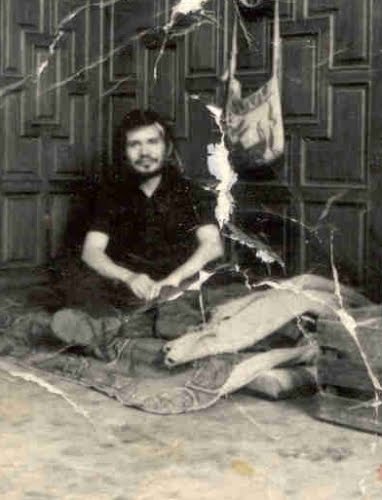
Mario Santiago Papasquiaro
Picture from here, a site with lots of other MSP pictures and some poems (in Spanish).

See also the First Infrarealist Manifesto.

My attention was drawn to this interview by this post at another blog, which contains some other links to things about Bolaño and Infrarealism.

18 June 2009

First Infrarealist Manifesto, English

Update: Since its first publication in 2009, this translation has undergone several minor changes.  To those who have reproduced this text elsewhere on the Internet, I recommend updating it to reflect these changes. (5 April, 2013)

Inspired by Roberto Bolaño's novel The Savage Detectives, and disappointed that I couldn't find one pre-existing, I have attempted a translation of the First Infrarealist Manifesto into English. The original can be found here.

See also an interview with Mario Santiago Papasquiaro, co-founder of Infrarealism.

infrarealism, infrarrealismo, roberto bolaño, mario santiago papasquiaro

-->ABANDON EVERYTHING, AGAIN

first infrarealist manifesto

“It is four light-hours to the end of the solar system; to the nearest star, four light-years. A disproportionate ocean of void. But are we really sure that it is only a void? We only know that in this space there are no bright stars; if they existed, would they be visible? And if there existed bodies neither bright nor dark? Could it not happen on the celestial maps, just as on those of the earth, that the star-cities are indicated and the star-villages omitted?”

-Soviet science fiction writers scratched their faces at midnight.

-The infrasuns (Drummond would say the happy proletarian boys).

-Peguero and Boris alone in a lower class room predicting the miracle behind the door.

-Free Money

*

Who has traversed the city and for music has only had the whistles of his fellows, his own words of amazement and rage?

The handsome type who didn’t know

that a girl’s orgasm is clitoral

(Look, it’s not only in the museums that there’s shit) (A process of individual museification) (Certainly all that has been mentioned, revealed) (Fear of discovering) (Fear of the imbalances not foreseen).

*

Our next of kin:

the snipers, the lone plainsmen who devastate the Chinese cafes of Latin America, the butchers in supermarkets, in their tremendous individual-collective dilemma; the impotence of action and investigation (on the individual level or clouded in aesthetic contradictions) of the poetic act.

*

Tiny bright stars eternally winking at us from a place in the universe called The labyrinths.

-Dancing-Club of misery.

-Pepito Tequila sobbing his love for Lisa Underground.

-He sucks it, you suck it, we suck it. [In Spanish as in English, the verb can be used literally or informally in a derogatory sense.]

-And Horror

*

Curtains of water, cement, or tin separate a cultural mechanism, which serves as both the conscience and the asshole of the ruling class, from a living cultural event, scrubbed clean, in constant death and birth, ignorant of most of history and the fine arts (quotidian creator of its own insane istory and its amazing fyne artz), body that suddenly tests new sensations on itself, product of an epoch in which we approach at 200 kmph the toilet or the revolution.
“New forms, rare forms”, as old Bertolt said, half curious and half smiling.

*

Sensations don’t arise out of nothing (obviousness of obviousnesses), but from a conditioned reality, in a thousand ways, as a constant flow.

-Complex reality makes us seasick!

So, it is possible that in part this is a birth and in part we are in the front row for the death throes. Forms of life and forms of death pass by the retina daily. Their collision constantly gives rise to infrarealist forms: THE EYE OF TRANSITION

*

Put the whole city in the insane asylum. Sweet sister, howling tanks, hermaphrodite songs, diamond deserts, we only live once and every day the visions are bulkier and more slippery. Sweet sister, lifts to Monte Albán. Tighten your belts because the corpses have been watered. A scene of subtraction.

*

And the good bourgeois culture? And academia and the incendiaries? And the vanguards and the rearguards? And certain conceptions of love, good scenery, the precise and multinational Colt?

Like I told Saint-Just in a dream I had once: Even the heads of aristocrats can’t use us as weapons.

*

-A good part of the world is being born and another good part dying, and we all know that we all have to live or we all have to die: in this there is no middle road.

Chirico says: thought must move away from all that which is called logic and good sense, must move away from all human problems, in such a way that things appear under a new aspect, as if illuminated by a constellation appearing for the first time. The infrarealists say: We are going to fill our heads with all human problems, such that things begin to move inside themselves, an extraordinary vision of man.

-The Constellation of the Beautiful Bird.

-The infrarealists propose indigenousness to the world: a crazy and timid Indian.

-A new lyricism, which is starting to rise Latin America, supports itself in ways that never fail to amaze us. The way in to matter is ultimately the way in to adventure: the poem is a journey and the poet is a hero revealing heroes. Tenderness like an exercise in speed. Breathing and heat. The shotgun experience, structures that are devouring themselves, crazy contradictions.

If the poet is mixed up, the reader will have to mix himself up.

“erotic books without spelling

*

The THOUSAND DISMEMBERED AVANT-GARDES OF THE SIXTIES precede us

The 99 open flowers like a smashed-open head

The massacre, the new concentration camps

The White underground rivers, the violet winds

These are hard times for poetry, some say, drinking tea, listening to music in their apartments, talking (listening) to the old masters. These are difficult times for man, we say, turning to the barricades after a full day’s work of shit and tear gas, discovering / creating music even in our apartments, largely overlooking cemeteries-that-spread, where they [sic] despairingly drink a cup of tea or get drunk on pure rage or the inertia of old masters.

HORA ZERO precedes us

((Raise baboons and the hags will bite you)) [Sp: Cría zambos y te picarán los callos]

Still we are in the quaternary era. Are we still in the quaternary era?

Pepito Tequila kisses Lisa Underground’s phosphorescent nipples and watches her leave for a beach on which black pyramids sprout.

*

I repeat:

the poet is a hero revealing heroes, like the fallen red tree that announces the start of the forest.

-The attempts at a consistent ethic-aesthetic are paved with betrayals or pathetic survivals.

-And it is the individual who will be able to walk a thousand kilometers but eventually the road will eat him.

-Our ethic is Revolution, our aesthetic is Life: one-single-thing.

*

For the bourgeoisie and the petit bourgeoisie life is a party. Every weekend they have one. The proletariat doesn’t have parties. Only rhythmic funerals. That is going to change. The exploited will have a grand party. Memory and guillotines. Sensing it, acting it certain nights, inventing edges and humid corners, is like caressing the acidic eyes of the new spirit.

*

Journey of the poem through the seasons of rioting: poetry producing poets producing poems producing poetry. Not an electric alley / the poet with arms separate from the body / the poem slowly displacing his Vision of his Revolution. The alley is a complex point. “We are going to invent in order to discover its contradiction, its invisible forms of refusing, until it is explained”. Journey of the act of writing through zones not at all favorable to the act of writing.

Rimbaud, come home!

Subverting the everyday reality of modern poetry. The confinements that lead a circular reality to the poem. A good reference: the madman Kurt Schwitters. Lanke trr gll, o, upa kupa arggg, runs the official line, phonetic investigators codifying the howl. The bridges of Noba Express are anti-codification: let him shout, let him shout (please don’t take out pencil or paper, don’t record him, shout with him if you want to participate), so let him shout, in order to see what face he makes when he finishes, what other incredible things we experience.

Our bridges to ignored stations. The poem interrelating reality and unreality.

*

Convulsively

*
What can I demand of current Latin American painting? What can I demand of the theatre?

More revealing and expressive is stopping in a demolished park because of the smog and seeing people crossing the avenues in groups (which contract and expand), when so many motorists, like the pedestrians, urgently approach their hovels, and it’s the hour when the murderers come out and the victims follow them.

What stories do the painters really tell me?

Interesting void, fixed form and color, at best the parody of movement. Canvases that will only serve as bright posters in the rooms of engineers and doctors who collect.

The painter is made comfortable in a society that is every day more “painter” than he is himself, and that is where he is found unarmed and registered as a clown.

If a painting by X is encountered in some street by Mara, this painting acquires the standing of an amusing and informative thing; [in] a sitting room it’s as decorative as the iron armchairs of the bourgeois / a question of the retina? / yes and no / but it would be better to find ( and unfortunately to systematize for a time) the explosive factor, class-conscious, one hundred percent concerned with work, in juxtaposition to the value of “work” that precedes it and conditions it.

-The painter abandons the studio and ANY status quo and fills his head with wonders / or sets out to play chess like Duchamp / A painting that shows how to paint it again / And a painting of poverty, free or cheap enough, unfinished, of participation, of questioning the participation, of unlimited physical and spiritual extension.

Latin America’s best painting is the one that has even unconscious levels, the game, the party, the experiment that gives us a real vision of what we are and reveals to us what we can do will be Latin America’s best painting is the one that we paint with greens and reds and blues on our faces, to recognize ourselves in the incessant creation of the tribe.

*

Try to abandon everything every day.

Architects, abandon the construction of stages inside and extend your hands (or clench them, depending on the place) toward this space outside. A wall and a ceiling become useful when they are not only used for sleeping or avoiding rain but when they establish, starting, for example, at the everyday act of sleep, conscious bridges between man and his creations, or the momentary impossibility of them.

For architecture and sculpture the infrarealists start from two points: the barricade and the bed.


*


The true imagination is the one that dynamites, elucidates, injects emerald microbes into other imaginations. In poetry and in what is, the way in to matter still has to be the way in to adventure. Creating the tools for everyday subversion. The subjective seasons of being human, with their beautiful trees, giant and obscene, like laboratories of experimentation. Establishing, seeing signs of parallel situations and as harrowing as a great scratch on the chest, on the face. Unending analogy of the face. There are so many of them that when newcomers appear we don’t even count, although we are creating them / looking into a mirror. Nights of torment. Perception is opened up by means of an ethic-aesthetic taken to the extreme.


*

Galaxies of love appear in the palms of our hands.

-Poets, let down your hair (if you have any)

-Burn your garbage and start to love until you get down to the priceless poems

-We don’t want synthetic paintings, but enormous synthetic sunsets

-Horses running 500 kilometers per hour

-Squirrles of fire jumping through trees of fire

-A bet to see who blinks first, between the nerve and the sleeping pill

*

The risk is always somewhere else. The true poet is the one who is always letting go of himself. Never too much time in the same place, like guerrillas, like UFOs, like the white eyes of prisoners in perpetual chains.


*

Fusion and explosion of two shores: creation like audacious graffiti and opened by a crazy kid.

Nothing mechanical. The scales of of amazement. Someone, maybe Hieronymus Bosch, breaks the aquarium of love. Free money. Sweet sister. Libidinous visions like corpses. Little boys cutting the meat of kisses until December.


*

At two in the morning, after having been at Mara’s house, we listen (Mario Santiago and some of us) to laughter that came out of the penthouse of a 9 story building. They didn’t stop, they laughed and laughed while we slept below propped up in various phone booths. It was enough for the moment in that only Mario went on paying attention to to the laughter (the penthouse is a gay bar or something similar and Darío Galicia had told us that the police are always vigilant). We made telephone calls but the coins were made of water. The laughter continued. After we left that district Mario told me that really no one had been laughing, it was recorded laughter and upstairs there, in the penthouse, a small group, or perhaps a single homosexual, had been listening in silence to his records and had made us listen.

-The death of the swan, the last song of the swan, the last song of the black swan, ARE NOT in the Bolshoi but in the pain and the unbearable beauty of the streets.

-A rainbow that begins at a B movie and ends with a factory on strike.

-That amnesia never kisses us on the mouth. That it never kisses us.

-We dreamt of utopia and we wake up screaming.

-A poor lonely cowherd who goes back home, that is the wonder.


*

Making new sensations appear –Subverting the everyday


O.K.

ABANDON EVERYTHING, AGAIN

HIT THE ROAD


Roberto Bolaño, México, 1976