Showing posts with label philosophy. Show all posts

09 July 2013

The Appetitive Soul


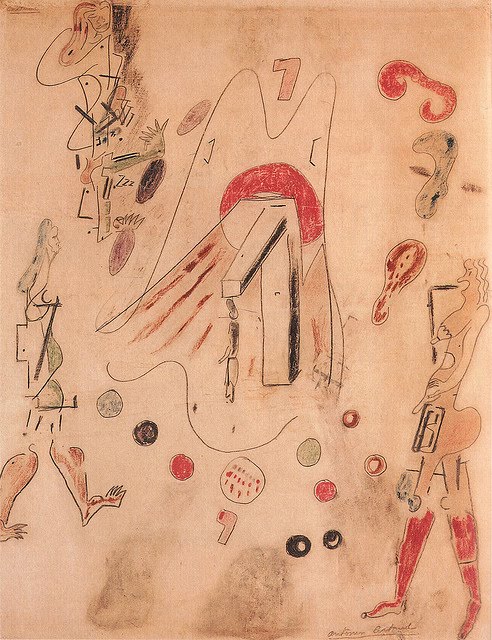
Two pages from The Cardboard Valise by Ben Katchor.  Click to enlarge.
Ben Katchor, from The Cardboard Valise


From Plato's Phaedrus:
Of the nature of the soul, though her true form be ever a theme of large and more than mortal discourse, let me speak briefly, and in a figure. And let the figure be composite--a pair of winged horses and a charioteer. Now the winged horses and the charioteers of the gods are all of them noble and of noble descent, but those of other races are mixed; the human charioteer drives his in a pair; and one of them is noble and of noble breed, and the other is ignoble and of ignoble breed; and the driving of them of necessity gives a great deal of trouble to him. ...The soul in her totality has the care of inanimate being everywhere, and traverses the whole heaven in divers forms appearing--when perfect and fully winged she soars upward, and orders the whole world; whereas the imperfect soul, losing her wings and drooping in her flight at last settles on the solid ground.
...
The chariots of the gods in even poise, obeying the rein, glide rapidly; but the [mortals] labour, for the vicious steed goes heavily, weighing down the charioteer to the earth when his steed has not been thoroughly trained:--and this is the hour of agony and extremest conflict for the soul.
...
The right-hand horse is upright and cleanly made; he has a lofty neck and an aquiline nose; his colour is white, and his eyes dark; he is a lover of honour and modesty and temperance, and the follower of true glory; he needs no touch of the whip, but is guided by word and admonition only. The other is a crooked lumbering animal, put together anyhow; he has a short thick neck; he is flat-faced and of a dark colour, with grey eyes and blood-red complexion; the mate of insolence and pride, shag-eared and deaf, hardly yielding to whip and spur. Now when the charioteer beholds the vision of love, and has his whole soul warmed through sense, and is full of the prickings and ticklings of desire, the obedient steed, then as always under the government of shame, refrains from leaping on the beloved; but the other, heedless of the pricks and of the blows of the whip, plunges and runs away, giving all manner of trouble to his companion and the charioteer, whom he forces to approach the beloved and to remember the joys of love. They at first indignantly oppose him and will not be urged on to do terrible and unlawful deeds; but at last, when he persists in plaguing them, they yield and agree to do as he bids them.

And now they are at the spot and behold the flashing beauty of the beloved; which when the charioteer sees, his memory is carried to the true beauty, whom he beholds in company with Modesty like an image placed upon a holy pedestal. He sees her, but he is afraid and falls backwards in adoration, and by his fall is compelled to pull back the reins with such violence as to bring both the steeds on their haunches, the one willing and unresisting, the unruly one very unwilling; and when they have gone back a little, the one is overcome with shame and wonder, and his whole soul is bathed in perspiration; the other, when the pain is over which the bridle and the fall had given him, having with difficulty taken breath, is full of wrath and reproaches, which he heaps upon the charioteer and his fellow-steed, for want of courage and manhood, declaring that they have been false to their agreement and guilty of desertion. Again they refuse, and again he urges them on, and will scarce yield to their prayer that he would wait until another time. When the appointed hour comes, they make as if they had forgotten, and he reminds them, fighting and neighing and dragging them on, until at length he, on the same thoughts intent, forces them to draw near again. And when they are near he stoops his head and puts up his tail, and takes the bit in his teeth. and pulls shamelessly. Then the charioteer is worse off than ever; he falls back like a racer at the barrier, and with a still more violent wrench drags the bit out of the teeth of the wild steed and covers his abusive tongue and jaws with blood, and forces his legs and haunches to the ground and punishes him sorely. And when this has happened several times and the villain has ceased from his wanton way, he is tamed and humbled, and follows the will of the charioteer, and when he sees the beautiful one he is ready to die of fear. And from that time forward the soul of the lover follows the beloved in modesty and holy fear.

What is beneath the tunic of the charioteer of the gods, who drives two white horses? 


Giulio Romano, Chariot of the Sun, 1527
Palazzo Te, Mantua, Italy

24 February 2013

Chess

Having become somewhat weary of the curatorial life, I have been preparing something new.  Still, one cannot always resist the impulse to organize and to collate.

The text below comes from John Locke's Essay Concerning Human Understanding, which can be found online in its entirety here.


A company of chess-men, standing on the same squares of the chess-board where we left them, we say they are all in the same place, or unmoved, though perhaps the chess-board hath been in the mean time carried out of one room into another; because we compared them only to the parts of the chess-board, which keep the same distance one with another. The chess-board, we also say, is in the same place it was...

Andy Warhol, Chess Player, 1954

In the chess-board, the use of the designation of the place of each chess-man being determined only within that chequered piece of wood, it would cross that purpose to measure it by anything else; but when these very chess-men are put up in a bag, if any one should ask where the black king is, it would be proper to determine the place by the part of the room it was in, and not by the chess-board.
Max Ernst and Dorothea Tanning Playing Chess
Max Ernst and Dorothea Tanning Playing Chess, 1948 - Source unknown


So if any one should ask, in what place are the verses which report the story of Nisus and Euryalus, it would be very improper to determine this place, by saying, they were in such a part of the earth, or in Bodley's library: but the right designation of the place would be by the parts of Virgil's works; and the proper answer would be, that these verses were about the middle of the ninth book of his AEneids, and that they have been always constantly in the same place ever since Virgil was printed: which is true, though the book itself hath moved a thousand times, the use of the idea of place here being, to know in what part of the book that story is, that so, upon occasion, we may know where to find it, and have recourse to it for use.

 Dorothea Tanning, End Game, 1944

26 January 2012

Fragments II: Symbol


blood flight by Jenny Hval


[The Parnassians] still treat their subjects as the old philosophers and orators did: that is, present things directly, whereas I think that they should be presented allusively. Poetry lies in the contemplation of tings, in the image emanating from the reveries which things arouse in us. They take something in its entirety and simply exhibit it; in so doing, they fall short of mystery; they fail to give our minds that exquisite joy which consists in believing that we are creating something. To name an object is largely to destroy poetic enjoyment, which comes from gradual divination. The ideal is to suggest the object. It is the perfect use of this mystery which constitutes symbol. An object must be gradually evoked in order to show a state of soul; or else, choose an object and from it elicit a state of soul by means of a series of decodings.

Attributed to Stéphane Mallarmé.


bridal veil stinkhorn fungus


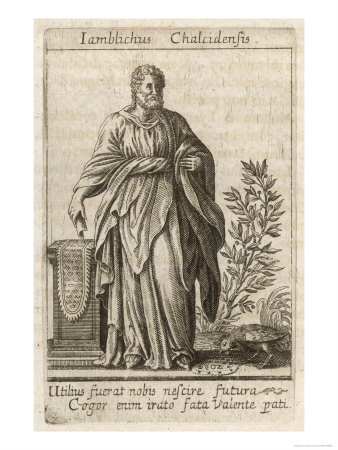
Iamblichus:
Iamblichus Chalcidensis, Neoplatonic philosopher
Granting, then, that ignorance and deception are faulty and impious, it does not follow that the offerings made to the gods and divine works are invalid, for it is not pure thought that unites theurgists to the gods. Indeed, what then would hinder those who are theoretical philosophers from enjoying a theurgic union with the gods? But the situation is not so: it is the accomplishment of acts not to be divulged and beyond all conception, and the power of unutterable symbols, understood solely by the gods that establishes theurgic union. For this reason, we do not bring about these things by thinking alone. If we did, their efficacy would be intellectual, and dependent on us. But neither assumption is true. For even when we are not engaged in thinking, the symbols themselves, by themselves, perform their appropriate work, and the ineffable power of the gods, to whom these symbols relate, itself recognizes the proper images of itself, not through being aroused by our thought.

17 May 2011

Part II: The Sea

The following is the second part of a multi-part post. The post can stand alone, but if you would like to begin at the beginning, click here for Part I.

Socrates: The awe which I always feel, Protarchus, about the names of the gods is more than human--it exceeds all other fears.


&

Roy_Lichtenstein_Drowning_Girl 1963

IV. Death by Water
Phlebas the Phoenician, a fortnight dead,
Forgot the cry of gulls, and the deep sea swell
And the profit and loss.
A current under sea
Picked his bones
in whispers. As he rose and fell
He passes the stages of his age and youth
Entering the whirlpool.
Gentile or Jew
O you who turn the wheel and look windward,
Consider Phlebas, who was once handsome and tall as you.

Roy Lichtenstein, Drowning Girl, 1963

A Reefnetter's Paean to the Sea by Tyree Callahan(source)


Tiresias: If I did not know at least this, I would not be a priest. Take a boy who bathes in the Asopus. It is a summer morning. The boy comes out of the water, goes back in happily, dives and dives again, then he is taken ill and drowns. What do the gods have to do with this? Should he attribute his end to the gods or else the pleasure he enjoyed? Neither the one nor the other. Something happened––which is neither good nor evil, something which has no name––then the gods will give it a name.

Oedipus: And to give a name, to explain things, seems little to you, Tiresias?

Tiresias: You are young, Oedipus, and like the gods who are young you yourself clear up things and name them. You still don’t know that beneath the earth there is stone, and that the bluest sky is the emptiest. For him who like me does not see, all things are a blow, nothing else.

--From “The Blind,” a dialogue by Cesare Pavese


Jacob Isaakszoon van Ruisdael - Rough Sea at a Jetty 1650s Jacob Isaakszoon van Ruisdael, Rough Sea at a Jetty, c. 1650


22 November 2010

Part I: Blindness


This is part 1 of a multi-part post. See also: Appendix to Part I, Part II.


corneal abrasion


The following is from a letter sent by Voltaire to the Marquise du Deffand, who had gone blind shortly before.
Colmar, March 3, 1754
Your letter, madam, touched me more deeply than you can imagine, and I assure you my eyes were wet when I read what had happened to yours. I had gathered, from M. de Formont's letter, that you were, so to speak, in the dusk but not in complete darkness...

Therefore, dear madam, I only regretted that your eyes had lost their beauty: and I was sure you were enough of a philosopher to console yourself for that: but, if you have lost your sight, I pity you very deeply...I agree with you that life is not worth much: we only endure it from an almost invincible instinct which nature has planted in us: to this instinct she has added the bottom of Pandora's box--hope.

Only when hope is absolutely lacking, or when an unbearable depression settles down upon us, do we triumph over the natural impulse to hug the chains that bind us to life: and gather courage to leave an ill-built house which we can never hope to repair. Two people in the country where I now am have elected to do this.
One of these two philosophers is a girl of eighteen, whose brain had been turned by the Jesuits, and who, to rid herself of them, set out for the next world. That is a thing I shall not do, or at any rate not yet, for I am in receipt of annuities from two potentates, and I should be inconsolable if by my death I enriched two crowned heads.

If you, madam, have a pension from the King, be exceedingly careful of yourself, eat little, go to bed early, and live to be a hundred.


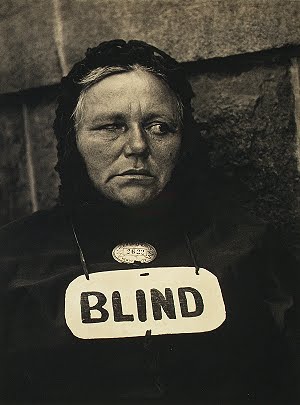
Paul Strand, 'Blind', 1916When I consider how my light is spent
Ere half my days, in this dark world and wide,
And that one Talent which is death to hide,
Lodged with me useless, though my Soul more bent
To serve therewith my Maker, and present
My true account, least he returning chide,
Doth God exact day-labour, light denied,
I fondly ask; But patience to prevent
That murmur, soon replies, God doth not need
Either man's work or his own gifts, who best
Bear his mild yoke, they serve him best, his State
Is Kingly. Thousands at his bidding speed
And post o're Land and Ocean without rest:
They also serve who only stand and wait.

-John Milton, "On His Blindness," 1655

Image: "Blindness" by Paul Strand, 1916


From Diderot's Letter on the Blind, 1749. Diderot describes an interview with a blind man from Puiseaux [emphasis added]:

He asked us if only persons who were called naturalists could see with the microscope, and if only astronomers could see with the telescope; if the instrument for enlarging objects were bigger than that for diminishing them; if that which brings them nearer were shorter than that for removing them farther off. But what puzzled him was that the other self, which according to him the mirror represents in relief, should not be tactile.

"So this little instrument," said he, "sets two senses to contradict one another; a more perfect instrument would perhaps reconcile these contradictions, without the object being ever more real for that, and perhaps a third instrument, still more perfect and less illusory, would cause these contradictions to disappear and show us our error."

the 400 blows / les quatrecents coups / 400 batow / polish movie poster 1959
Polish poster for Francois Truffaut's The 400 Blows, 1959
Designed by Waldemar Swierzy

28 September 2010

On Scholarship

Albrecht Dürer, Saint Jerome in his Study, 1514

A Graduate Record Examination (GRE) "Issue task" matching game. The test takers were to present their perspectives on the following issue:

It is unfortunate that today's educators place so much emphasis on finding out what students want to include in the curriculum and then giving it to them. It is the educator's duty to determine the curriculum and the students' duty to study what is presented to them.

Below, sample phrases come from essays that received scores of 5 and 6 (6 is the highest possible score). Five of the comments relate to those two essays, and one comment relates to a third essay, which received a score of 1 (the lowest).

Phrase from sample essay
Grader's comment
1. As an elementary educator, I believe this stance is extremist. Educators and the public must come to a middle road.
A. The discussion is generally confusing and barely addresses the central issue presented in the topic.
2. Hard work must be lauded, while freeloaders are punished.
B. This is an insightful, well-articulated discussion of curricular responsibility and the larger issue of academic responsibility.
3. Content and performance standards (i.e. curricula) need to be developed by the district's educators as a map for teachers. When educators provide students with choices WITHIN the map of curriculum, students relish in the freedom and take ownership for their learning.
C. Language use is generally precise and effective, and sentence structure is well controlled.
4. Of course, any school in which the students decide "what goes" is bound to have problems controlling students. Once the educators, be they administrators or teachers, are under the control of students, even a democratic situation would be like holding royalty acountable to the mob.
D. The examples are varied and used effectively to further support the writer's position.
5. Presently, students hear for hours that they should not forget to use a condom in the heat of the moment, and educators think the message gets through, while half the kids can't even remember to bring a pencil to class.
E. The careful choice of words and carefully structured paragraphs help unify the structure of the argument.
6. I do NOT think it is unfortunate that today's educators emphasize students' interests. It IS our duty, however, to provide the parameters for their education.
F. This response presents a well-developed analysis of the issue and displays strong control of the elements of writing.

Answers:
Essay 1 (scored 6): 2, 4, 5, & B, C, D
Essay 2 (scored 5): 1, 3, 6, & E, F
Essay 3 (scored 1): A


The young scholar was praised by friends and acquaintances as one of the clearest, most powerful, and most incisive writers living. It was inexplicable, therefore, that he continued to receive low scores on the writing sections of the Examination, and all the more so given that his scores on the verbal and quantitative multiple choice sections were among the highest achievable. Tragically, there was no way to circumvent the Examination, and the young scholar was barred from living the life he had imagined for himself. Settling for a life of intellectual isolation, he took up a manual craft, which provided a meager existence and afforded some time for private study. The scholar died, when, soon afterward, his lungs began to turn to glass. When he drew his last breath, the glass shattered, leaving no part of him intact for scrutiny.

Johannes Hevelius, Foot-powered Lathe, from Selenographia, sive Lunae descriptio, 1647

07 September 2010

Here am I shedding one of my life-skins, and all they will say is, 'Bernard is spending ten days in Rome.'

Painting: Virginia Woolf by Vanessa Bell, 1912
"Now I sit on a stone seat in these gardens surveying the eternal city, and the little man who was shaving in London five days ago looks already like a heap of old clothes. [...] I sit here like a convalescent, like a very simple man who knows only words of one syllable. 'The sun is hot,' I say. 'The wind is cold.' I feel myself carried round like an insect on top of the earth and could swear that, sitting here, I feel its hardness, its turning movement. I have no desire to go the opposite way from the earth. Could I prolong this sense another six inches I have a foreboding that I should touch some queer territory. But I have a very limited proboscis. I never wish to prolong these states of detachment; I dislike them; I also despise them. I do not wish to be a man who sits for fifty years on the same spot thinking of his navel. I wish to be harnessed to a cart, a vegetable-cart that rattles over the cobbles."

- Virginia Woolf, The Waves
Image: "Virginia Woolf" by Vanessa Bell, c. 1912

I expose myself to that risk voluntarily.

I have but one passion: to enlighten those who have been kept in the dark, in the name of humanity which has suffered so much and is entitled to happiness. My fiery protest is simply the cry of my very soul. Let them dare, then, to bring me before a court of law and let the enquiry take place in broad daylight! I am waiting.

- Émile Zola, J'accuse!


Painting: The Prisoner by Nikolai Alexandrovich Yaroshenko, 1878
"The Prisoner" by Nikolai Alexandrovich Yaroshenko, 1878 [1]


A man cannot live intensely except at the cost of the self. Now the bourgeois treasures nothing more highly than the self (rudimentary as his may be). And so at the cost of intensity he achieves his own preservation and security. His harvest is a quiet mind which he prefers to being possessed by God, as he does comfort to pleasure, convenience to liberty, and a pleasant temperature to that deathly inner consuming fire.

- Hermann Hesse, Steppenwolf


Painting: Zola Insulted by Henry de Groux
"Zola Insulted" by Henry de Groux, date unknown [2]


It appears to be an inborn and imperative need of all men to regard the self as a unit. However often and however grievously this illusion is shattered, it always mends again. The judge who sits over the murderer and looks into his face, and at one moment recognizes all the emotions and potentialities of the murderer in his own soul and hears the murderer's voice as his own, is at the next moment one and indivisible as the judge, and scuttles back into the shell of his cultivated self and does his duty and condemns the murderer to death. And if ever the suspicion of their manifold being dawns upon men of unusual powers and of unusually delicate perceptions, so that, as all genius must, they break through the illusion of the unity of the personality and perceive that the self is made up of a bundle of selves, they have only to say so and at once the majority puts them under lock and key, calls science to aid, establishes schizomania and protects humanity from the necessity of hearing the cry of truth from the lips of these unfortunate persons.

- Hermann Hesse, Steppenwolf


Antonin Artaud, La Pendue (The Hanged), 1945
"La Pendue" ("The Hanged") by Antonin Artaud, 1945 [3]


[1] Image taken from this page, where an oddly-phrased comment is good for a laugh: "[Yaroshenko's] genre paintings depict torture, struggles, fruit, bathing suits, and other hardships faced in Russia."

[2] From Dreyfus Rehabilitated: "painting by Henri Degroux depicting the hatred of the masses, a present to the writer from his admirers".

[3] Image taken from an excellent blog called A Journey Round My Skull; includes a link to a larger version of the image.

28 July 2009

Re: Becoming Nothing

What follows is a letter I received from the author of the italicized text in the previous post, "Becoming Nothing". Reader responses posted here will be forwarded to the author.

Dear -------,

I wanted to submit a few remarks in response to the comments of mine that you included in the previous exhibit at Altarpiece. In conjunction with the ideas presented there, I have been plagued by another thought, and, more relevantly, I have been plagued by my own inability to express it. In this particular case it seems that I might benefit from trying to express it clearly to someone who has a hope of understanding. I trust you won’t mind me using you as a sort of test subject in this endeavor, but if you do, stop reading now and discard the letter! In any case, perhaps you will also get something out of my meandering here to include in a future exhibit.

The idea in question began as an intuition, which you posted, regarding the relationship between art and the “real world.” This was the intuition expressed in the phrase, “Politics is [or perhaps it should have been ‘are’] a lame substitute for art.” What I had in mind was the ability of art to transform the state of humanity, to create better worlds by virtue of its ability to awaken truths that lie dormant in our spirits. Art is direct democracy imbued with a sense of what is good and true. This, I thought, renders politics unnecessary as a form of representation of art, an unnecessary regulation of a world that man self-regulates through communicative and expressive tools given him at and before birth.

Of course, this all sounds more or less wonderful on paper, but it began to butt heads with reality when I was put upon recently to explain it in the language of “daily life” in conversation. My interlocutor insisted that any system of organization of the exigencies of daily life counts as a political system, for example the working out of how a society’s collective garbage will be dealt with. Art, he argued, simply could not take the place of such necessities.

This argument upset me considerably because, while I could see how it derived from my own remarks, it seemed to miss the point entirely. It seemed to miss the significance of what I was saying, to somehow render banal a point that had begun in my mind as a (subjectively) inspired moment. I couldn’t see how to reconcile this problem, and in fact it appeared to me as merely an instantiation of a general difficulty I had encountered before. Namely, so many of the ideas and principles that are the most important to me are seemingly incompatible with daily reality. The values implied by a commitment to the realms of art and ideas bear no relation to the world inhabited by people. At best they provide some guidelines by which those in positions of comfort can organize their thinking, but even the lives lived by these individuals are not freed of their ultimate constraints. It seems more likely that thought and art have developed into parasites that flourish in the fertile heat and moisture of the first-world intellect. At this point in history we feel deeply the need to reconnect with our own species and not to labor under the illusion that the idea is a creature that serves and depends upon us. We experience a keen drive toward action, which unites us with our immediate, physical realities and brings us back into existence, back into integration with a world we have almost destroyed.

This is a historical pressure that I feel in the same moment that I feel illuminated by the transcendent importance of art in the broadest sense. When I am confronted with the question of how my dream for the world—so full of expression and expressive forms of knowing that politics as we know it no longer fits—relates to the need to dispose of garbage, I am stricken with something like the pain of separation… the realization that my visions, about which I care deeply, do not relate to people, about whom I care deeply. The idea of communicating with and transforming people’s souls is irrelevant and indulgent when people are too abused and too hungry to have souls in the first place. So you can see the depths of confusion into which my friend’s well-meaning criticism plunged me.

I have, however, recently come to a possible solution, or a justification which I would like to submit to both your and my own scrutiny. After a brief chat with another friend about the degree to which the present systems of the world have doomed themselves, we agreed that the human species will probably outlive the impending implosion in some form. We couldn’t escape the inevitability of, at the very least, a sort of Malthusian collapse after the failure or refusal of human ingenuity and compassion to catch up to growing populations and dwindling resources and compromised ecologies and greed. (You and I have discussed this as well in connection with that National Geographic article.) Nevertheless, the total elimination of mankind seems unlikely. We will still be here, and this allowed me to realize that the questions of why and how we are here are becoming more rather than less relevant. Perhaps in order to undertake intellectual and artistic projects in the face of such contagion in the modern world, one has to resign oneself to an almost appalling level of hopelessness.

But even as I write I can sense the weakness in this point of view. Have I so little hope and love for people living now that I have to resort to the apologetics of art as a withered attempt at communication with people who do not yet live? And, you will point out, I have not even addressed the original problem of politics and art. I suppose the only response I can give is to admit with a mixture of pride and shame that, yes, my dream involves such a radical reorganization of life, such a reinvention of the real, that art will supplant even trash collection, that there will be no such thing as trash as we pull ourselves along the rope of existence toward the infinite and the truly meaningful. That almost no one now living can understand this. As for how it will come about I do not know, I guess there will have to be some kind of disaster, or perhaps people can claw their way there slowly through the mud (a process for which, surely, I am not needed).

Art in its broadest sense is not only writing and painting and film, but also every thought and action in which we chip away at the veil between us and everything. Maybe the straight-talk description of this involves all of us sitting in silent meditation from birth, or voluntarily extinguishing the species, or simply living in such a way that we create no excesses like garbage or profit or nations that can’t sustain all their individual voices.

Ultimately I think I would like to distinguish between politics and governance. The governance of things like the way water flows, how food is stored, where information can be found, etc…. these can be artistic acts insofar as they are externalized means of integration with the world—insofar, basically, as they are done selflessly and out of the same duty toward people that the artist-poet feels. This is how politics destroys art and inhabits the resulting void. Politics is the governance of people, the creation of mutes, the belief that we can be spoken-form, the hypnotized agreement of people to remain uninvolved in the creation and exposition of reality.

07 May 2009

Cordyceps

From a Planet Earth segment (imperative to watch in HQ):
Its infected brain directs this ant upwards. Then, utterly disorientated, it grips the stem with its mandibles. Those afflicted that are discovered by the workers are quickly taken away and dumped far away from the colony.


The fungus is so virulent, it can wipe out whole colonies of ants. There are literally thousands of different types of cordyceps fungi, and, remarkably, each specializes on just one species.
Cordyceps sinesis, for example, specializes on the caterpillar of a type of ghost moth found in some parts of China. Other types of ghost moth, susceptible to other types of cordyceps, are found in Tibet, where their medicinal use may have originated.

Photo by David Gerrard
According to Wikipedia, the Chinese name for caterpillar fungus means "winter worm, summer grass." The medicinal use of the fungus became well-known in connection with the success of Chinese athletes at the 1993 Beijing Olympic Games.
Today the most common way to prepare the caterpillar fungus is to stuff a duck with the caterpillar fungus then after boiling the duck in hot water, patients drink the liquid. It sounds unpleasant, but Vivian reports the aroma is pleasant and the broth tastes sweet. The caterpillar fungus is reported to have many benefits as a traditional medicine. Some consider the benefits to be similar to those of another valuable Chinese tonic, ginseng. Traditional Chinese medicines like the caterpillar fungus and ginseng are bought in Chinese drug stores. The price varies from $27 to $53 a pound depending on quality. The fungus fruiting body has been removed in the most expensive grade. Caterpillar fungi are also used as gifts. A large gift box costs about $400. [As of 1998.]
In addition to its aesthetic, medicinal, and shock values, cordyceps has a considerable metaphorical value, which is explicated by Arthur Schopenhauer (whose aphorisms are available to read in their entirety online) by way of another example:
The brain may be regarded as a kind of parasite of the organism, a pensioner, as it were, who dwells with the body: and leisure, that is, the time one has for the free enjoyment of one's consciousness or individuality, is the fruit or produce of the rest of existence, which is in general only labor and effort. But what does most people's leisure yield?—boredom and dullness; except, of course, when it is occupied with sensual pleasure or folly. How little such leisure is worth may be seen in the way in which it is spent: and, as Ariosto observes,how miserable are the idle hours of ignorant men!—ozio lungo d'uomini ignoranti. ...And if there is nothing else to be done, a man will twirl his thumbs or beat the devil's tattoo; or a cigar may be a welcome substitute for exercising his brains. Hence, in all countries the chief occupation of society is card-playing, and it is the gauge of its value, and an outward sign that it is bankrupt in thought. Because people have no thoughts to deal in, they deal cards, and try and win one another's money. Idiots! But I do not wish to be unjust; so let me remark that it may certainly be said in defence of cardplaying that it is a preparation for the world and for business life, because one learns thereby how to make a clever use of fortuitous but unalterable circumstances (cards, in this case), and to get as much out of them as one can: and to do this a man must learn a little dissimulation, and how to put a good face upon a bad business. But, on the other hand, it is exactly for this reason that card-playing is so demoralizing, since the whole object of it is to employ every kind of trick and machination in order to win what belongs to another. And a habit of this sort, learnt at the card-table, strikes root and pushes its way into practical life; and in theaffairs of every day a man gradually comes to regard meum and tuum in much the same light as cards, and to consider that he may use to the utmost whatever advantages he possesses, so long as he does not come within the arm of the law.
Twelve-foot high wax busts of Schopenhauer afflicted by several varieties of cordyceps fungus, which fungus he termed the Will, can be viewed in an upcoming conceptual exhibition.

28 January 2009

On novelty

This is worth living for: that I can imagine as hard as I wish, I can mentally construct in the maximum detail of which I am capable the most mundane of future events, build a daydream out of things I already know, but that despite my best efforts, the future is always absolutely novel. Each moment I am alive is a complete surprise, and never more than when I am in fact experiencing things for the first time. May he who denies life novelty come face to face with himself in the realization that every moment runs aground all his expectations, and this, instead, is what it is like.


From Henri Bergson's The Creative Mind:
Our action exerts itself conveniently only on fixed points; fixity is therefore what our intelligence seeks; it asks itself where the mobile is to be found, where it will be, where it will pass. ... But it is always with immobilities, real or possible, that it seeks to deal.
...
But how can we help seeing that the essence of duration is to flow, and that the fixed placed side by side with the fixed will never constitute anything which has duration.
...
Intuition is what attains the spirit, duration, pure change.
...
To think intuitively is to think in duration.
...
Criticism of an intuitive philosophy is so easy and so certain to be well received that it will always tempt the beginner.
...
[When thinking intuitively] our mind is as if it were in a strange land, whereas matter is familiar to it and in it the mind is at home. But that is because a certain ignorance of self is perhaps useful to a being which must exteriorize itself in order to act.
...
This direct vision of the mind by the mind is the chief function of intuition.
...
True, the faculty of intuition exists in each one of us, but covered over by functions more useful to life.
...
Man is essentially a manufacturer.

30 November 2008

What is the difference?


Mohandas "Mahatma" Gandhi


To which groups are our identities opposed? Who do we place outside of ourselves so that we may draw a boundary around ourselves and know that boundary to be safe? There is no mystery in ourselves; we know what we are not. I know what I am not--I am not you. At least I am not you. There are five castes.

There are five senses. Everything you perceive must come through one of these or it is a fantasy. There are seven colors in the rainbow. A wave of light stretches from red to violet in six violent jerks as if it is falling down the stairs.


An evicted Roma family (Budapest, 2000)

- Tell me more about the village where your grandmother lives.
- It is a very nice village, 120 kilometers from here. There is a lake on the edge of a forest.
- How many people live there?
- It is a small village, 3,000 people. And no gypsies!


I have been thinking ...
I have been thinking of the difference between water
and the waves on it. Rising,
water's still water, falling back,
it is water, will you give me a hint
how to tell them apart?

Because someone has made up the word
"wave," do I have to distinguish it
from water?

There is a Secret One inside us;
the planets in all the galaxies
pass through his hands like beads.

That is a string of beads one should look at with luminous eyes.

-Kabir, 13th Century