Showing posts with label politics. Show all posts

28 September 2010

On Scholarship

Albrecht Dürer, Saint Jerome in his Study, 1514

A Graduate Record Examination (GRE) "Issue task" matching game. The test takers were to present their perspectives on the following issue:

It is unfortunate that today's educators place so much emphasis on finding out what students want to include in the curriculum and then giving it to them. It is the educator's duty to determine the curriculum and the students' duty to study what is presented to them.

Below, sample phrases come from essays that received scores of 5 and 6 (6 is the highest possible score). Five of the comments relate to those two essays, and one comment relates to a third essay, which received a score of 1 (the lowest).

Phrase from sample essay
Grader's comment
1. As an elementary educator, I believe this stance is extremist. Educators and the public must come to a middle road.
A. The discussion is generally confusing and barely addresses the central issue presented in the topic.
2. Hard work must be lauded, while freeloaders are punished.
B. This is an insightful, well-articulated discussion of curricular responsibility and the larger issue of academic responsibility.
3. Content and performance standards (i.e. curricula) need to be developed by the district's educators as a map for teachers. When educators provide students with choices WITHIN the map of curriculum, students relish in the freedom and take ownership for their learning.
C. Language use is generally precise and effective, and sentence structure is well controlled.
4. Of course, any school in which the students decide "what goes" is bound to have problems controlling students. Once the educators, be they administrators or teachers, are under the control of students, even a democratic situation would be like holding royalty acountable to the mob.
D. The examples are varied and used effectively to further support the writer's position.
5. Presently, students hear for hours that they should not forget to use a condom in the heat of the moment, and educators think the message gets through, while half the kids can't even remember to bring a pencil to class.
E. The careful choice of words and carefully structured paragraphs help unify the structure of the argument.
6. I do NOT think it is unfortunate that today's educators emphasize students' interests. It IS our duty, however, to provide the parameters for their education.
F. This response presents a well-developed analysis of the issue and displays strong control of the elements of writing.

Answers:
Essay 1 (scored 6): 2, 4, 5, & B, C, D
Essay 2 (scored 5): 1, 3, 6, & E, F
Essay 3 (scored 1): A


The young scholar was praised by friends and acquaintances as one of the clearest, most powerful, and most incisive writers living. It was inexplicable, therefore, that he continued to receive low scores on the writing sections of the Examination, and all the more so given that his scores on the verbal and quantitative multiple choice sections were among the highest achievable. Tragically, there was no way to circumvent the Examination, and the young scholar was barred from living the life he had imagined for himself. Settling for a life of intellectual isolation, he took up a manual craft, which provided a meager existence and afforded some time for private study. The scholar died, when, soon afterward, his lungs began to turn to glass. When he drew his last breath, the glass shattered, leaving no part of him intact for scrutiny.

Johannes Hevelius, Foot-powered Lathe, from Selenographia, sive Lunae descriptio, 1647

07 September 2010

I expose myself to that risk voluntarily.

I have but one passion: to enlighten those who have been kept in the dark, in the name of humanity which has suffered so much and is entitled to happiness. My fiery protest is simply the cry of my very soul. Let them dare, then, to bring me before a court of law and let the enquiry take place in broad daylight! I am waiting.

- Émile Zola, J'accuse!


Painting: The Prisoner by Nikolai Alexandrovich Yaroshenko, 1878
"The Prisoner" by Nikolai Alexandrovich Yaroshenko, 1878 [1]


A man cannot live intensely except at the cost of the self. Now the bourgeois treasures nothing more highly than the self (rudimentary as his may be). And so at the cost of intensity he achieves his own preservation and security. His harvest is a quiet mind which he prefers to being possessed by God, as he does comfort to pleasure, convenience to liberty, and a pleasant temperature to that deathly inner consuming fire.

- Hermann Hesse, Steppenwolf


Painting: Zola Insulted by Henry de Groux
"Zola Insulted" by Henry de Groux, date unknown [2]


It appears to be an inborn and imperative need of all men to regard the self as a unit. However often and however grievously this illusion is shattered, it always mends again. The judge who sits over the murderer and looks into his face, and at one moment recognizes all the emotions and potentialities of the murderer in his own soul and hears the murderer's voice as his own, is at the next moment one and indivisible as the judge, and scuttles back into the shell of his cultivated self and does his duty and condemns the murderer to death. And if ever the suspicion of their manifold being dawns upon men of unusual powers and of unusually delicate perceptions, so that, as all genius must, they break through the illusion of the unity of the personality and perceive that the self is made up of a bundle of selves, they have only to say so and at once the majority puts them under lock and key, calls science to aid, establishes schizomania and protects humanity from the necessity of hearing the cry of truth from the lips of these unfortunate persons.

- Hermann Hesse, Steppenwolf


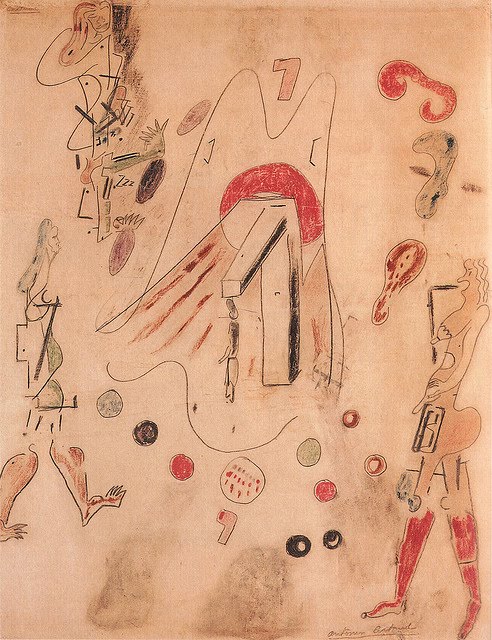
Antonin Artaud, La Pendue (The Hanged), 1945
"La Pendue" ("The Hanged") by Antonin Artaud, 1945 [3]


[1] Image taken from this page, where an oddly-phrased comment is good for a laugh: "[Yaroshenko's] genre paintings depict torture, struggles, fruit, bathing suits, and other hardships faced in Russia."

[2] From Dreyfus Rehabilitated: "painting by Henri Degroux depicting the hatred of the masses, a present to the writer from his admirers".

[3] Image taken from an excellent blog called A Journey Round My Skull; includes a link to a larger version of the image.

18 December 2009

Food

The following is reposted from http://erinhooley.blogspot.com/.
Erin's remarkable portfolio is: heavyglow.com.


Why do people always donate food to homeless shelters that they themselves would never eat?

28 July 2009

Re: Becoming Nothing

What follows is a letter I received from the author of the italicized text in the previous post, "Becoming Nothing". Reader responses posted here will be forwarded to the author.

Dear -------,

I wanted to submit a few remarks in response to the comments of mine that you included in the previous exhibit at Altarpiece. In conjunction with the ideas presented there, I have been plagued by another thought, and, more relevantly, I have been plagued by my own inability to express it. In this particular case it seems that I might benefit from trying to express it clearly to someone who has a hope of understanding. I trust you won’t mind me using you as a sort of test subject in this endeavor, but if you do, stop reading now and discard the letter! In any case, perhaps you will also get something out of my meandering here to include in a future exhibit.

The idea in question began as an intuition, which you posted, regarding the relationship between art and the “real world.” This was the intuition expressed in the phrase, “Politics is [or perhaps it should have been ‘are’] a lame substitute for art.” What I had in mind was the ability of art to transform the state of humanity, to create better worlds by virtue of its ability to awaken truths that lie dormant in our spirits. Art is direct democracy imbued with a sense of what is good and true. This, I thought, renders politics unnecessary as a form of representation of art, an unnecessary regulation of a world that man self-regulates through communicative and expressive tools given him at and before birth.

Of course, this all sounds more or less wonderful on paper, but it began to butt heads with reality when I was put upon recently to explain it in the language of “daily life” in conversation. My interlocutor insisted that any system of organization of the exigencies of daily life counts as a political system, for example the working out of how a society’s collective garbage will be dealt with. Art, he argued, simply could not take the place of such necessities.

This argument upset me considerably because, while I could see how it derived from my own remarks, it seemed to miss the point entirely. It seemed to miss the significance of what I was saying, to somehow render banal a point that had begun in my mind as a (subjectively) inspired moment. I couldn’t see how to reconcile this problem, and in fact it appeared to me as merely an instantiation of a general difficulty I had encountered before. Namely, so many of the ideas and principles that are the most important to me are seemingly incompatible with daily reality. The values implied by a commitment to the realms of art and ideas bear no relation to the world inhabited by people. At best they provide some guidelines by which those in positions of comfort can organize their thinking, but even the lives lived by these individuals are not freed of their ultimate constraints. It seems more likely that thought and art have developed into parasites that flourish in the fertile heat and moisture of the first-world intellect. At this point in history we feel deeply the need to reconnect with our own species and not to labor under the illusion that the idea is a creature that serves and depends upon us. We experience a keen drive toward action, which unites us with our immediate, physical realities and brings us back into existence, back into integration with a world we have almost destroyed.

This is a historical pressure that I feel in the same moment that I feel illuminated by the transcendent importance of art in the broadest sense. When I am confronted with the question of how my dream for the world—so full of expression and expressive forms of knowing that politics as we know it no longer fits—relates to the need to dispose of garbage, I am stricken with something like the pain of separation… the realization that my visions, about which I care deeply, do not relate to people, about whom I care deeply. The idea of communicating with and transforming people’s souls is irrelevant and indulgent when people are too abused and too hungry to have souls in the first place. So you can see the depths of confusion into which my friend’s well-meaning criticism plunged me.

I have, however, recently come to a possible solution, or a justification which I would like to submit to both your and my own scrutiny. After a brief chat with another friend about the degree to which the present systems of the world have doomed themselves, we agreed that the human species will probably outlive the impending implosion in some form. We couldn’t escape the inevitability of, at the very least, a sort of Malthusian collapse after the failure or refusal of human ingenuity and compassion to catch up to growing populations and dwindling resources and compromised ecologies and greed. (You and I have discussed this as well in connection with that National Geographic article.) Nevertheless, the total elimination of mankind seems unlikely. We will still be here, and this allowed me to realize that the questions of why and how we are here are becoming more rather than less relevant. Perhaps in order to undertake intellectual and artistic projects in the face of such contagion in the modern world, one has to resign oneself to an almost appalling level of hopelessness.

But even as I write I can sense the weakness in this point of view. Have I so little hope and love for people living now that I have to resort to the apologetics of art as a withered attempt at communication with people who do not yet live? And, you will point out, I have not even addressed the original problem of politics and art. I suppose the only response I can give is to admit with a mixture of pride and shame that, yes, my dream involves such a radical reorganization of life, such a reinvention of the real, that art will supplant even trash collection, that there will be no such thing as trash as we pull ourselves along the rope of existence toward the infinite and the truly meaningful. That almost no one now living can understand this. As for how it will come about I do not know, I guess there will have to be some kind of disaster, or perhaps people can claw their way there slowly through the mud (a process for which, surely, I am not needed).

Art in its broadest sense is not only writing and painting and film, but also every thought and action in which we chip away at the veil between us and everything. Maybe the straight-talk description of this involves all of us sitting in silent meditation from birth, or voluntarily extinguishing the species, or simply living in such a way that we create no excesses like garbage or profit or nations that can’t sustain all their individual voices.

Ultimately I think I would like to distinguish between politics and governance. The governance of things like the way water flows, how food is stored, where information can be found, etc…. these can be artistic acts insofar as they are externalized means of integration with the world—insofar, basically, as they are done selflessly and out of the same duty toward people that the artist-poet feels. This is how politics destroys art and inhabits the resulting void. Politics is the governance of people, the creation of mutes, the belief that we can be spoken-form, the hypnotized agreement of people to remain uninvolved in the creation and exposition of reality.

27 June 2009

Becoming Nothing


Art creates, alters, and reinforces certain aspects of human nature. This fact destroys the notion of art as apolitical. Politics is a lame substitution for art.


times and winds/bes vakit still


Susan Sontag
I have several times applied to the work of art the metaphor of a mode of nourishment. To become involved with a work of art entails, to be sure, the experience of detaching oneself from the world. But the work of art itself is also a vibrant, magical, and exemplary object which returns us to the world in some way more open and enriched.


times and winds/bes vakit still


We are working now to dissolve human nature through art. To achieve an aesthetic experience that does not remove us from ourselves but annuls the self, allowing us to become empty and to merge seamlessly with everything else so that we are everything else.


Robert Musil:
And so, whatever the relationship may be between objects and feeling in the civilized person's mature view of the world, everyone surely knows those ecstatic moments in which a split has not yet occurred, as though water and land had not yet been divided and the waves of feeling still shared the same horizon as the hills and valleys that form the shape of things.


times and winds/bes vakit still


Andrei Tarkovsky:
The allotted function of art is not, as is often assumed, to put across ideas, to propagate thoughts, to serve as example. The aim of art is to prepare a person for death, to plough and harrow his soul, rendering it capable of turning to good.


times and winds/bes vakit still


The pinnacle of human nature is Nature.


[1] [2] [3]

24 May 2009

a bird which died advised me to / commit flight to memory.

Forough Farrokhzad's short documentary The House is Black can be viewed at UbuWeb.

Leprosy is chronic and contagious. Leprosy is not hereditary. Leprosy can be anywhere or everywhere. Leprosy goes with poverty. Upon attacking the body it deepens and enlarges wrinkles, eats away the tissues, covers the nerves with a dry shield, dulls sensitivity to heat and touch, causes blindness, destroys the nasal septum, it finds its way to the liver and bone marrow, withers the fingers, it clears the way for other diseases.

Leprosy is not incurable. Taking care of lepers stops the disease from spreading. Wherever lepers have been adequately cared for, the disease has vanished. When the leper is cared for early, he can be treated completely. Leprosy is not incurable.


The filmmaker, Forough Farrokhzad, is considered one of the most accomplished modern Iranian poets. Though her mastery of poetic form in Persian is probably difficult to translate into English, free translations capture something of the spirit.

Two excerpts from "Another Brith" (click here to read the whole thing):

Life is perhaps
a rope with which a man hangs himself from a branch
life is perhaps a child returning home from school.

...

I will plant my hands in the garden
I will grow I know I know I know and
swallows will lay eggs
in the hollow of my ink-stained hands.


"The Couple":

Night comes
and after night, darkness
and after darkness
eyes
hands
and breathing and more breathing
and the sound of water
which drips drips drips
from the faucet.

then two red points
from two lighted cigarettes
the clock's tick-tock
and two heads
and two lonelinesses.
Much more of Forough's poetry, occasionally with Persian audio of the poems available, can be read at http://www.forughfarrokhzad.org/.

"I believe in being a poet in all moments of life. Being a poet means being human. I know some poets whose daily behavior has nothing to do with their poetry. In other words, they are only poets when they wrote poetry. Then it is finished and they turn into greedy, indulgent, oppressive, shortsighted, miserable, and envious people. Well, I cannot believe their poems. I value the realities of life and when I find these gentlemen making fists and claims--that is, in their poems and essays--I get disgusted, and I doubt their honesty. I say to myself: Perhaps it is only for a plate of rice that they are screaming. "

20 April 2009

Baby


The Brazilian band Os Mutantes created two versions of their song "Baby," one in Portuguese in 1968 and the other in English in 1971. Until today, I always assumed that the English version was a close translation of the Portuguese, just slightly different stylistically. Reading the lyrics to the English version alongside a translation of the Portuguese version (from the Luaka Bop website) gives a different impression:

Baby (1971)
click here to listen on YouTube

You know,
you must take a new look at the new land
The swimming pool and
the teeth of your friend
The dirt in my hand
You know,
you must take a look at me

Baby, baby
I know that’s the way

You know,
you must try the new ice-cream flavor
Do me a favor,
look at me closer
Join us and go far
And hear the new sound of my bossa nova

Baby, baby
It’s been a long time

You know, it’s time now to learn Portuguese
It’s time now to learn what I know
And what I don’t know
I know, with me everything is fine
It’s time now to make up your mind
We live in the biggest city of South America
Look here, read what I wrote on my shirt:
Baby, baby
I love you
Baby (1968), translated
click here to listen on YouTube

You need to learn of swimming pools
Of margarine, of Caroline, of gasoline
You need to learn of me

Baby, Baby
I know you do

You need to eat an ice cream cone
At the corner diner, to hang out with us
To see me up close
To hear Roberto Carlos’ new song

Baby, baby
It’s been so long

You need to learn English
And learn what I know
And what I don’t know

With me, skies are blue
With you all is cool
We live in the best city
In South America
You need to... you need to...
I don’t know, read it on my shirt
Baby, baby
I love you

Although I have no idea how this song comes across in Portuguese, in English the 1968 version is distinctly more emotional, more adolescent. The 1971 version sounds surreal and whimsical, the 1968 version more exasperated and simple. The tiny, tiny difference between "We live in the biggest city of South America" and "We live in the best city in South America" is a perfect example. Living in the biggest city in South America is chance, a randomish factoid, but living in the best city is full of possibilities, suggests a world or a life that's fresh and almost perfect. (For more thoughts on this song, see the interesting discussion in the comments of this post.)

Here is the English translation (from notbored.org) of the lyrics to "Panis et Circenses," one of my favorite Mutantes songs, and an example (in my opinion) of the band's more political side. Click here to watch a video of the band performing this song (YouTube).

I wanted to sing a song illuminated by the sun
I raised the sails to the wind
I freed the tigers and the lions in the yard
But the people in the dining hall
Are busy being born and dying

I demanded that a dagger of pure luminous steel be made
To kill my love and I killed her
At five o'clock on Central Avenue
But the people in the dining hall
Are busy being born and dying

I demanded that leaves of dreams be planted in the Garden of the Sun
The leaves know how to seek the sun
And the roots seek, seek
But the people in the dining hall
These people in the dining hall
But the people in the dining hall
Are busy being born and dying

17 March 2009

Harun Farocki's documentary Images of the World and the Inscription of War is available in English on YouTube in 8 parts. (Click here for part 1). Two highlights:


The idea of obtaining measurement through photography came to [the inventor of the technique] after he was suspended between life and death. That means, it is dangerous to hold out physically on the spot... safer to take a picture.
...
Arduous and dangerous to hold out physically on the spot. Safer to take a picture and evaluate it later protected from the elements at one's desk.
***


[On the examination of aerial photographs of concentration camps in the 1960s and 1970s:]
The snow on the roofs of the neighboring barracks is already melting, which means that they are still inhabited. The evaluators verify, that means they establish the verity, of the existence of the camp down to the last detail, and they do this with relish for their role as specialists.
Although the film is about many things, it is basically about the Holocaust. In this regard and in others, it is the same color as W. G. Sebald's book The Rings of Saturn, which, although it never mentions the Holocaust directly, is basically "about" the Holocaust in the sense of "around".


In China, the placating of the elements has always been intimately connected with the ceremonial rites which surrounded the ruler on the dragon throne and which governed everything from affairs of state down to daily ablutions, rituals that also served to legitimize and immortalize the immense profane power that was focused in the person of the emperor. At any moment of the day or night, the members of the imperial household, which numbered more than six thousand and consisted exclusively of eunuchs and women, would be circling, on precisely defined orbits, the sole male inhabitant of the Forbidden City that lay concealed behind purple-coloured walls. In the latter half of the nineteenth century, the ritualization of imperial power was at its most elaborate: at the same time, that power itself was by now almost completely hollowed out. While all court appointments, rigidly controlled as they were by an immutable hierarchy, continued to be made according to rules that had been perfected down to the last detail, the empire in its entirety was on the brink of collapse, owing to mounting pressure from enemies both within and without.
I read this book some months ago, but I didn't realize that it was about the Holocaust at all until I heard a radio interview with the author in which he explains it. Originally I was unimpressed, since I don't like puzzles that can't be figured out and I don't like art that can't stand alone. With time, though, I've come to the conclusion that the Holocaust serves in both these cases as a horizon against which concepts can be set. It's not necessary to understand the horizon in order to use it as a new way of linking concepts, a new way of thinking. The point, rather, is that historical events create interpretive possibilities, possible routes to the truth, that did not exist before. And the method is an innocent one because the truth always stands alone.

Brief clips of many of Harun Farocki's other excellent documentaries (most of them are not feature length) can be found on YouTube and here.

30 November 2008

What is the difference?


Mohandas "Mahatma" Gandhi


To which groups are our identities opposed? Who do we place outside of ourselves so that we may draw a boundary around ourselves and know that boundary to be safe? There is no mystery in ourselves; we know what we are not. I know what I am not--I am not you. At least I am not you. There are five castes.

There are five senses. Everything you perceive must come through one of these or it is a fantasy. There are seven colors in the rainbow. A wave of light stretches from red to violet in six violent jerks as if it is falling down the stairs.


An evicted Roma family (Budapest, 2000)

- Tell me more about the village where your grandmother lives.
- It is a very nice village, 120 kilometers from here. There is a lake on the edge of a forest.
- How many people live there?
- It is a small village, 3,000 people. And no gypsies!


I have been thinking ...
I have been thinking of the difference between water
and the waves on it. Rising,
water's still water, falling back,
it is water, will you give me a hint
how to tell them apart?

Because someone has made up the word
"wave," do I have to distinguish it
from water?

There is a Secret One inside us;
the planets in all the galaxies
pass through his hands like beads.

That is a string of beads one should look at with luminous eyes.

-Kabir, 13th Century