Showing posts with label humor. Show all posts

09 July 2013

The Appetitive Soul


Two pages from The Cardboard Valise by Ben Katchor.  Click to enlarge.
Ben Katchor, from The Cardboard Valise


From Plato's Phaedrus:
Of the nature of the soul, though her true form be ever a theme of large and more than mortal discourse, let me speak briefly, and in a figure. And let the figure be composite--a pair of winged horses and a charioteer. Now the winged horses and the charioteers of the gods are all of them noble and of noble descent, but those of other races are mixed; the human charioteer drives his in a pair; and one of them is noble and of noble breed, and the other is ignoble and of ignoble breed; and the driving of them of necessity gives a great deal of trouble to him. ...The soul in her totality has the care of inanimate being everywhere, and traverses the whole heaven in divers forms appearing--when perfect and fully winged she soars upward, and orders the whole world; whereas the imperfect soul, losing her wings and drooping in her flight at last settles on the solid ground.
...
The chariots of the gods in even poise, obeying the rein, glide rapidly; but the [mortals] labour, for the vicious steed goes heavily, weighing down the charioteer to the earth when his steed has not been thoroughly trained:--and this is the hour of agony and extremest conflict for the soul.
...
The right-hand horse is upright and cleanly made; he has a lofty neck and an aquiline nose; his colour is white, and his eyes dark; he is a lover of honour and modesty and temperance, and the follower of true glory; he needs no touch of the whip, but is guided by word and admonition only. The other is a crooked lumbering animal, put together anyhow; he has a short thick neck; he is flat-faced and of a dark colour, with grey eyes and blood-red complexion; the mate of insolence and pride, shag-eared and deaf, hardly yielding to whip and spur. Now when the charioteer beholds the vision of love, and has his whole soul warmed through sense, and is full of the prickings and ticklings of desire, the obedient steed, then as always under the government of shame, refrains from leaping on the beloved; but the other, heedless of the pricks and of the blows of the whip, plunges and runs away, giving all manner of trouble to his companion and the charioteer, whom he forces to approach the beloved and to remember the joys of love. They at first indignantly oppose him and will not be urged on to do terrible and unlawful deeds; but at last, when he persists in plaguing them, they yield and agree to do as he bids them.

And now they are at the spot and behold the flashing beauty of the beloved; which when the charioteer sees, his memory is carried to the true beauty, whom he beholds in company with Modesty like an image placed upon a holy pedestal. He sees her, but he is afraid and falls backwards in adoration, and by his fall is compelled to pull back the reins with such violence as to bring both the steeds on their haunches, the one willing and unresisting, the unruly one very unwilling; and when they have gone back a little, the one is overcome with shame and wonder, and his whole soul is bathed in perspiration; the other, when the pain is over which the bridle and the fall had given him, having with difficulty taken breath, is full of wrath and reproaches, which he heaps upon the charioteer and his fellow-steed, for want of courage and manhood, declaring that they have been false to their agreement and guilty of desertion. Again they refuse, and again he urges them on, and will scarce yield to their prayer that he would wait until another time. When the appointed hour comes, they make as if they had forgotten, and he reminds them, fighting and neighing and dragging them on, until at length he, on the same thoughts intent, forces them to draw near again. And when they are near he stoops his head and puts up his tail, and takes the bit in his teeth. and pulls shamelessly. Then the charioteer is worse off than ever; he falls back like a racer at the barrier, and with a still more violent wrench drags the bit out of the teeth of the wild steed and covers his abusive tongue and jaws with blood, and forces his legs and haunches to the ground and punishes him sorely. And when this has happened several times and the villain has ceased from his wanton way, he is tamed and humbled, and follows the will of the charioteer, and when he sees the beautiful one he is ready to die of fear. And from that time forward the soul of the lover follows the beloved in modesty and holy fear.

What is beneath the tunic of the charioteer of the gods, who drives two white horses? 


Giulio Romano, Chariot of the Sun, 1527
Palazzo Te, Mantua, Italy

28 July 2011

Hogs is hogs

Charles Jacque - Le Retour du BergerLe Retour du Berger, Charles Jacque (1879-1959)

A scene of uncommon hilarity from Cormac McCarthy in Outer Dark:

On a good spring day he paused to rest at the side of the road. He had been walking for a long time and he had been hearing them for a long time before he knew what the sound was, a faint murmurous droning portending multitudes, locusts, the advent of primitive armies. He rose and went on until he reached the gap in the ridge and before long he could see the first of them coming along the road below him and then suddenly the entire valley was filled with hogs, a weltering sea of them that came smoking over the dusty plain and flowed undiminished into the narrows of the cut, fanning on the slopes in ragged shoals like the harried outer guard of schooled fish and here and there upright and cursing among them and laboring with poles the drovers, gaunt and fever-eyed with incredible rag costumes and wild hair.
     Holme left the road and clambered up the rocky slope to give them leeway. The first of the drovers was beating his way obliquely across the herd toward him, the hogs flaring and squealing and closing behind him again like syrup. When he gained the open ground he came along easily, smiling up to where Holme sat on a rock with his feet dangling and looking down with no little wonder at this spectacle. hog drovers
     Howdy neighbor, called out the drover. Sweet day, ain't she?
     It is, he said. Whereabouts are ye headed with them hogs if you don't care for me astin?
     Crost the mountain to Charlestown.
     Holme shook his head reverently. That there is the damndest sight of hogs ever I seen, he said. How many ye got?
     The drover had come about the base of the rock and was now standing looking down with Holme at the passing hogs. God hisself don't know, he said solemnly.
     Well it's a bunch.
     They Lord, said the drover, they just now commencin to come in sight. He passed his stave from the crook of one arm to the other and cocked one foot on the ledge of rock, his sparse whiskers fluttering in the mountain wind, leaning forward and watching the howling polychrome tide of hogs that glutted the valley from wall to wall as might any chance traveler a thing of interest.
     They's more than one mulefoot in that lot, he said.
     What?
     Mulefoot. I calculate they's several hunnerd head of them alone and they ain't no common hog to come upon.
     What's a mulefoot? Holme said.
     The drover squinted professionally. Mountain hog from north of here. You ain't never seen one?
     No.
     Got a foot like a mule.
     You mean they ain't got a split hoof?
     Nary split to it.
     I ain't never seen no such hog as that, Holme said.
     I ain't surprised, the drover said. But ye can see one here if you've a mind to.
     I'd admire to, Holme said.
     The drover shifted his stave again. Seems like that don't agree with the bible, what would you say?
     About what?
     About them hogs. Bein unclean on account of they got a split foot.
     I ain't never heard that, Holme said.
     I heard it preached in a sermon one time. Feller knowed right smart about the subject. Said the devil had a foot like a hog's. He laid claim it was in the bible so I reckon it's so.
     I reckon.
     He said a jew wouldn't eat hogmeat on account of it.
     What's a jew?
     That's one of them old-timey people from in the bible. But that still don't say nothin about a mulefoot hog does it? What about him?
     I don't know, Holme said. What about him?
     Well is he a hog or ain't he? Accordin to the bible.
     I'd say a hog was a hog if he didn't have nary feet a-tall.
     I might do it myself, the drover said, because if he was to have feet you'd look for em to be hog's feet. Like if ye had a hog didn't have no head you'd know it for a hog anyways. But if ye seen one walkin around with a mule's head on him ye might be puzzled.
     That's true, Holme allowed.
     Yessir. Makes ye wonder some about the bible and about hogs too, don't it?
     Yes, Holme said.
     I've studied it a good deal and I cain't come to no conclusions about it one way or the other.
     No.
     The drover stroked his whiskers and nodded his head. Hogs is a mystery by theyselves, he said. What can a feller know about one? Not a whole lot. I've run with hogs since I was just a shirttail and I ain't never come to no real understandin of em. and I don't doubt but what other folks has had the same experience. A hog is a hog. Pure and simple. And that's about all ye can say about him. And smart, don't think they ain't. Smart as the devil. And don't be fooled by one that ain't got nary clove foot cause he's devilish too.
     I guess hogs is hogs, Holme said.
     The drover spat and nodded. That's what I've always maintained, he said.


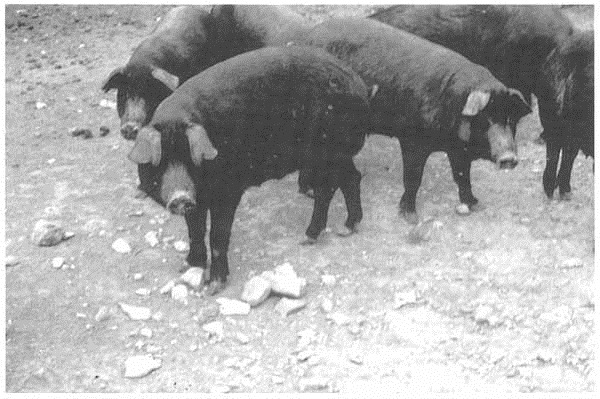
mulefoot hogs “The last remaining herd of Mulefoot Hogs in the USA has been conserved by an individual farmer.” [source]


“Hog Drovers” as sung by Ollie Gilbert, Mountain View, Arkansas on October 28, 1969. [source] [see also]


Charles Joshua Chaplin - Le porcher Le Porcher, Charles Joshua Chaplin (1825-1891)

10 November 2010

30,000 feet

GOOSE, n. A bird that supplies quills for writing. These, by some occult process of nature, are penetrated and suffused with various degrees of the bird's intellectual energies and emotional character, so that when inked and drawn mechanically across paper by a person called an "author," there results a very fair and accurate transcript of the fowl's thought and feeling. The difference in geese, as discovered by this ingenious method, is considerable: many are found to have only trivial and insignificant powers, but some are seen to be very great geese indeed.
-Ambrose Bierce, The Devil's Dictionary


Bar-Headed Geese