Showing posts with label literature. Show all posts

28 July 2011

Hogs is hogs

Charles Jacque - Le Retour du BergerLe Retour du Berger, Charles Jacque (1879-1959)

A scene of uncommon hilarity from Cormac McCarthy in Outer Dark:

On a good spring day he paused to rest at the side of the road. He had been walking for a long time and he had been hearing them for a long time before he knew what the sound was, a faint murmurous droning portending multitudes, locusts, the advent of primitive armies. He rose and went on until he reached the gap in the ridge and before long he could see the first of them coming along the road below him and then suddenly the entire valley was filled with hogs, a weltering sea of them that came smoking over the dusty plain and flowed undiminished into the narrows of the cut, fanning on the slopes in ragged shoals like the harried outer guard of schooled fish and here and there upright and cursing among them and laboring with poles the drovers, gaunt and fever-eyed with incredible rag costumes and wild hair.
     Holme left the road and clambered up the rocky slope to give them leeway. The first of the drovers was beating his way obliquely across the herd toward him, the hogs flaring and squealing and closing behind him again like syrup. When he gained the open ground he came along easily, smiling up to where Holme sat on a rock with his feet dangling and looking down with no little wonder at this spectacle. hog drovers
     Howdy neighbor, called out the drover. Sweet day, ain't she?
     It is, he said. Whereabouts are ye headed with them hogs if you don't care for me astin?
     Crost the mountain to Charlestown.
     Holme shook his head reverently. That there is the damndest sight of hogs ever I seen, he said. How many ye got?
     The drover had come about the base of the rock and was now standing looking down with Holme at the passing hogs. God hisself don't know, he said solemnly.
     Well it's a bunch.
     They Lord, said the drover, they just now commencin to come in sight. He passed his stave from the crook of one arm to the other and cocked one foot on the ledge of rock, his sparse whiskers fluttering in the mountain wind, leaning forward and watching the howling polychrome tide of hogs that glutted the valley from wall to wall as might any chance traveler a thing of interest.
     They's more than one mulefoot in that lot, he said.
     What?
     Mulefoot. I calculate they's several hunnerd head of them alone and they ain't no common hog to come upon.
     What's a mulefoot? Holme said.
     The drover squinted professionally. Mountain hog from north of here. You ain't never seen one?
     No.
     Got a foot like a mule.
     You mean they ain't got a split hoof?
     Nary split to it.
     I ain't never seen no such hog as that, Holme said.
     I ain't surprised, the drover said. But ye can see one here if you've a mind to.
     I'd admire to, Holme said.
     The drover shifted his stave again. Seems like that don't agree with the bible, what would you say?
     About what?
     About them hogs. Bein unclean on account of they got a split foot.
     I ain't never heard that, Holme said.
     I heard it preached in a sermon one time. Feller knowed right smart about the subject. Said the devil had a foot like a hog's. He laid claim it was in the bible so I reckon it's so.
     I reckon.
     He said a jew wouldn't eat hogmeat on account of it.
     What's a jew?
     That's one of them old-timey people from in the bible. But that still don't say nothin about a mulefoot hog does it? What about him?
     I don't know, Holme said. What about him?
     Well is he a hog or ain't he? Accordin to the bible.
     I'd say a hog was a hog if he didn't have nary feet a-tall.
     I might do it myself, the drover said, because if he was to have feet you'd look for em to be hog's feet. Like if ye had a hog didn't have no head you'd know it for a hog anyways. But if ye seen one walkin around with a mule's head on him ye might be puzzled.
     That's true, Holme allowed.
     Yessir. Makes ye wonder some about the bible and about hogs too, don't it?
     Yes, Holme said.
     I've studied it a good deal and I cain't come to no conclusions about it one way or the other.
     No.
     The drover stroked his whiskers and nodded his head. Hogs is a mystery by theyselves, he said. What can a feller know about one? Not a whole lot. I've run with hogs since I was just a shirttail and I ain't never come to no real understandin of em. and I don't doubt but what other folks has had the same experience. A hog is a hog. Pure and simple. And that's about all ye can say about him. And smart, don't think they ain't. Smart as the devil. And don't be fooled by one that ain't got nary clove foot cause he's devilish too.
     I guess hogs is hogs, Holme said.
     The drover spat and nodded. That's what I've always maintained, he said.


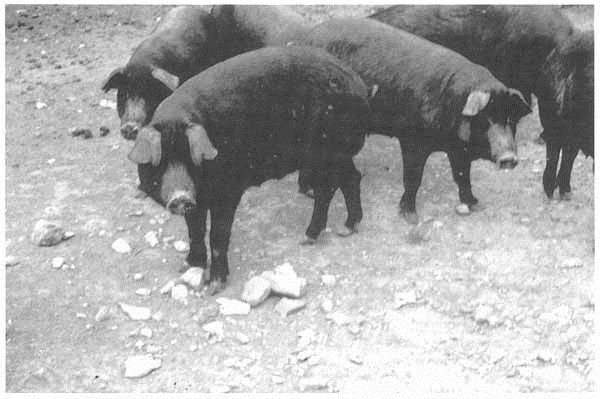
mulefoot hogs “The last remaining herd of Mulefoot Hogs in the USA has been conserved by an individual farmer.” [source]


“Hog Drovers” as sung by Ollie Gilbert, Mountain View, Arkansas on October 28, 1969. [source] [see also]


Charles Joshua Chaplin - Le porcher Le Porcher, Charles Joshua Chaplin (1825-1891)

23 January 2011

REMAINDER


I remembered that my windscreen washer reservoir was empty and I asked him for some fill-up. [...] Before I drove off I pushed the windscreen spurter button to make sure it worked. Liquid should have squired out onto the glass, but nothing happened. I pushed it some more. Still nothing. I got out, opened the bonnet again and checked the reservoir. It was empty.

"It's all gone!" I said.

The boys peered in. The oldest one got down on his knees and looked under the car.

"There's no patch," he said. "It hasn't leaked. It should be there." He turned to the middling boy and said: "Go get another bottle."

Another bottle was brought out and poured into the reservoir. Once more I climbed inside the car and pressed the spurter button. Once more nothing happened--and once more, when we looked inside the reservoir, we found it empty.

"Two litres!" I said. "Where has it all gone?"

They'd vaporized, evaporated. And do you know what? It felt wonderful. Don't ask me why: it just did. It was as though I'd just witnessed a miracle: matter--these two litres of liquid--becoming un-matter--not surplus matter, mess or clutter, but pure, bodiless blueness. Transubstantiated. I looked up at the sky: it was blue and endless. I looked back at the boy. His overalls and face were covered in smears. He'd taken on these smears so that the miracle could happen, like a Christian martyr being flagellated, crucified, scrawled over with stigmata. I felt elated--elated and inspired.

"If only..." I started, but paused.

"What?" he asked.

"If only everything could..."

I trailed off again. I knew what I meant. I stood there looking at his grubby face and told him:

"Thank you."

Then I got into the car and turned the ignition key in its slot. The engine caught--and as it did, a torrent of blue liquid burst out of the dashboard and cascaded down. It gushed from the radio, the heating panel, the hazard-lights switch and the speedometer and mileage counter. It gushed all over me: my shirt, my legs, my groin.


The brilliance of Tom McCarthy's Remainder lies not in the way it is written, but in the way it writes the reader. One must usually come upon books at the right time in life in order to get the most out of them. How this typically happens is a mysterious combination of instinct, guesswork, and rereading. Remainder, however, manages to create a perfect space for itself, and by the time one has finished reading it, one's life has become right for the book. Reality has become one with fiction, realizing the book's theme in a way that many of Tom McCarthy's predecessors did not, uncovering the sublime where once there was only gimmick.

They're like bunnies in headlights: frozen. You step in and move them gently away from the counters, get them to lie down. You use their shock to create a... bridge, a... a suspension in which you can operate. A little enclave, a defile.
Gun
One of the images that appeared in an image search for "scale model of London".

10 November 2010

30,000 feet

GOOSE, n. A bird that supplies quills for writing. These, by some occult process of nature, are penetrated and suffused with various degrees of the bird's intellectual energies and emotional character, so that when inked and drawn mechanically across paper by a person called an "author," there results a very fair and accurate transcript of the fowl's thought and feeling. The difference in geese, as discovered by this ingenious method, is considerable: many are found to have only trivial and insignificant powers, but some are seen to be very great geese indeed.
-Ambrose Bierce, The Devil's Dictionary


Bar-Headed Geese

21 October 2010

Nuestro Señor de La Mancha

In honor of the Festival Internacional Cervantino, currently in its 38th year, and in honor of Miguel de Cervantes Saavedra, whose celebration needs no occasion, the following:


Detail of sculpture in Alcalá de Henares, Cervantes' birthplace. [Source]


If by chance these gentlemen should wish to know who is the valorous one that served them so, let your worship tell them that it is the famous Don Quixote of La Mancha, who is otherwise called the Knight of the Rueful Figure.


Don Quixote and Sancho Panza, Alcalá de Henares


Madrid, 1979 [Source]


Detail of the above.


Don Quixote of Havana


Detail of above.


Don Quixote, relief by Anna Hyatt Huntington, Audubon Terrace, New York


Guanajuato, Mexico, home of Cervantino. (The full sculpture includes Sancho Panza, but there seems to exist no good photo of the entire thing online.)

07 September 2010

Here am I shedding one of my life-skins, and all they will say is, 'Bernard is spending ten days in Rome.'

Painting: Virginia Woolf by Vanessa Bell, 1912
"Now I sit on a stone seat in these gardens surveying the eternal city, and the little man who was shaving in London five days ago looks already like a heap of old clothes. [...] I sit here like a convalescent, like a very simple man who knows only words of one syllable. 'The sun is hot,' I say. 'The wind is cold.' I feel myself carried round like an insect on top of the earth and could swear that, sitting here, I feel its hardness, its turning movement. I have no desire to go the opposite way from the earth. Could I prolong this sense another six inches I have a foreboding that I should touch some queer territory. But I have a very limited proboscis. I never wish to prolong these states of detachment; I dislike them; I also despise them. I do not wish to be a man who sits for fifty years on the same spot thinking of his navel. I wish to be harnessed to a cart, a vegetable-cart that rattles over the cobbles."

- Virginia Woolf, The Waves
Image: "Virginia Woolf" by Vanessa Bell, c. 1912

I expose myself to that risk voluntarily.

I have but one passion: to enlighten those who have been kept in the dark, in the name of humanity which has suffered so much and is entitled to happiness. My fiery protest is simply the cry of my very soul. Let them dare, then, to bring me before a court of law and let the enquiry take place in broad daylight! I am waiting.

- Émile Zola, J'accuse!


Painting: The Prisoner by Nikolai Alexandrovich Yaroshenko, 1878
"The Prisoner" by Nikolai Alexandrovich Yaroshenko, 1878 [1]


A man cannot live intensely except at the cost of the self. Now the bourgeois treasures nothing more highly than the self (rudimentary as his may be). And so at the cost of intensity he achieves his own preservation and security. His harvest is a quiet mind which he prefers to being possessed by God, as he does comfort to pleasure, convenience to liberty, and a pleasant temperature to that deathly inner consuming fire.

- Hermann Hesse, Steppenwolf


Painting: Zola Insulted by Henry de Groux
"Zola Insulted" by Henry de Groux, date unknown [2]


It appears to be an inborn and imperative need of all men to regard the self as a unit. However often and however grievously this illusion is shattered, it always mends again. The judge who sits over the murderer and looks into his face, and at one moment recognizes all the emotions and potentialities of the murderer in his own soul and hears the murderer's voice as his own, is at the next moment one and indivisible as the judge, and scuttles back into the shell of his cultivated self and does his duty and condemns the murderer to death. And if ever the suspicion of their manifold being dawns upon men of unusual powers and of unusually delicate perceptions, so that, as all genius must, they break through the illusion of the unity of the personality and perceive that the self is made up of a bundle of selves, they have only to say so and at once the majority puts them under lock and key, calls science to aid, establishes schizomania and protects humanity from the necessity of hearing the cry of truth from the lips of these unfortunate persons.

- Hermann Hesse, Steppenwolf


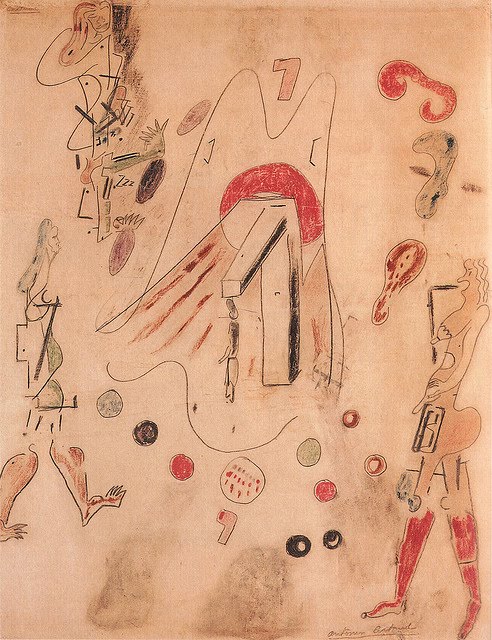
Antonin Artaud, La Pendue (The Hanged), 1945
"La Pendue" ("The Hanged") by Antonin Artaud, 1945 [3]


[1] Image taken from this page, where an oddly-phrased comment is good for a laugh: "[Yaroshenko's] genre paintings depict torture, struggles, fruit, bathing suits, and other hardships faced in Russia."

[2] From Dreyfus Rehabilitated: "painting by Henri Degroux depicting the hatred of the masses, a present to the writer from his admirers".

[3] Image taken from an excellent blog called A Journey Round My Skull; includes a link to a larger version of the image.

19 June 2010

Schiele, Miller, Matisse

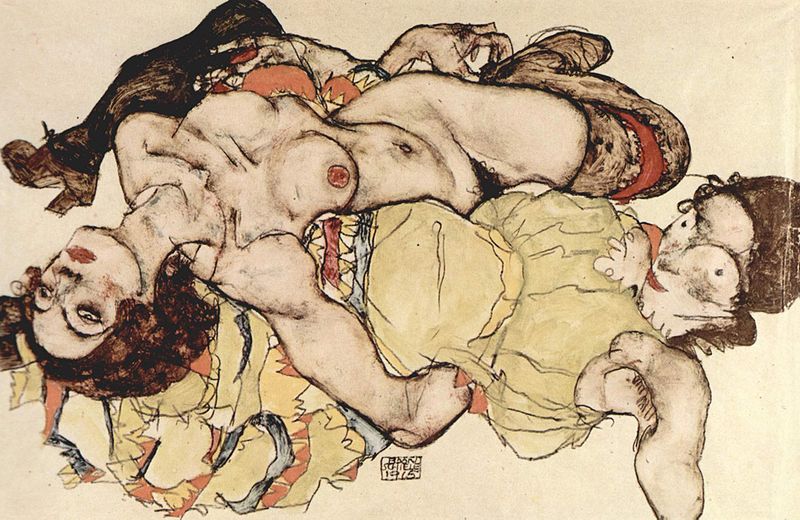
Egon Schiele, Zurückgelehnte Frau, or Two Women, 1915

I have never seen a place like Paris for varieties of sexual provender. As soon as a woman loses a front tooth or an eye or a leg she goes on the loose. In America she'd starve to death if she had nothing to recommend her but a mutilation. Here it is different. A missing tooth or a nose eaten away or a fallen womb, any misfortune that aggravates the natural homeliness of the female, seems to be regarded as an added spice, a stimulant for the jaded appetites of the male.

I am speaking naturally of that world which is peculiar to the big cities, the world of men and women whose last drop of juice has been squeezed out by the machine--the martyrs of modern progress. It is this mass of bones and collar buttons which the painter finds so difficult to put flesh on.

henri matisse, la bonheur de vivre (the joy of life), 1906
Henri Matisse, La Bonheur de Vivre (The Joy of Life), 1906

It is only later, in the afternoon, when I find myself in an art gallery on the Rue de Sèze, surrounded by the men and women of Matisse, that I am drawn back again to the proper precincts of the human world. On the threshold of that big hall whose walls are now ablaze, I pause a moment to recover from the shock which one experiences when the habitual gray of the world is rent asunder and the color of life splashes forth in song and poem. I find myself in a world so natural, so complete, that I am lost.
[...]
In every poem by Matisse there is the history of a particle of human flesh which refused the consummation of death. The whole run of flesh, from hair to nails, expresses the miracle of breathing, as if the inner eye, in its thirst for a greater reality, had converted the pores of the flesh into hungry seeing mouths. [...] He is a bright sage, a dancing seer who, with a sweep of the brush, removes the ugly scaffold to which the body of man is chained by the incontrovertible facts of life. He it is, if any man today possesses the gift, who knows where to dissolve the human figure, who has the courage to sacrifice an harmonious line in order to detect the rhythm and murmur of the blood, who takes the light that has been refracted inside him and lets it flood the keyboard of color. Behind the minutiae, the chaos, the mockery of life, he detects the invisible pattern; he announces his discoveries in the metaphysical pigment of space.


Henri Matisse, La Leçon de Musique (The Music Lesson), 1917


Text: Henry Miller, Tropic of Cancer

18 June 2009

First Infrarealist Manifesto, English

Update: Since its first publication in 2009, this translation has undergone several minor changes.  To those who have reproduced this text elsewhere on the Internet, I recommend updating it to reflect these changes. (5 April, 2013)

Inspired by Roberto Bolaño's novel The Savage Detectives, and disappointed that I couldn't find one pre-existing, I have attempted a translation of the First Infrarealist Manifesto into English. The original can be found here.

See also an interview with Mario Santiago Papasquiaro, co-founder of Infrarealism.

infrarealism, infrarrealismo, roberto bolaño, mario santiago papasquiaro

-->ABANDON EVERYTHING, AGAIN

first infrarealist manifesto

“It is four light-hours to the end of the solar system; to the nearest star, four light-years. A disproportionate ocean of void. But are we really sure that it is only a void? We only know that in this space there are no bright stars; if they existed, would they be visible? And if there existed bodies neither bright nor dark? Could it not happen on the celestial maps, just as on those of the earth, that the star-cities are indicated and the star-villages omitted?”

-Soviet science fiction writers scratched their faces at midnight.

-The infrasuns (Drummond would say the happy proletarian boys).

-Peguero and Boris alone in a lower class room predicting the miracle behind the door.

-Free Money

*

Who has traversed the city and for music has only had the whistles of his fellows, his own words of amazement and rage?

The handsome type who didn’t know

that a girl’s orgasm is clitoral

(Look, it’s not only in the museums that there’s shit) (A process of individual museification) (Certainly all that has been mentioned, revealed) (Fear of discovering) (Fear of the imbalances not foreseen).

*

Our next of kin:

the snipers, the lone plainsmen who devastate the Chinese cafes of Latin America, the butchers in supermarkets, in their tremendous individual-collective dilemma; the impotence of action and investigation (on the individual level or clouded in aesthetic contradictions) of the poetic act.

*

Tiny bright stars eternally winking at us from a place in the universe called The labyrinths.

-Dancing-Club of misery.

-Pepito Tequila sobbing his love for Lisa Underground.

-He sucks it, you suck it, we suck it. [In Spanish as in English, the verb can be used literally or informally in a derogatory sense.]

-And Horror

*

Curtains of water, cement, or tin separate a cultural mechanism, which serves as both the conscience and the asshole of the ruling class, from a living cultural event, scrubbed clean, in constant death and birth, ignorant of most of history and the fine arts (quotidian creator of its own insane istory and its amazing fyne artz), body that suddenly tests new sensations on itself, product of an epoch in which we approach at 200 kmph the toilet or the revolution.
“New forms, rare forms”, as old Bertolt said, half curious and half smiling.

*

Sensations don’t arise out of nothing (obviousness of obviousnesses), but from a conditioned reality, in a thousand ways, as a constant flow.

-Complex reality makes us seasick!

So, it is possible that in part this is a birth and in part we are in the front row for the death throes. Forms of life and forms of death pass by the retina daily. Their collision constantly gives rise to infrarealist forms: THE EYE OF TRANSITION

*

Put the whole city in the insane asylum. Sweet sister, howling tanks, hermaphrodite songs, diamond deserts, we only live once and every day the visions are bulkier and more slippery. Sweet sister, lifts to Monte Albán. Tighten your belts because the corpses have been watered. A scene of subtraction.

*

And the good bourgeois culture? And academia and the incendiaries? And the vanguards and the rearguards? And certain conceptions of love, good scenery, the precise and multinational Colt?

Like I told Saint-Just in a dream I had once: Even the heads of aristocrats can’t use us as weapons.

*

-A good part of the world is being born and another good part dying, and we all know that we all have to live or we all have to die: in this there is no middle road.

Chirico says: thought must move away from all that which is called logic and good sense, must move away from all human problems, in such a way that things appear under a new aspect, as if illuminated by a constellation appearing for the first time. The infrarealists say: We are going to fill our heads with all human problems, such that things begin to move inside themselves, an extraordinary vision of man.

-The Constellation of the Beautiful Bird.

-The infrarealists propose indigenousness to the world: a crazy and timid Indian.

-A new lyricism, which is starting to rise Latin America, supports itself in ways that never fail to amaze us. The way in to matter is ultimately the way in to adventure: the poem is a journey and the poet is a hero revealing heroes. Tenderness like an exercise in speed. Breathing and heat. The shotgun experience, structures that are devouring themselves, crazy contradictions.

If the poet is mixed up, the reader will have to mix himself up.

“erotic books without spelling

*

The THOUSAND DISMEMBERED AVANT-GARDES OF THE SIXTIES precede us

The 99 open flowers like a smashed-open head

The massacre, the new concentration camps

The White underground rivers, the violet winds

These are hard times for poetry, some say, drinking tea, listening to music in their apartments, talking (listening) to the old masters. These are difficult times for man, we say, turning to the barricades after a full day’s work of shit and tear gas, discovering / creating music even in our apartments, largely overlooking cemeteries-that-spread, where they [sic] despairingly drink a cup of tea or get drunk on pure rage or the inertia of old masters.

HORA ZERO precedes us

((Raise baboons and the hags will bite you)) [Sp: Cría zambos y te picarán los callos]

Still we are in the quaternary era. Are we still in the quaternary era?

Pepito Tequila kisses Lisa Underground’s phosphorescent nipples and watches her leave for a beach on which black pyramids sprout.

*

I repeat:

the poet is a hero revealing heroes, like the fallen red tree that announces the start of the forest.

-The attempts at a consistent ethic-aesthetic are paved with betrayals or pathetic survivals.

-And it is the individual who will be able to walk a thousand kilometers but eventually the road will eat him.

-Our ethic is Revolution, our aesthetic is Life: one-single-thing.

*

For the bourgeoisie and the petit bourgeoisie life is a party. Every weekend they have one. The proletariat doesn’t have parties. Only rhythmic funerals. That is going to change. The exploited will have a grand party. Memory and guillotines. Sensing it, acting it certain nights, inventing edges and humid corners, is like caressing the acidic eyes of the new spirit.

*

Journey of the poem through the seasons of rioting: poetry producing poets producing poems producing poetry. Not an electric alley / the poet with arms separate from the body / the poem slowly displacing his Vision of his Revolution. The alley is a complex point. “We are going to invent in order to discover its contradiction, its invisible forms of refusing, until it is explained”. Journey of the act of writing through zones not at all favorable to the act of writing.

Rimbaud, come home!

Subverting the everyday reality of modern poetry. The confinements that lead a circular reality to the poem. A good reference: the madman Kurt Schwitters. Lanke trr gll, o, upa kupa arggg, runs the official line, phonetic investigators codifying the howl. The bridges of Noba Express are anti-codification: let him shout, let him shout (please don’t take out pencil or paper, don’t record him, shout with him if you want to participate), so let him shout, in order to see what face he makes when he finishes, what other incredible things we experience.

Our bridges to ignored stations. The poem interrelating reality and unreality.

*

Convulsively

*
What can I demand of current Latin American painting? What can I demand of the theatre?

More revealing and expressive is stopping in a demolished park because of the smog and seeing people crossing the avenues in groups (which contract and expand), when so many motorists, like the pedestrians, urgently approach their hovels, and it’s the hour when the murderers come out and the victims follow them.

What stories do the painters really tell me?

Interesting void, fixed form and color, at best the parody of movement. Canvases that will only serve as bright posters in the rooms of engineers and doctors who collect.

The painter is made comfortable in a society that is every day more “painter” than he is himself, and that is where he is found unarmed and registered as a clown.

If a painting by X is encountered in some street by Mara, this painting acquires the standing of an amusing and informative thing; [in] a sitting room it’s as decorative as the iron armchairs of the bourgeois / a question of the retina? / yes and no / but it would be better to find ( and unfortunately to systematize for a time) the explosive factor, class-conscious, one hundred percent concerned with work, in juxtaposition to the value of “work” that precedes it and conditions it.

-The painter abandons the studio and ANY status quo and fills his head with wonders / or sets out to play chess like Duchamp / A painting that shows how to paint it again / And a painting of poverty, free or cheap enough, unfinished, of participation, of questioning the participation, of unlimited physical and spiritual extension.

Latin America’s best painting is the one that has even unconscious levels, the game, the party, the experiment that gives us a real vision of what we are and reveals to us what we can do will be Latin America’s best painting is the one that we paint with greens and reds and blues on our faces, to recognize ourselves in the incessant creation of the tribe.

*

Try to abandon everything every day.

Architects, abandon the construction of stages inside and extend your hands (or clench them, depending on the place) toward this space outside. A wall and a ceiling become useful when they are not only used for sleeping or avoiding rain but when they establish, starting, for example, at the everyday act of sleep, conscious bridges between man and his creations, or the momentary impossibility of them.

For architecture and sculpture the infrarealists start from two points: the barricade and the bed.


*


The true imagination is the one that dynamites, elucidates, injects emerald microbes into other imaginations. In poetry and in what is, the way in to matter still has to be the way in to adventure. Creating the tools for everyday subversion. The subjective seasons of being human, with their beautiful trees, giant and obscene, like laboratories of experimentation. Establishing, seeing signs of parallel situations and as harrowing as a great scratch on the chest, on the face. Unending analogy of the face. There are so many of them that when newcomers appear we don’t even count, although we are creating them / looking into a mirror. Nights of torment. Perception is opened up by means of an ethic-aesthetic taken to the extreme.


*

Galaxies of love appear in the palms of our hands.

-Poets, let down your hair (if you have any)

-Burn your garbage and start to love until you get down to the priceless poems

-We don’t want synthetic paintings, but enormous synthetic sunsets

-Horses running 500 kilometers per hour

-Squirrles of fire jumping through trees of fire

-A bet to see who blinks first, between the nerve and the sleeping pill

*

The risk is always somewhere else. The true poet is the one who is always letting go of himself. Never too much time in the same place, like guerrillas, like UFOs, like the white eyes of prisoners in perpetual chains.


*

Fusion and explosion of two shores: creation like audacious graffiti and opened by a crazy kid.

Nothing mechanical. The scales of of amazement. Someone, maybe Hieronymus Bosch, breaks the aquarium of love. Free money. Sweet sister. Libidinous visions like corpses. Little boys cutting the meat of kisses until December.


*

At two in the morning, after having been at Mara’s house, we listen (Mario Santiago and some of us) to laughter that came out of the penthouse of a 9 story building. They didn’t stop, they laughed and laughed while we slept below propped up in various phone booths. It was enough for the moment in that only Mario went on paying attention to to the laughter (the penthouse is a gay bar or something similar and Darío Galicia had told us that the police are always vigilant). We made telephone calls but the coins were made of water. The laughter continued. After we left that district Mario told me that really no one had been laughing, it was recorded laughter and upstairs there, in the penthouse, a small group, or perhaps a single homosexual, had been listening in silence to his records and had made us listen.

-The death of the swan, the last song of the swan, the last song of the black swan, ARE NOT in the Bolshoi but in the pain and the unbearable beauty of the streets.

-A rainbow that begins at a B movie and ends with a factory on strike.

-That amnesia never kisses us on the mouth. That it never kisses us.

-We dreamt of utopia and we wake up screaming.

-A poor lonely cowherd who goes back home, that is the wonder.


*

Making new sensations appear –Subverting the everyday


O.K.

ABANDON EVERYTHING, AGAIN

HIT THE ROAD


Roberto Bolaño, México, 1976

05 April 2009

Non-fiction

Note: This post must be viewed directly at Altarpiece, (click here), rather than through an RSS reader, because such applications often do not render background images.

Please be patient with the large images in this post. After some deliberation I opted to embed high-quality versions rather. I think the result is worthwhile.


The images below were captured in Google Earth from panoramas taken by the Opportunity and Spirit Mars rovers. Experiencing the panoramas in Google Earth has the advantage of better-simulated reality; the viewer can move dynamically through the picture in such a way that the true-color photographs of Mars have a more startling impact than can be achieved in these static images. One gets a sense of how wonderfully strange it would be to move around beneath a sky like dust and skin and olives, of how untouched the planet is, of how real it is as a location, and of how (somehow) absurd it is to stand there and snap a picture.

The text accompanying the images consists of excerpts from Rainer Maria Rilke's Letters to a Young Poet, which can be read online in its entirety at Scribd.com. The sterility of Mars on the one hand, and the virility of Rilke's thoughts on the other... perhaps posting these two things together will mute them both, but the juxtaposition seemed so unlikely, even ridiculous and impossible, as to be somehow necessary.


Loving does not at first mean merging, surrendering, and uniting with another person (for what would a union be of two people who are unclarified, unfinished, and still incoherent - ?), it is a high inducement for the individual to ripen, to become something in himself, to become world, to become world in himself for the sake of another person; it is a great, demanding claim on him, something that chooses him and calls him to vast distances. Only in this sense, as the task of working on themselves ("to hearken and to hammer day and night"), may young people use the love that is given to them. Merging and surrendering and every kind of communion is not for them (who must still, for a long, long time, save and gather themselves); it is the ultimate, is perhaps that for which human lives are as yet barely large enough.

Click for larger image.


Bodily delight is a sensory experience, not any different from pure looking or the feeling with which a beautiful fruit fills the tongue; it is a great, an infinite learning that is given to us, a knowledge of the world, the fullness and the splendor of all knowledge. And it is not our acceptance of it that is bad; what is bad is that most people misuse this learning and squander it and apply it as a stimulant on the tired places of their lives and as a distraction rather than as a way of gathering themselves for their highest moments.... If only they could be more reverent toward their own fruitfulness, which is essentially one, whether it is manifested as mental or physical; for mental creation too arises from the physical, is of one nature with it and only like a softer, more enraptured and more eternal repetition of bodily delight.
Click for larger image.


Richard Dehmel: ... You have characterized him quite well with the phrase: "living and writing in heat." - And in fact the artist's experience lies so unbelievably close to the sexual, to its pain and its pleasure, that the two phenomena are really just different forms of one and the same longing and bliss. And if instead of "heat" one could say "sex" - sex in the great, pure sense of the word, free of any sin attached to it by the Church - then his art would be very great and infinitely important. His poetic power is great and as strong as a primal instinct; it has its own relentless rhythms in itself and explodes from him like a volcano.

Click for larger image.


Whoever looks seriously will find that neither for death, which is difficult, nor for difficult love has any clarification, any solution, any hint of a path been perceived; and for both these tasks, which we carry wrapped up and hand on without opening, there is not general, agreed-upon rule that can be discovered. But in the same measure in which we begin to test life as individuals, these great Things will come to meet us, the individuals, with greater intimacy. The claims that the difficult work of love makes upon our development are greater than life, and we, as beginners, are not equal to them. But if we nevertheless endure and take this love upon us as burden and apprenticeship, instead of losing ourselves in the whole easy and frivolous game behind which people have hidden from the most solemn solemnity of their being, - then a small advance and a lightening will perhaps be perceptible to those who come long after us. That would be much.
Click for larger image.


We must accept our reality as vastly as we possibly can; everything, even the unprecedented, must be possible within it. This is in the end the only kind of courage that is required of us: the courage to face the strangest, most unusual, most inexplicable experiences that can meet us. The fact that people have in this sense been cowardly has done infinite harm to life; the experiences that are called "apparitions," the whole so-called "spirit world," death, all these Things that are so closely related to us, have through our daily defensiveness been so entirely pushed out of life that the senses with which we might have been able to grasp them have atrophied. To say nothing of God. But the fear of the inexplicable has not only impoverished the reality of the individual; it has also narrowed the relationship between one human being and another, which has as it were been lifted out of the riverbed of infinite possibilities and set down in a fallow place on the bank, where nothing happens. For it is not only indolence that causes human relationships to be repeated from case to case with such unspeakable monotony and boredom; it is timidity before any new, inconceivable experience, which we don't think we can deal with. but only someone who is ready for everything, who doesn't exclude any experience, even the most incomprehensible, will live the relationship with another person as something alive and will himself sound the depths of his own being.

Click for larger image.

17 March 2009

Harun Farocki's documentary Images of the World and the Inscription of War is available in English on YouTube in 8 parts. (Click here for part 1). Two highlights:


The idea of obtaining measurement through photography came to [the inventor of the technique] after he was suspended between life and death. That means, it is dangerous to hold out physically on the spot... safer to take a picture.
...
Arduous and dangerous to hold out physically on the spot. Safer to take a picture and evaluate it later protected from the elements at one's desk.
***


[On the examination of aerial photographs of concentration camps in the 1960s and 1970s:]
The snow on the roofs of the neighboring barracks is already melting, which means that they are still inhabited. The evaluators verify, that means they establish the verity, of the existence of the camp down to the last detail, and they do this with relish for their role as specialists.
Although the film is about many things, it is basically about the Holocaust. In this regard and in others, it is the same color as W. G. Sebald's book The Rings of Saturn, which, although it never mentions the Holocaust directly, is basically "about" the Holocaust in the sense of "around".


In China, the placating of the elements has always been intimately connected with the ceremonial rites which surrounded the ruler on the dragon throne and which governed everything from affairs of state down to daily ablutions, rituals that also served to legitimize and immortalize the immense profane power that was focused in the person of the emperor. At any moment of the day or night, the members of the imperial household, which numbered more than six thousand and consisted exclusively of eunuchs and women, would be circling, on precisely defined orbits, the sole male inhabitant of the Forbidden City that lay concealed behind purple-coloured walls. In the latter half of the nineteenth century, the ritualization of imperial power was at its most elaborate: at the same time, that power itself was by now almost completely hollowed out. While all court appointments, rigidly controlled as they were by an immutable hierarchy, continued to be made according to rules that had been perfected down to the last detail, the empire in its entirety was on the brink of collapse, owing to mounting pressure from enemies both within and without.
I read this book some months ago, but I didn't realize that it was about the Holocaust at all until I heard a radio interview with the author in which he explains it. Originally I was unimpressed, since I don't like puzzles that can't be figured out and I don't like art that can't stand alone. With time, though, I've come to the conclusion that the Holocaust serves in both these cases as a horizon against which concepts can be set. It's not necessary to understand the horizon in order to use it as a new way of linking concepts, a new way of thinking. The point, rather, is that historical events create interpretive possibilities, possible routes to the truth, that did not exist before. And the method is an innocent one because the truth always stands alone.

Brief clips of many of Harun Farocki's other excellent documentaries (most of them are not feature length) can be found on YouTube and here.

13 March 2009

An Interview


Q: What first drew you to the idea of bioluminescence?
A: When I was, like, 14 or 15 I think, maybe as late as 16, my dad told me about it. He had seen a blurb about it in one of his science magazines. Fish who eat a certain kind of glowing bacteria or something, and then they make the algae change color within their stomachs, glowing to camouflage the fish or frighten enemies. He showed me the article, which he had cut out of the magazine, and then later he wanted it back! I was devastated! (Laughs) I made him photocopy it for me, which he found odd.

Q: So you were immediately attracted to this image, then?
A: I fell in love with it. It was something... so unexpected and unbelievable that it could have been magic, a little bit of magic at a time when the world was such a disappointment for me. But yes, I loved it with that adolescent passion... you know, somehow emotionally sexual but still totally pure. I posted my photocopied blurb on a bulletin board for years.

Q: Were you trying to recreate that adolescent feeling in your exhibit?
A: No, nothing like that. I would rather find passion in new places, though it gets harder and harder. But no, I wanted to create the magic, real magic--to make people feel with a sense they didn't know they had, or see that... I don't know... the world can still be exciting despite everything being fed to us as a let-down.

Q: Did you do a lot of research beforehand, or did you just jump in so to speak?
A: Well, there was a lot of research. We were working in collaboration, the three of us in the show, and a lot of the science was uncovered by JC. But over the years you learn things as well... In 20,000 Leagues Under the Sea, Jules Verne describes a bloom of bioluminescent algae, which is called a milk sea in the book. We wanted people to walk in and for there to be that sense of surprise.


About seven o’clock in the evening, the Nautilus, half-immersed, was sailing in a sea of milk. At first sight the ocean seemed lactified. Was it the effect of the lunar rays? No; for the moon, scarcely two days old, was still lying hidden under the horizon in the rays of the sun. The whole sky, though lit by the sidereal rays, seemed black by contrast with the whiteness of the waters.

Conseil could not believe his eyes, and questioned me as to the cause of this strange phenomenon. Happily I was able to answer him.

“It is called a milk sea,” I explained. “A large extent of white wavelets often to be seen on the coasts of Amboyna, and in these parts of the sea.”

“But, sir,” said Conseil, “can you tell me what causes such an effect? for I suppose the water is not really turned into milk.”

“No, my boy; and the whiteness which surprises you is caused only by the presence of myriads of infusoria, a sort of luminous little worm, gelatinous and without colour, of the thickness of a hair, and whose length is not more than seven-thousandths of an inch. These insects adhere to one another sometimes for several leagues.”

“Several leagues!” exclaimed Conseil.

“Yes, my boy; and you need not try to compute the number of these infusoria. You will not be able, for, if I am not mistaken, ships have floated on these milk seas for more than forty miles.”

Towards midnight the sea suddenly resumed its usual colour; but behind us, even to the limits of the horizon, the sky reflected the whitened waves, and for a long time seemed impregnated with the vague glimmerings of an aurora borealis.

Q: Were you happy with the way the show was received?
A: The reviews were mostly positive, so yeah, I was mostly happy. But I think a lot of people saw it as just another experimental thing or gimmicky or too contemporary. Not enough people let themselves go when they walked into the first room, not enough people saw the magic we were trying to portray. People don't want to see real magical things. When they do see it they're always looking for a guy behind the curtains, you know? All the pieces we put up were totally self-contained, you know, no electricity or lights anywhere or anything, but people just assumed there must've been something. We could set it up in the middle of a forest and it would be the same, but I don't know if even then people would see it as magical. (Laughs) They'd blame it on aliens or something.

17 February 2009

Clowns


A young man goes to see his doctor. He is overcome by a terrible sadness and doesn't think anything will make him feel better. The doctor says, "Why not do something happy, like going to see Grimaldi the clown?". The young man answers, with a knowing look, "Ah, but Doctor", he says, "I am Grimaldi."


(Photo taken at the Münchener Stadtmuseum)


Karl Valentin


From Angela Carter's Magic Toyshop:

[A group of clowns dances in honor of a fellow clown, George Buffins, who had gone mad during a performance and was taken away to an asylum as the audience laughed, thinking it was part of the act.]
Didn't clowns always summon to your mind disintegration, disaster, chaos?
This dance was the dance of death, and they danced it for George Buffins, that they might be as him. They danced it for the wretched of the earth, that they might witness their own wretchedness. They danced the dance for the outcasts who watched them.

15 November 2008

Jean CocteauTo be gifted is to be lost, unless one sees clearly in time to level the slopes instead of sliding down them all. How to conquer a gift should be the main study of anyone who recognizes one in himself
...
And what a complex matter it is to be clear-sighted, since gifts assume the first shape they meet and this shape might perchance be the right one.

-Jean Cocteau, La Difficulté d'Etre