Showing posts with label painting. Show all posts

28 October 2015

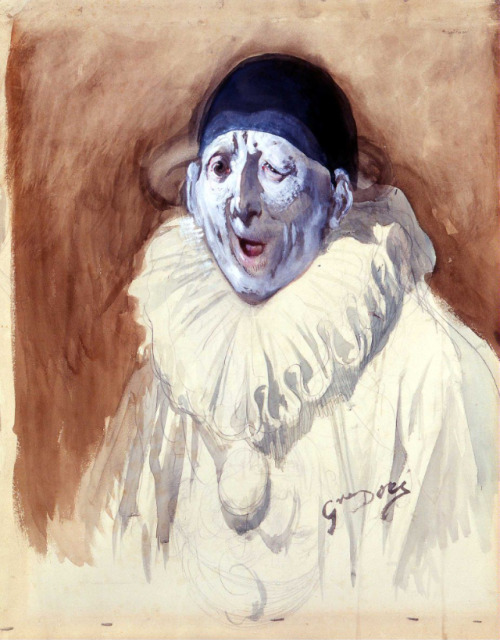
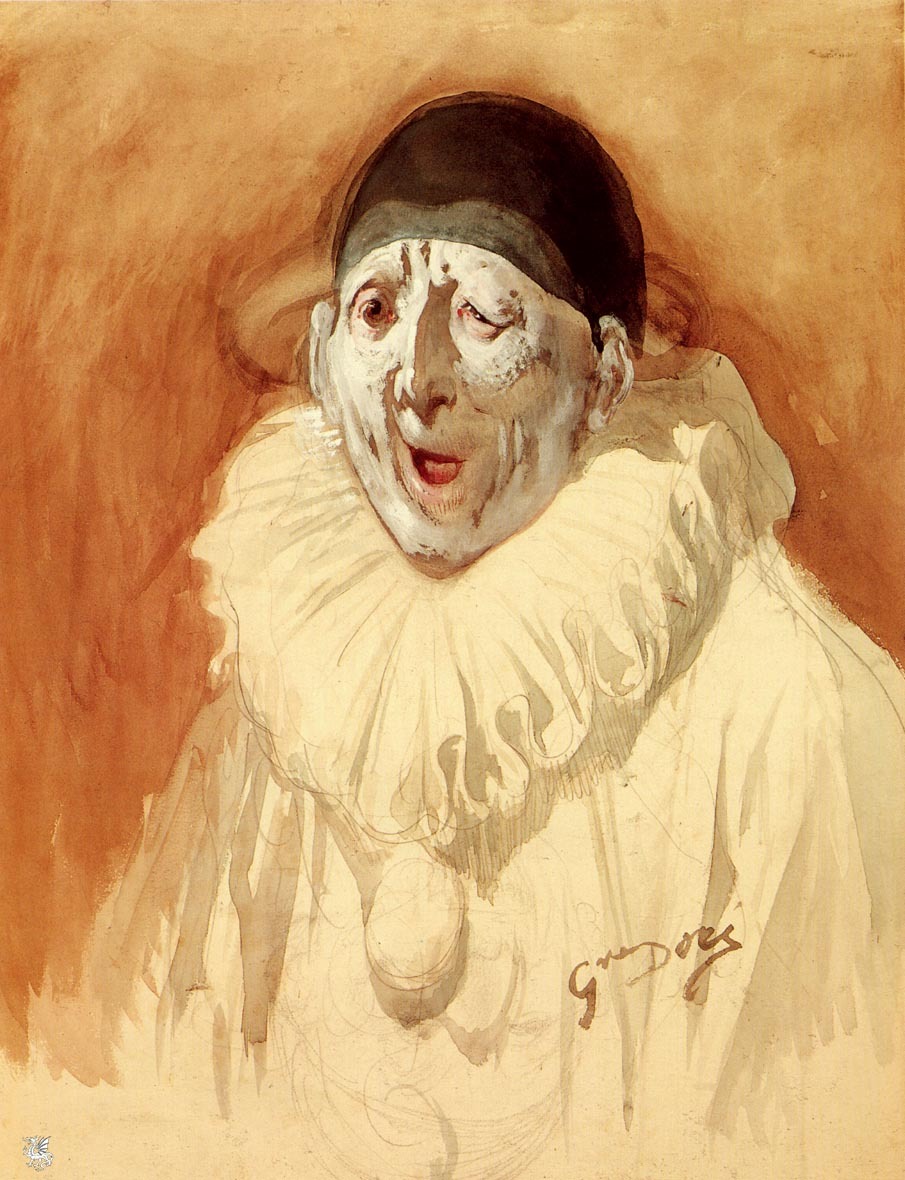
Pierrot grimacing


Here are two images of the painting Pierrot grimaçant (Pierrot Grimacing) by Gustave Doré, located in Strasbourg at the Musée d’Art moderne et contemporain. This undated work is said to be a self-portrait of Doré in clown form, but I don't understand why. Isn't there something beautifully, nauseatingly deformed about this Pierrot? Or perhaps it's a spiritual self-portrait. It is certainly a portrait of some spiritual part of me.

Incidentally (or perhaps not), this painting has been uploaded to WikiArt under the incorrectly translated title, Pierrot Grin. As anyone who is still following this blog after three years of silence will be aware, correcting mistranslated titles is my sole reason for being. So my motivation for posting this here is to hijack searches for Pierrot Grin and correct the misinformation!

I may as well also mention that I have been reposting nice things posted by others on my tumblr, which you can find here: http://putonflesh.tumblr.com. Every time the moon is in Pisces I also post some original poetry or photography there.

Portrait of Gustave Doré on woodburytype, 1870s, unknown phographer. Source.


09 July 2013

The Appetitive Soul


Two pages from The Cardboard Valise by Ben Katchor.  Click to enlarge.
Ben Katchor, from The Cardboard Valise


From Plato's Phaedrus:
Of the nature of the soul, though her true form be ever a theme of large and more than mortal discourse, let me speak briefly, and in a figure. And let the figure be composite--a pair of winged horses and a charioteer. Now the winged horses and the charioteers of the gods are all of them noble and of noble descent, but those of other races are mixed; the human charioteer drives his in a pair; and one of them is noble and of noble breed, and the other is ignoble and of ignoble breed; and the driving of them of necessity gives a great deal of trouble to him. ...The soul in her totality has the care of inanimate being everywhere, and traverses the whole heaven in divers forms appearing--when perfect and fully winged she soars upward, and orders the whole world; whereas the imperfect soul, losing her wings and drooping in her flight at last settles on the solid ground.
...
The chariots of the gods in even poise, obeying the rein, glide rapidly; but the [mortals] labour, for the vicious steed goes heavily, weighing down the charioteer to the earth when his steed has not been thoroughly trained:--and this is the hour of agony and extremest conflict for the soul.
...
The right-hand horse is upright and cleanly made; he has a lofty neck and an aquiline nose; his colour is white, and his eyes dark; he is a lover of honour and modesty and temperance, and the follower of true glory; he needs no touch of the whip, but is guided by word and admonition only. The other is a crooked lumbering animal, put together anyhow; he has a short thick neck; he is flat-faced and of a dark colour, with grey eyes and blood-red complexion; the mate of insolence and pride, shag-eared and deaf, hardly yielding to whip and spur. Now when the charioteer beholds the vision of love, and has his whole soul warmed through sense, and is full of the prickings and ticklings of desire, the obedient steed, then as always under the government of shame, refrains from leaping on the beloved; but the other, heedless of the pricks and of the blows of the whip, plunges and runs away, giving all manner of trouble to his companion and the charioteer, whom he forces to approach the beloved and to remember the joys of love. They at first indignantly oppose him and will not be urged on to do terrible and unlawful deeds; but at last, when he persists in plaguing them, they yield and agree to do as he bids them.

And now they are at the spot and behold the flashing beauty of the beloved; which when the charioteer sees, his memory is carried to the true beauty, whom he beholds in company with Modesty like an image placed upon a holy pedestal. He sees her, but he is afraid and falls backwards in adoration, and by his fall is compelled to pull back the reins with such violence as to bring both the steeds on their haunches, the one willing and unresisting, the unruly one very unwilling; and when they have gone back a little, the one is overcome with shame and wonder, and his whole soul is bathed in perspiration; the other, when the pain is over which the bridle and the fall had given him, having with difficulty taken breath, is full of wrath and reproaches, which he heaps upon the charioteer and his fellow-steed, for want of courage and manhood, declaring that they have been false to their agreement and guilty of desertion. Again they refuse, and again he urges them on, and will scarce yield to their prayer that he would wait until another time. When the appointed hour comes, they make as if they had forgotten, and he reminds them, fighting and neighing and dragging them on, until at length he, on the same thoughts intent, forces them to draw near again. And when they are near he stoops his head and puts up his tail, and takes the bit in his teeth. and pulls shamelessly. Then the charioteer is worse off than ever; he falls back like a racer at the barrier, and with a still more violent wrench drags the bit out of the teeth of the wild steed and covers his abusive tongue and jaws with blood, and forces his legs and haunches to the ground and punishes him sorely. And when this has happened several times and the villain has ceased from his wanton way, he is tamed and humbled, and follows the will of the charioteer, and when he sees the beautiful one he is ready to die of fear. And from that time forward the soul of the lover follows the beloved in modesty and holy fear.

What is beneath the tunic of the charioteer of the gods, who drives two white horses? 


Giulio Romano, Chariot of the Sun, 1527
Palazzo Te, Mantua, Italy

24 February 2013

Chess

Having become somewhat weary of the curatorial life, I have been preparing something new.  Still, one cannot always resist the impulse to organize and to collate.

The text below comes from John Locke's Essay Concerning Human Understanding, which can be found online in its entirety here.


A company of chess-men, standing on the same squares of the chess-board where we left them, we say they are all in the same place, or unmoved, though perhaps the chess-board hath been in the mean time carried out of one room into another; because we compared them only to the parts of the chess-board, which keep the same distance one with another. The chess-board, we also say, is in the same place it was...

Andy Warhol, Chess Player, 1954

In the chess-board, the use of the designation of the place of each chess-man being determined only within that chequered piece of wood, it would cross that purpose to measure it by anything else; but when these very chess-men are put up in a bag, if any one should ask where the black king is, it would be proper to determine the place by the part of the room it was in, and not by the chess-board.
Max Ernst and Dorothea Tanning Playing Chess
Max Ernst and Dorothea Tanning Playing Chess, 1948 - Source unknown


So if any one should ask, in what place are the verses which report the story of Nisus and Euryalus, it would be very improper to determine this place, by saying, they were in such a part of the earth, or in Bodley's library: but the right designation of the place would be by the parts of Virgil's works; and the proper answer would be, that these verses were about the middle of the ninth book of his AEneids, and that they have been always constantly in the same place ever since Virgil was printed: which is true, though the book itself hath moved a thousand times, the use of the idea of place here being, to know in what part of the book that story is, that so, upon occasion, we may know where to find it, and have recourse to it for use.

 Dorothea Tanning, End Game, 1944

26 April 2012

First Works

WikiPaintings allows visitors to view all works by a given artist in chronological order.  The Salvador Dalí "collection" includes paintings dating from 1910, when the artist was 6 years old.  Moving forward in time, Dalí's predecessors show their faces one after another.  This leads to the invention of a game: begin at the beginning and move forward until you come across a work in which you can perceive nothing but the artist's own style.  Call this the First Work.

Salvador Dalí, The Station at Figueras, 1926
Salvador Dalí, The Station at Figueras, 1926, age 22

(The shadows, the shadowy figures, the desolate landscape of unexplained shapes, the trees obviously preparing for The Persistence of Memory.  If, in the application of paint, there is not yet Dalí, neither is there anyone else in particular [so far as is evident from the picture].)
Of course, there can be no winning this game.  Disputation can only lead further discovery.  If you, readers, decide to play this game, comment here with your findings.  I will perhaps post them, and more of my own, in future posts.

Another suggestion:

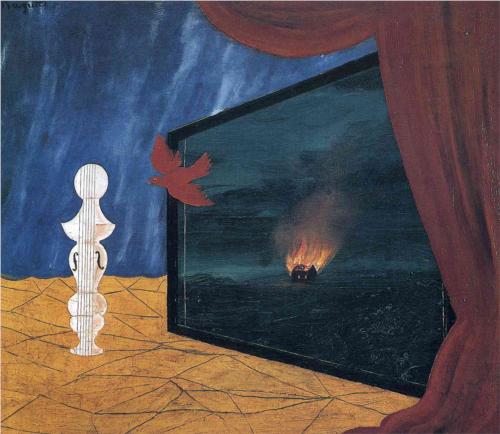
René Magritte, Nocturne, 1925
René Magritte, Nocturne, 1925, age 27

11 February 2012

The Faces of Alexei Korzukhin

Alexei Korzukhin, Russian realist painter, 1835–1894. Wikipedia styles his portraits as "generally accepted as masterpieces of Russian portrait painting." Some highlights from a timeline on rusartnet:

  • Born to a family of gold panners at Uktussky Zavod near Ekaterinburg (1835).
  • One of the rebellious fourteen students who refused to paint the set topic in the competition for a major gold medal and resigned from the Imperial Academy of Arts with the title of second-class artist (1863).
[It isn't clear what the "set topic" was, but it seems the group was protesting the strict guidelines and divisions between high and low art that the Imperial Academy endorsed. They wanted to make art more accessible to the masses, and after leaving the Imperial Academy of Arts founded a collective called the Peredvizhniki, or The Wanderers, which later became the Society for Travelling Art Exhibitions. Evidently Korzukhin was a member of the society but did not participate in the exhibitions. More here, and, of course, here.]
  • Suffered from nervous shock and poor health after witnessing the assassination of Tsar Alexander II on the Ekaterinburg Canal in St Petersburg (1881).
Master of portraiture thought Korzukhin may be, the extent of his mastery is more clearly evident in his portrayal of faces in action. Examples below, with details. Click on the full paintings for large versions.


Separation, 1872


Alexei Korzukhin, Separation, 1872

Alexei Korzukhin, Separation, 1872, detail


Before Confession, 1877


Alexei Korzukhin, Before confession, 1877

Alexei Korzukhin, Before confession, 1877, deatil

Alexei Korzukhin, Before confession, 1877, deatil


Peasant Girls in a Forest, 1878


Alexei Korzukhin, Peasant Girls in a Forest, 1878

Alexei Korzukhin, Peasant Girls in a Forest, 1878, detail


In a Monastic Hotel, 1882


Alexei Korzukhin, In a Monastic Hotel, 1882

Alexei Korzukhin, In a Monastic Hotel, 1882, detail


The Sunday, 1884


Alexei Korzukhin, The Sunday, 1884

Alexei Korzukhin, The Sunday, 1884, detail


There Goes Petrushka, 1888


Alexei Korzukhin, There Goes Petrushka, 1888

Alexei Korzukhin, There Goes Petrushka, 1888, detail

15 October 2011

Sterility, mental and physical

I apologize to the readers of altarpiece for its state of disrepair. I have begun a Ph.D. program in philosophy, so I spend most of my time thinking about things that are not suitable for presentation here. I'll try to keep posting as I can, but really altarpiece-style posts will probably become more rare (if that's possible).

Yesterday I went to Pittsburgh's Andy Warhol Museum. Here is the only image I've been able to find online of my favorite piece there:

Andy Warhol - Jean-Michel Basquiat, 1984Jean-Michel Basquiat. Andy Warhol, 1984.

In reality it's about 8 feet tall. Each limb section has a different grain, a different texture. The color is reminiscent of x-ray images.

I was captivated by this, and stood looking at it for an embarrassingly long time, from different parts of the room. Basquiat's left arm in two positions gives the impression of a captured movement, is also reminiscent of da Vinci's Vitruvian Man. The pose is Michaelangelo's David.


The x-ray quality combined with the pasted together panels gives the impression of resurrection.

I asked myself whether I would have been so interested in the portrait if it hadn't been Basquiat. The head is the most awkwardly attached limb. The contrast is starker, the seam is more exact and thus more distracting. It's only the head the objects to its positioning. The tension between the head and the body reminds me of the tension between life and self. But it doesn't detract from the beauty of the human body, which doesn't seem to be the least bit disturbed by being cut up and put back together.

28 July 2011

Hogs is hogs

Charles Jacque - Le Retour du BergerLe Retour du Berger, Charles Jacque (1879-1959)
A scene of uncommon hilarity from Cormac McCarthy in Outer Dark:

On a good spring day he paused to rest at the side of the road. He had been walking for a long time and he had been hearing them for a long time before he knew what the sound was, a faint murmurous droning portending multitudes, locusts, the advent of primitive armies. He rose and went on until he reached the gap in the ridge and before long he could see the first of them coming along the road below him and then suddenly the entire valley was filled with hogs, a weltering sea of them that came smoking over the dusty plain and flowed undiminished into the narrows of the cut, fanning on the slopes in ragged shoals like the harried outer guard of schooled fish and here and there upright and cursing among them and laboring with poles the drovers, gaunt and fever-eyed with incredible rag costumes and wild hair.
     Holme left the road and clambered up the rocky slope to give them leeway. The first of the drovers was beating his way obliquely across the herd toward him, the hogs flaring and squealing and closing behind him again like syrup. When he gained the open ground he came along easily, smiling up to where Holme sat on a rock with his feet dangling and looking down with no little wonder at this spectacle. hog drovers
     Howdy neighbor, called out the drover. Sweet day, ain't she?
     It is, he said. Whereabouts are ye headed with them hogs if you don't care for me astin?
     Crost the mountain to Charlestown.
     Holme shook his head reverently. That there is the damndest sight of hogs ever I seen, he said. How many ye got?
     The drover had come about the base of the rock and was now standing looking down with Holme at the passing hogs. God hisself don't know, he said solemnly.
     Well it's a bunch.
     They Lord, said the drover, they just now commencin to come in sight. He passed his stave from the crook of one arm to the other and cocked one foot on the ledge of rock, his sparse whiskers fluttering in the mountain wind, leaning forward and watching the howling polychrome tide of hogs that glutted the valley from wall to wall as might any chance traveler a thing of interest.
     They's more than one mulefoot in that lot, he said.
     What?
     Mulefoot. I calculate they's several hunnerd head of them alone and they ain't no common hog to come upon.
     What's a mulefoot? Holme said.
     The drover squinted professionally. Mountain hog from north of here. You ain't never seen one?
     No.
     Got a foot like a mule.
     You mean they ain't got a split hoof?
     Nary split to it.
     I ain't never seen no such hog as that, Holme said.
     I ain't surprised, the drover said. But ye can see one here if you've a mind to.
     I'd admire to, Holme said.
     The drover shifted his stave again. Seems like that don't agree with the bible, what would you say?
     About what?
     About them hogs. Bein unclean on account of they got a split foot.
     I ain't never heard that, Holme said.
     I heard it preached in a sermon one time. Feller knowed right smart about the subject. Said the devil had a foot like a hog's. He laid claim it was in the bible so I reckon it's so.
     I reckon.
     He said a jew wouldn't eat hogmeat on account of it.
     What's a jew?
     That's one of them old-timey people from in the bible. But that still don't say nothin about a mulefoot hog does it? What about him?
     I don't know, Holme said. What about him?
     Well is he a hog or ain't he? Accordin to the bible.
     I'd say a hog was a hog if he didn't have nary feet a-tall.
     I might do it myself, the drover said, because if he was to have feet you'd look for em to be hog's feet. Like if ye had a hog didn't have no head you'd know it for a hog anyways. But if ye seen one walkin around with a mule's head on him ye might be puzzled.
     That's true, Holme allowed.
     Yessir. Makes ye wonder some about the bible and about hogs too, don't it?
     Yes, Holme said.
     I've studied it a good deal and I cain't come to no conclusions about it one way or the other.
     No.
     The drover stroked his whiskers and nodded his head. Hogs is a mystery by theyselves, he said. What can a feller know about one? Not a whole lot. I've run with hogs since I was just a shirttail and I ain't never come to no real understandin of em. and I don't doubt but what other folks has had the same experience. A hog is a hog. Pure and simple. And that's about all ye can say about him. And smart, don't think they ain't. Smart as the devil. And don't be fooled by one that ain't got nary clove foot cause he's devilish too.
     I guess hogs is hogs, Holme said.
     The drover spat and nodded. That's what I've always maintained, he said.


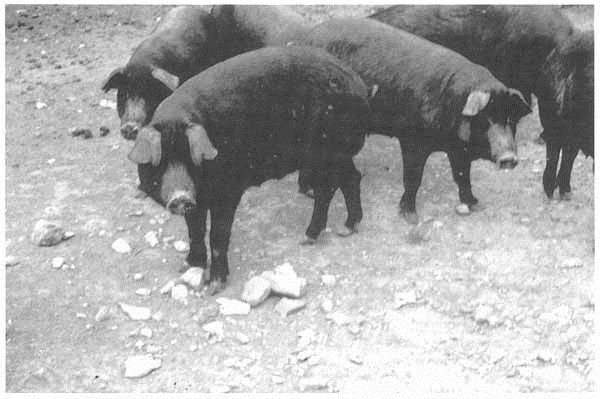
mulefoot hogs “The last remaining herd of Mulefoot Hogs in the USA has been conserved by an individual farmer.” [source]


“Hog Drovers” as sung by Ollie Gilbert, Mountain View, Arkansas on October 28, 1969. [source] [see also]


Charles Joshua Chaplin - Le porcher Le Porcher, Charles Joshua Chaplin (1825-1891)

17 May 2011

Part II: The Sea

The following is the second part of a multi-part post. The post can stand alone, but if you would like to begin at the beginning, click here for Part I.

Socrates: The awe which I always feel, Protarchus, about the names of the gods is more than human--it exceeds all other fears.


&

Roy_Lichtenstein_Drowning_Girl 1963

IV. Death by Water
Phlebas the Phoenician, a fortnight dead,
Forgot the cry of gulls, and the deep sea swell
And the profit and loss.
A current under sea
Picked his bones
in whispers. As he rose and fell
He passes the stages of his age and youth
Entering the whirlpool.
Gentile or Jew
O you who turn the wheel and look windward,
Consider Phlebas, who was once handsome and tall as you.

Roy Lichtenstein, Drowning Girl, 1963

A Reefnetter's Paean to the Sea by Tyree Callahan(source)


Tiresias: If I did not know at least this, I would not be a priest. Take a boy who bathes in the Asopus. It is a summer morning. The boy comes out of the water, goes back in happily, dives and dives again, then he is taken ill and drowns. What do the gods have to do with this? Should he attribute his end to the gods or else the pleasure he enjoyed? Neither the one nor the other. Something happened––which is neither good nor evil, something which has no name––then the gods will give it a name.

Oedipus: And to give a name, to explain things, seems little to you, Tiresias?

Tiresias: You are young, Oedipus, and like the gods who are young you yourself clear up things and name them. You still don’t know that beneath the earth there is stone, and that the bluest sky is the emptiest. For him who like me does not see, all things are a blow, nothing else.

--From “The Blind,” a dialogue by Cesare Pavese


Jacob Isaakszoon van Ruisdael - Rough Sea at a Jetty 1650s Jacob Isaakszoon van Ruisdael, Rough Sea at a Jetty, c. 1650


07 September 2010

I expose myself to that risk voluntarily.

I have but one passion: to enlighten those who have been kept in the dark, in the name of humanity which has suffered so much and is entitled to happiness. My fiery protest is simply the cry of my very soul. Let them dare, then, to bring me before a court of law and let the enquiry take place in broad daylight! I am waiting.

- Émile Zola, J'accuse!


Painting: The Prisoner by Nikolai Alexandrovich Yaroshenko, 1878
"The Prisoner" by Nikolai Alexandrovich Yaroshenko, 1878 [1]


A man cannot live intensely except at the cost of the self. Now the bourgeois treasures nothing more highly than the self (rudimentary as his may be). And so at the cost of intensity he achieves his own preservation and security. His harvest is a quiet mind which he prefers to being possessed by God, as he does comfort to pleasure, convenience to liberty, and a pleasant temperature to that deathly inner consuming fire.

- Hermann Hesse, Steppenwolf


Painting: Zola Insulted by Henry de Groux
"Zola Insulted" by Henry de Groux, date unknown [2]


It appears to be an inborn and imperative need of all men to regard the self as a unit. However often and however grievously this illusion is shattered, it always mends again. The judge who sits over the murderer and looks into his face, and at one moment recognizes all the emotions and potentialities of the murderer in his own soul and hears the murderer's voice as his own, is at the next moment one and indivisible as the judge, and scuttles back into the shell of his cultivated self and does his duty and condemns the murderer to death. And if ever the suspicion of their manifold being dawns upon men of unusual powers and of unusually delicate perceptions, so that, as all genius must, they break through the illusion of the unity of the personality and perceive that the self is made up of a bundle of selves, they have only to say so and at once the majority puts them under lock and key, calls science to aid, establishes schizomania and protects humanity from the necessity of hearing the cry of truth from the lips of these unfortunate persons.

- Hermann Hesse, Steppenwolf


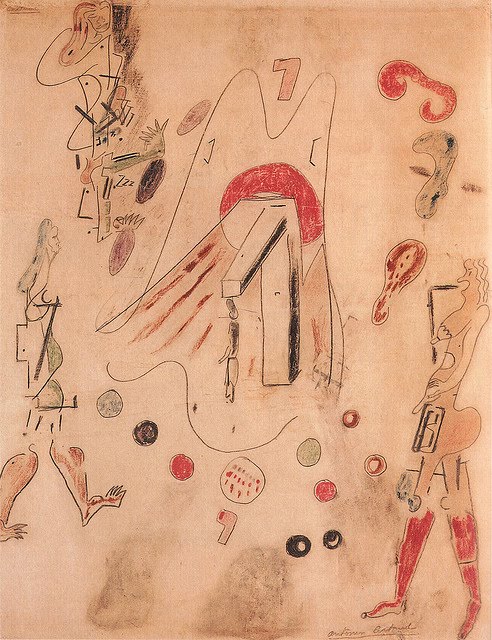
Antonin Artaud, La Pendue (The Hanged), 1945
"La Pendue" ("The Hanged") by Antonin Artaud, 1945 [3]


[1] Image taken from this page, where an oddly-phrased comment is good for a laugh: "[Yaroshenko's] genre paintings depict torture, struggles, fruit, bathing suits, and other hardships faced in Russia."

[2] From Dreyfus Rehabilitated: "painting by Henri Degroux depicting the hatred of the masses, a present to the writer from his admirers".

[3] Image taken from an excellent blog called A Journey Round My Skull; includes a link to a larger version of the image.

19 June 2010

Schiele, Miller, Matisse

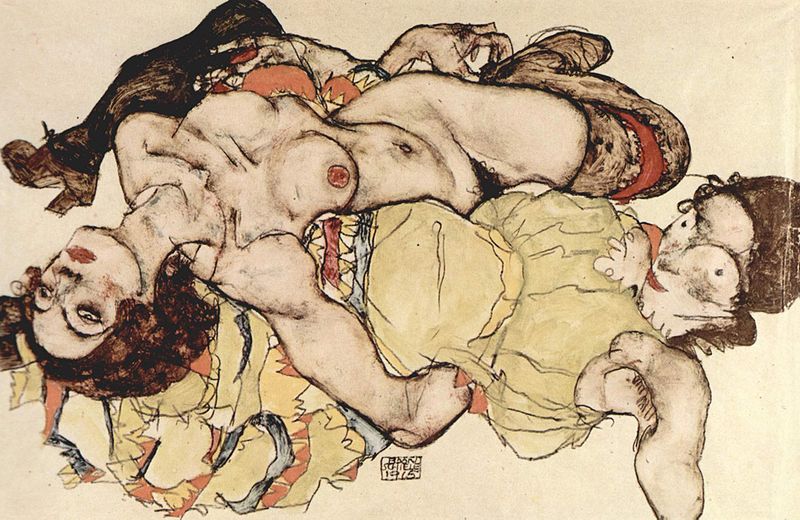
Egon Schiele, Zurückgelehnte Frau, or Two Women, 1915

I have never seen a place like Paris for varieties of sexual provender. As soon as a woman loses a front tooth or an eye or a leg she goes on the loose. In America she'd starve to death if she had nothing to recommend her but a mutilation. Here it is different. A missing tooth or a nose eaten away or a fallen womb, any misfortune that aggravates the natural homeliness of the female, seems to be regarded as an added spice, a stimulant for the jaded appetites of the male.

I am speaking naturally of that world which is peculiar to the big cities, the world of men and women whose last drop of juice has been squeezed out by the machine--the martyrs of modern progress. It is this mass of bones and collar buttons which the painter finds so difficult to put flesh on.

henri matisse, la bonheur de vivre (the joy of life), 1906
Henri Matisse, La Bonheur de Vivre (The Joy of Life), 1906

It is only later, in the afternoon, when I find myself in an art gallery on the Rue de Sèze, surrounded by the men and women of Matisse, that I am drawn back again to the proper precincts of the human world. On the threshold of that big hall whose walls are now ablaze, I pause a moment to recover from the shock which one experiences when the habitual gray of the world is rent asunder and the color of life splashes forth in song and poem. I find myself in a world so natural, so complete, that I am lost.
[...]
In every poem by Matisse there is the history of a particle of human flesh which refused the consummation of death. The whole run of flesh, from hair to nails, expresses the miracle of breathing, as if the inner eye, in its thirst for a greater reality, had converted the pores of the flesh into hungry seeing mouths. [...] He is a bright sage, a dancing seer who, with a sweep of the brush, removes the ugly scaffold to which the body of man is chained by the incontrovertible facts of life. He it is, if any man today possesses the gift, who knows where to dissolve the human figure, who has the courage to sacrifice an harmonious line in order to detect the rhythm and murmur of the blood, who takes the light that has been refracted inside him and lets it flood the keyboard of color. Behind the minutiae, the chaos, the mockery of life, he detects the invisible pattern; he announces his discoveries in the metaphysical pigment of space.


Henri Matisse, La Leçon de Musique (The Music Lesson), 1917


Text: Henry Miller, Tropic of Cancer

16 June 2010

The Storm & The Calm

gustave courbet the calm sea
Gustave Courbet, The Calm Sea


After brief search, I was unable to find John Donne's The Storm and The Calm presented together anywhere online. The Calm appears to be more famous than The Storm, though the two form a sort of poetic diptych. In the versions presented below (in which the English has been modernized), I have taken the liberty of emboldening several of my favorite passages.

===

(To Mr. Christopher Brooke)

The Storm

Thou which art I, ('tis nothing to be so)
Thou which art still thyself, by these shalt know
Part of our passage; and, a hand, or eye
By Hilliard drawn, is worth an history,
By a worse painter made; and (without pride)
When by thy judgment they are dignified,
My lines are such: 'tis the preeminence
Of friendship only to impute excellence.
England to whom we owe, what we be, and have,
Sad that her sons did seek a foreign grave
(For, Fate's, or Fortune's drifts none can soothsay,
Honour and misery have one face and way)
From out her pregnant entrails signed a wind
Which at th' air's middle marble room did find
Such strong resistance, that itself it threw
Downard again; and so when it did view
How in the port, our fleet dear time did leese,
Withering like prisoners, which lie but for fees,
Mildly it kissed our sails, and, fresh and sweet,
As to a stomach starved, whose insides meet,
Meat comes, it came; and swole our sails, when we
So joyed, as Sara her swelling joyed to see.
But 'twas but so kind, as our countrymen,
Which bring friends one day's way, and leave them then.
Then like two mighty kings, which dwelling far
Asunder, meet against a third to war,
The south and west winds joined, and, as they blew,
Waves like a rolling trench before them threw.
Sooner than you read this line, did the gale,
Like a shot, not feared till felt, our sails assail;

And what at first was called a gust, the same

Hath now a storm's, anon a tempest's name.

Jonas, I pity thee, and curse those men,

Who when the storm raged most, did wake thee then;

Sleep is pain's easiest salve, and doth fulfil

All offices of death, except to kill.

But when I waked, I saw, that I saw not.

I, and the sun, which should teach me had forgot

East, west, day night, and I could only say,

If the world had lasted, now it had been day.

Thousands our noises were, yet we 'mongst all
Could none by his right name, but thunder all:
Lightning was all our light, and it rained more
Than if the sun had drunk the sea before.
Some coffined in their cabins lie, equally
Grieved that they are not dead, and yet must die.
And as sin-burdened souls from graves will creep,
At the last day, some forth their cabins peep:
And tremblingly ask what news, and do hear so,
Like jealous husbands, what they would not know.
Some sitting on the hatches, would seem there,
With hideous gazing to fear away fear.
Then note they the ship's sicknesses, the mast
Shaked with this ague, and the hold and waist
With a salt dropsy clogged, and all our tacklings
Snapping, like too high stretched treble strings.
And from our tottered sails, rags drop down so,
As from one hanged in chains, a year ago.
Even our ordnance placed for our defence,
Strive to break loose, and 'scape away from thence.
Pumping hath tired our men, and what's the gain?
Seas into seas thrown, we suck in again;
Hearing hath deafed our sailors; and if they
Knew how to hear, there's none knows what to say.
Compared to these storms, death is but a qualm,
Hell somewhat lightsome, and the Bermuda calm.
Darkness, light's elder brother, his birth-right
Claims o'er this world, and to heaven hath chased light.
All things are one, and that one none can be,
Since all forms, uniform deformity
Doth cover, so that we, except God say
Another Fiat, shall have no more day.
So violent, yet long these furies be,
That though thine absence starve me, I wish not thee.


***

The Calm

Our storm is past, and that storm's tyrannous rage,
A stupid calm, but nothing it, doth 'suage.
The fable is inverted, and far more
A Block afflicts, now, than a stork before.
Storms chafe, and soon wear out themselves, or us;
In calms, heaven laughs to see us languish thus.
As steady as I can wish, that my thoughts were,
Smooth as thy mistress' glass, or what shines there,
The sea is now. And, as those Isles which we
Seek, when we can move, our ships rooted be.
As water did in storms, now pitch runs out
As lead, when a fired church becomes one spout.
And all our beauty, and our trim, decays,
Like courts removing, or like ended plays.
The fighting place now seamen's rags supply;
And all the tackling is a frippery.
No use of lanthorns; and in one place lay
Feathers and dust, today and yesterday.
Earth's hollownesses, which the world's lungs are,
Have no more wind than the upper vault of air.
We can nor lost friends, nor sought foes recover,
But meteor-like, save that we move not, hover.
Only the calenture together draws
Dear friends, which meet dead in great fishes' maws
And on the hatches as on altars lies
Each one, his own priest, and own sacrifice.
Who live, that miracle do multiply
Where walkers in hot ovens, do not die.
If in despite of these, we swim, that hath
No more refreshing, than our brimstone bath,
But from the sea, into the ship we turn,
Like parboiled wretches, on the coals to burn.
Like Bajazet encaged, the shepherd's scoff,
Or like slack-sinewed Samson, his hair off,
Languish our ships. Now, as a myriad
Of ants, durst th' Emperor's loved snake invade,
The crawling galleys, sea-goals, finny chips,
Might brave our Venice's, now bed-rid ships.
Whether a rotten state, and hope of gain,
Or to disuse me from the queasy pain
Of being beloved, and loving, or the thirst
Of honour, or fair death, out pushed me first,
I lose my end: for here as well as I
A desperate may live, and a coward die.
Stag, dog, and all which from, or towards flies,
Is paid with life, or prey, or doing dies.
Fate grudges us all, and doth subtly lay
A scourge, 'gainst which we all forget to pray,
He that at sea prays for more wind, as well
Under the poles may beg cold, heat in hell.
What are we then? How little more alas
Is man now, than before he was! he was
Nothing; for us, we are for nothing fit;
Chance, or ourselves still disproportion it.
We have no power, no will, no sense; I lie,
I should not then thus feel this misery.


john donne

27 February 2009

The Face of Post-Impressionism


a) Paul Gauguin

b) Henri Rousseau

d) Paul Signac


d) Henri Matisse

e) Vincent van Gogh

f) Émile Bernard
g) Paul Cézanne
h) Odilon Redon
i) Henri de Toulouse-Lautrec