Showing posts with label art. Show all posts

17 April 2011

Black, white, gangrene


Sara Hayward, "Two Figures I," 2011.

The following is excerpted from "Poetry Black, Poetry White", an essay by René Daumal. When you are done with this post, please read the whole thing: click here!

René Daumal, Mount Analogue cover
The black poet tastes every pleasure, adorns himself in every ornament, exercises every power - in his imagination. The white poet prefers reality, even paltry reality, to these rich lies. His work is an incessant struggle against pride, imagination and laziness. Accepting his gift, even if he suffers from it and suffers from suffering, he seeks to make it serve ends greater than his selfish desires: the as-yet-unknown cause of this gift.

...

Every poem is born of a seed, dark at first, which we must make luminous for it to produce fruits of light. ... To make it shine, one must create silence, for this seed is the Thing-to-be-said itself, the central emotion that seeks to express itself through my whole machine. ... Silence to word games, memorized lines, memories fortuitously assembled; silence to ambition, to the desire to shine - for only light shines by itself; silence to self-flattery and self-pity; silence to the rooster who thinks he makes the sun rise! ... It is very difficult, but each little effort receives a little glimmer of light in reward. The Thing-to-be-said then appears in its most intimate form, as an eternal certainty - a pinpoint of light containing the immensity of the desire for Being.

...

I have said what one must do to become a white poet. As if it were that easy! Even in prose, in ordinary speech and writing (as in all aspects of my daily life), all that I produce is grey, salt-and-pepper, soiled, a mixture of light and darkness. And so I take up the struggle after the fact. I re-read myself. In my sentences, I see words, expressions, interferences that do not serve the Thing-to-be-said: an image that meant to be strange, a pun that thought it was funny, the pedantry of a certain prig who would do better to stay seated at his desk instead of coming to play the fipple flute in my string quartet. And remarkably enough, it is simultaneously a mistake in taste, style, or even syntax. Language itself seems set up in such a way as to detect the intruders for me. Few mistakes are purely technical. Almost all of them are my mistakes. And I cross out, and I correct, with the joy one can have at cutting a gangrenous limb from one's body.


Jean Cocteau:

A true poet does not bother to be poetical. Nor does a nursery gardener scent his roses. What he does is to subject them to treatment which ensures their having the finest colour and the sweetest scent.

and

The poet doesn't invent. He listens.


(The first quote is from, at least, Professional Secrets. I haven't been able to source the second one precisely, but it's mentioned in an interview Cocteau gave for the Paris Review, published in 1964, and Cocteau does not disagree that he said it. The interview can (and must!) be read in its entirety here. As with everything Cocteau touches, it's full of truth and magic.)


Matthias Grünewald, Isenheim Altarpiece, crucifixion, Christ with gangrene
From Matthias Grünewald's "Isenheim Altarpiece", 1506-1515

Holy Sonnet IV.

O, my black soul, now thou art summoned
By sickness, Death's herald and champion ;
Thou'rt like a pilgrim, which abroad hath done
Treason, and durst not turn to whence he's fled ;
Or like a thief, which till death's doom be read,
Wisheth himself deliver'd from prison,
But damn'd and haled to execution,
Wisheth that still he might be imprisoned.
Yet grace, if thou repent, thou canst not lack ;
But who shall give thee that grace to begin ?
O, make thyself with holy mourning black,
And red with blushing, as thou art with sin ;
Or wash thee in Christ's blood, which hath this might,
That being red, it dyes red souls to white.

--John Donne

Matthias Grünewald, Isenheim Altarpiece, crucifixion, detail
Detail from Isenheim Altarpiece. Click for enlarged version. Incidentally, the filename is failureisnotanoption.jpg. That's how I found it; I thought it was funny so I left it that way.

19 June 2010

Schiele, Miller, Matisse

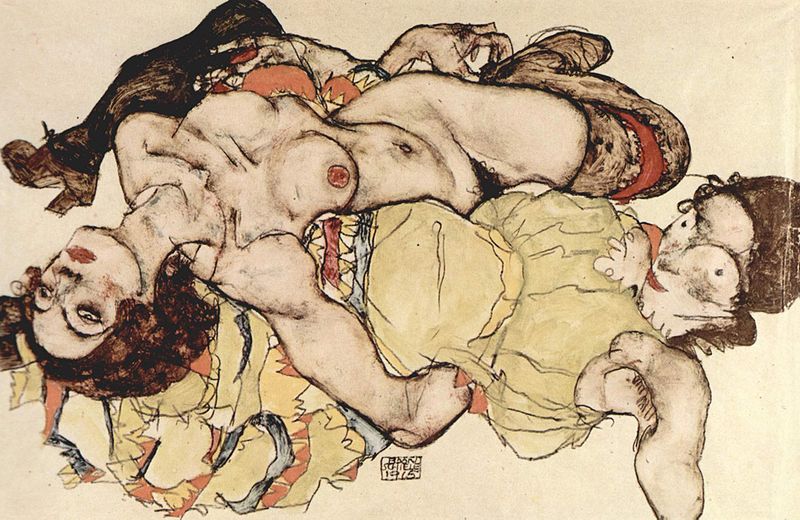
Egon Schiele, Zurückgelehnte Frau, or Two Women, 1915

I have never seen a place like Paris for varieties of sexual provender. As soon as a woman loses a front tooth or an eye or a leg she goes on the loose. In America she'd starve to death if she had nothing to recommend her but a mutilation. Here it is different. A missing tooth or a nose eaten away or a fallen womb, any misfortune that aggravates the natural homeliness of the female, seems to be regarded as an added spice, a stimulant for the jaded appetites of the male.

I am speaking naturally of that world which is peculiar to the big cities, the world of men and women whose last drop of juice has been squeezed out by the machine--the martyrs of modern progress. It is this mass of bones and collar buttons which the painter finds so difficult to put flesh on.

henri matisse, la bonheur de vivre (the joy of life), 1906
Henri Matisse, La Bonheur de Vivre (The Joy of Life), 1906

It is only later, in the afternoon, when I find myself in an art gallery on the Rue de Sèze, surrounded by the men and women of Matisse, that I am drawn back again to the proper precincts of the human world. On the threshold of that big hall whose walls are now ablaze, I pause a moment to recover from the shock which one experiences when the habitual gray of the world is rent asunder and the color of life splashes forth in song and poem. I find myself in a world so natural, so complete, that I am lost.
[...]
In every poem by Matisse there is the history of a particle of human flesh which refused the consummation of death. The whole run of flesh, from hair to nails, expresses the miracle of breathing, as if the inner eye, in its thirst for a greater reality, had converted the pores of the flesh into hungry seeing mouths. [...] He is a bright sage, a dancing seer who, with a sweep of the brush, removes the ugly scaffold to which the body of man is chained by the incontrovertible facts of life. He it is, if any man today possesses the gift, who knows where to dissolve the human figure, who has the courage to sacrifice an harmonious line in order to detect the rhythm and murmur of the blood, who takes the light that has been refracted inside him and lets it flood the keyboard of color. Behind the minutiae, the chaos, the mockery of life, he detects the invisible pattern; he announces his discoveries in the metaphysical pigment of space.


Henri Matisse, La Leçon de Musique (The Music Lesson), 1917


Text: Henry Miller, Tropic of Cancer

18 December 2009

Food

The following is reposted from http://erinhooley.blogspot.com/.
Erin's remarkable portfolio is: heavyglow.com.


Why do people always donate food to homeless shelters that they themselves would never eat?

02 September 2009

A Career

(a: 1863)

Rodin working on the bust of Father Eymard, from http://www.musee-rodin.fr/sjeun-e.htm

(b)

Rodin in his studio at Medoun. © Harlingue-Viollet, Paris, from http://www.rodin-art.com/

28 July 2009

Re: Becoming Nothing

What follows is a letter I received from the author of the italicized text in the previous post, "Becoming Nothing". Reader responses posted here will be forwarded to the author.

Dear -------,

I wanted to submit a few remarks in response to the comments of mine that you included in the previous exhibit at Altarpiece. In conjunction with the ideas presented there, I have been plagued by another thought, and, more relevantly, I have been plagued by my own inability to express it. In this particular case it seems that I might benefit from trying to express it clearly to someone who has a hope of understanding. I trust you won’t mind me using you as a sort of test subject in this endeavor, but if you do, stop reading now and discard the letter! In any case, perhaps you will also get something out of my meandering here to include in a future exhibit.

The idea in question began as an intuition, which you posted, regarding the relationship between art and the “real world.” This was the intuition expressed in the phrase, “Politics is [or perhaps it should have been ‘are’] a lame substitute for art.” What I had in mind was the ability of art to transform the state of humanity, to create better worlds by virtue of its ability to awaken truths that lie dormant in our spirits. Art is direct democracy imbued with a sense of what is good and true. This, I thought, renders politics unnecessary as a form of representation of art, an unnecessary regulation of a world that man self-regulates through communicative and expressive tools given him at and before birth.

Of course, this all sounds more or less wonderful on paper, but it began to butt heads with reality when I was put upon recently to explain it in the language of “daily life” in conversation. My interlocutor insisted that any system of organization of the exigencies of daily life counts as a political system, for example the working out of how a society’s collective garbage will be dealt with. Art, he argued, simply could not take the place of such necessities.

This argument upset me considerably because, while I could see how it derived from my own remarks, it seemed to miss the point entirely. It seemed to miss the significance of what I was saying, to somehow render banal a point that had begun in my mind as a (subjectively) inspired moment. I couldn’t see how to reconcile this problem, and in fact it appeared to me as merely an instantiation of a general difficulty I had encountered before. Namely, so many of the ideas and principles that are the most important to me are seemingly incompatible with daily reality. The values implied by a commitment to the realms of art and ideas bear no relation to the world inhabited by people. At best they provide some guidelines by which those in positions of comfort can organize their thinking, but even the lives lived by these individuals are not freed of their ultimate constraints. It seems more likely that thought and art have developed into parasites that flourish in the fertile heat and moisture of the first-world intellect. At this point in history we feel deeply the need to reconnect with our own species and not to labor under the illusion that the idea is a creature that serves and depends upon us. We experience a keen drive toward action, which unites us with our immediate, physical realities and brings us back into existence, back into integration with a world we have almost destroyed.

This is a historical pressure that I feel in the same moment that I feel illuminated by the transcendent importance of art in the broadest sense. When I am confronted with the question of how my dream for the world—so full of expression and expressive forms of knowing that politics as we know it no longer fits—relates to the need to dispose of garbage, I am stricken with something like the pain of separation… the realization that my visions, about which I care deeply, do not relate to people, about whom I care deeply. The idea of communicating with and transforming people’s souls is irrelevant and indulgent when people are too abused and too hungry to have souls in the first place. So you can see the depths of confusion into which my friend’s well-meaning criticism plunged me.

I have, however, recently come to a possible solution, or a justification which I would like to submit to both your and my own scrutiny. After a brief chat with another friend about the degree to which the present systems of the world have doomed themselves, we agreed that the human species will probably outlive the impending implosion in some form. We couldn’t escape the inevitability of, at the very least, a sort of Malthusian collapse after the failure or refusal of human ingenuity and compassion to catch up to growing populations and dwindling resources and compromised ecologies and greed. (You and I have discussed this as well in connection with that National Geographic article.) Nevertheless, the total elimination of mankind seems unlikely. We will still be here, and this allowed me to realize that the questions of why and how we are here are becoming more rather than less relevant. Perhaps in order to undertake intellectual and artistic projects in the face of such contagion in the modern world, one has to resign oneself to an almost appalling level of hopelessness.

But even as I write I can sense the weakness in this point of view. Have I so little hope and love for people living now that I have to resort to the apologetics of art as a withered attempt at communication with people who do not yet live? And, you will point out, I have not even addressed the original problem of politics and art. I suppose the only response I can give is to admit with a mixture of pride and shame that, yes, my dream involves such a radical reorganization of life, such a reinvention of the real, that art will supplant even trash collection, that there will be no such thing as trash as we pull ourselves along the rope of existence toward the infinite and the truly meaningful. That almost no one now living can understand this. As for how it will come about I do not know, I guess there will have to be some kind of disaster, or perhaps people can claw their way there slowly through the mud (a process for which, surely, I am not needed).

Art in its broadest sense is not only writing and painting and film, but also every thought and action in which we chip away at the veil between us and everything. Maybe the straight-talk description of this involves all of us sitting in silent meditation from birth, or voluntarily extinguishing the species, or simply living in such a way that we create no excesses like garbage or profit or nations that can’t sustain all their individual voices.

Ultimately I think I would like to distinguish between politics and governance. The governance of things like the way water flows, how food is stored, where information can be found, etc…. these can be artistic acts insofar as they are externalized means of integration with the world—insofar, basically, as they are done selflessly and out of the same duty toward people that the artist-poet feels. This is how politics destroys art and inhabits the resulting void. Politics is the governance of people, the creation of mutes, the belief that we can be spoken-form, the hypnotized agreement of people to remain uninvolved in the creation and exposition of reality.

27 June 2009

Becoming Nothing


Art creates, alters, and reinforces certain aspects of human nature. This fact destroys the notion of art as apolitical. Politics is a lame substitution for art.


times and winds/bes vakit still


Susan Sontag
I have several times applied to the work of art the metaphor of a mode of nourishment. To become involved with a work of art entails, to be sure, the experience of detaching oneself from the world. But the work of art itself is also a vibrant, magical, and exemplary object which returns us to the world in some way more open and enriched.


times and winds/bes vakit still


We are working now to dissolve human nature through art. To achieve an aesthetic experience that does not remove us from ourselves but annuls the self, allowing us to become empty and to merge seamlessly with everything else so that we are everything else.


Robert Musil:
And so, whatever the relationship may be between objects and feeling in the civilized person's mature view of the world, everyone surely knows those ecstatic moments in which a split has not yet occurred, as though water and land had not yet been divided and the waves of feeling still shared the same horizon as the hills and valleys that form the shape of things.


times and winds/bes vakit still


Andrei Tarkovsky:
The allotted function of art is not, as is often assumed, to put across ideas, to propagate thoughts, to serve as example. The aim of art is to prepare a person for death, to plough and harrow his soul, rendering it capable of turning to good.


times and winds/bes vakit still


The pinnacle of human nature is Nature.


[1] [2] [3]

18 June 2009

First Infrarealist Manifesto, English

Update: Since its first publication in 2009, this translation has undergone several minor changes.  To those who have reproduced this text elsewhere on the Internet, I recommend updating it to reflect these changes. (5 April, 2013)

Inspired by Roberto Bolaño's novel The Savage Detectives, and disappointed that I couldn't find one pre-existing, I have attempted a translation of the First Infrarealist Manifesto into English. The original can be found here.

See also an interview with Mario Santiago Papasquiaro, co-founder of Infrarealism.

infrarealism, infrarrealismo, roberto bolaño, mario santiago papasquiaro

-->ABANDON EVERYTHING, AGAIN

first infrarealist manifesto

“It is four light-hours to the end of the solar system; to the nearest star, four light-years. A disproportionate ocean of void. But are we really sure that it is only a void? We only know that in this space there are no bright stars; if they existed, would they be visible? And if there existed bodies neither bright nor dark? Could it not happen on the celestial maps, just as on those of the earth, that the star-cities are indicated and the star-villages omitted?”

-Soviet science fiction writers scratched their faces at midnight.

-The infrasuns (Drummond would say the happy proletarian boys).

-Peguero and Boris alone in a lower class room predicting the miracle behind the door.

-Free Money

*

Who has traversed the city and for music has only had the whistles of his fellows, his own words of amazement and rage?

The handsome type who didn’t know

that a girl’s orgasm is clitoral

(Look, it’s not only in the museums that there’s shit) (A process of individual museification) (Certainly all that has been mentioned, revealed) (Fear of discovering) (Fear of the imbalances not foreseen).

*

Our next of kin:

the snipers, the lone plainsmen who devastate the Chinese cafes of Latin America, the butchers in supermarkets, in their tremendous individual-collective dilemma; the impotence of action and investigation (on the individual level or clouded in aesthetic contradictions) of the poetic act.

*

Tiny bright stars eternally winking at us from a place in the universe called The labyrinths.

-Dancing-Club of misery.

-Pepito Tequila sobbing his love for Lisa Underground.

-He sucks it, you suck it, we suck it. [In Spanish as in English, the verb can be used literally or informally in a derogatory sense.]

-And Horror

*

Curtains of water, cement, or tin separate a cultural mechanism, which serves as both the conscience and the asshole of the ruling class, from a living cultural event, scrubbed clean, in constant death and birth, ignorant of most of history and the fine arts (quotidian creator of its own insane istory and its amazing fyne artz), body that suddenly tests new sensations on itself, product of an epoch in which we approach at 200 kmph the toilet or the revolution.
“New forms, rare forms”, as old Bertolt said, half curious and half smiling.

*

Sensations don’t arise out of nothing (obviousness of obviousnesses), but from a conditioned reality, in a thousand ways, as a constant flow.

-Complex reality makes us seasick!

So, it is possible that in part this is a birth and in part we are in the front row for the death throes. Forms of life and forms of death pass by the retina daily. Their collision constantly gives rise to infrarealist forms: THE EYE OF TRANSITION

*

Put the whole city in the insane asylum. Sweet sister, howling tanks, hermaphrodite songs, diamond deserts, we only live once and every day the visions are bulkier and more slippery. Sweet sister, lifts to Monte Albán. Tighten your belts because the corpses have been watered. A scene of subtraction.

*

And the good bourgeois culture? And academia and the incendiaries? And the vanguards and the rearguards? And certain conceptions of love, good scenery, the precise and multinational Colt?

Like I told Saint-Just in a dream I had once: Even the heads of aristocrats can’t use us as weapons.

*

-A good part of the world is being born and another good part dying, and we all know that we all have to live or we all have to die: in this there is no middle road.

Chirico says: thought must move away from all that which is called logic and good sense, must move away from all human problems, in such a way that things appear under a new aspect, as if illuminated by a constellation appearing for the first time. The infrarealists say: We are going to fill our heads with all human problems, such that things begin to move inside themselves, an extraordinary vision of man.

-The Constellation of the Beautiful Bird.

-The infrarealists propose indigenousness to the world: a crazy and timid Indian.

-A new lyricism, which is starting to rise Latin America, supports itself in ways that never fail to amaze us. The way in to matter is ultimately the way in to adventure: the poem is a journey and the poet is a hero revealing heroes. Tenderness like an exercise in speed. Breathing and heat. The shotgun experience, structures that are devouring themselves, crazy contradictions.

If the poet is mixed up, the reader will have to mix himself up.

“erotic books without spelling

*

The THOUSAND DISMEMBERED AVANT-GARDES OF THE SIXTIES precede us

The 99 open flowers like a smashed-open head

The massacre, the new concentration camps

The White underground rivers, the violet winds

These are hard times for poetry, some say, drinking tea, listening to music in their apartments, talking (listening) to the old masters. These are difficult times for man, we say, turning to the barricades after a full day’s work of shit and tear gas, discovering / creating music even in our apartments, largely overlooking cemeteries-that-spread, where they [sic] despairingly drink a cup of tea or get drunk on pure rage or the inertia of old masters.

HORA ZERO precedes us

((Raise baboons and the hags will bite you)) [Sp: Cría zambos y te picarán los callos]

Still we are in the quaternary era. Are we still in the quaternary era?

Pepito Tequila kisses Lisa Underground’s phosphorescent nipples and watches her leave for a beach on which black pyramids sprout.

*

I repeat:

the poet is a hero revealing heroes, like the fallen red tree that announces the start of the forest.

-The attempts at a consistent ethic-aesthetic are paved with betrayals or pathetic survivals.

-And it is the individual who will be able to walk a thousand kilometers but eventually the road will eat him.

-Our ethic is Revolution, our aesthetic is Life: one-single-thing.

*

For the bourgeoisie and the petit bourgeoisie life is a party. Every weekend they have one. The proletariat doesn’t have parties. Only rhythmic funerals. That is going to change. The exploited will have a grand party. Memory and guillotines. Sensing it, acting it certain nights, inventing edges and humid corners, is like caressing the acidic eyes of the new spirit.

*

Journey of the poem through the seasons of rioting: poetry producing poets producing poems producing poetry. Not an electric alley / the poet with arms separate from the body / the poem slowly displacing his Vision of his Revolution. The alley is a complex point. “We are going to invent in order to discover its contradiction, its invisible forms of refusing, until it is explained”. Journey of the act of writing through zones not at all favorable to the act of writing.

Rimbaud, come home!

Subverting the everyday reality of modern poetry. The confinements that lead a circular reality to the poem. A good reference: the madman Kurt Schwitters. Lanke trr gll, o, upa kupa arggg, runs the official line, phonetic investigators codifying the howl. The bridges of Noba Express are anti-codification: let him shout, let him shout (please don’t take out pencil or paper, don’t record him, shout with him if you want to participate), so let him shout, in order to see what face he makes when he finishes, what other incredible things we experience.

Our bridges to ignored stations. The poem interrelating reality and unreality.

*

Convulsively

*
What can I demand of current Latin American painting? What can I demand of the theatre?

More revealing and expressive is stopping in a demolished park because of the smog and seeing people crossing the avenues in groups (which contract and expand), when so many motorists, like the pedestrians, urgently approach their hovels, and it’s the hour when the murderers come out and the victims follow them.

What stories do the painters really tell me?

Interesting void, fixed form and color, at best the parody of movement. Canvases that will only serve as bright posters in the rooms of engineers and doctors who collect.

The painter is made comfortable in a society that is every day more “painter” than he is himself, and that is where he is found unarmed and registered as a clown.

If a painting by X is encountered in some street by Mara, this painting acquires the standing of an amusing and informative thing; [in] a sitting room it’s as decorative as the iron armchairs of the bourgeois / a question of the retina? / yes and no / but it would be better to find ( and unfortunately to systematize for a time) the explosive factor, class-conscious, one hundred percent concerned with work, in juxtaposition to the value of “work” that precedes it and conditions it.

-The painter abandons the studio and ANY status quo and fills his head with wonders / or sets out to play chess like Duchamp / A painting that shows how to paint it again / And a painting of poverty, free or cheap enough, unfinished, of participation, of questioning the participation, of unlimited physical and spiritual extension.

Latin America’s best painting is the one that has even unconscious levels, the game, the party, the experiment that gives us a real vision of what we are and reveals to us what we can do will be Latin America’s best painting is the one that we paint with greens and reds and blues on our faces, to recognize ourselves in the incessant creation of the tribe.

*

Try to abandon everything every day.

Architects, abandon the construction of stages inside and extend your hands (or clench them, depending on the place) toward this space outside. A wall and a ceiling become useful when they are not only used for sleeping or avoiding rain but when they establish, starting, for example, at the everyday act of sleep, conscious bridges between man and his creations, or the momentary impossibility of them.

For architecture and sculpture the infrarealists start from two points: the barricade and the bed.


*


The true imagination is the one that dynamites, elucidates, injects emerald microbes into other imaginations. In poetry and in what is, the way in to matter still has to be the way in to adventure. Creating the tools for everyday subversion. The subjective seasons of being human, with their beautiful trees, giant and obscene, like laboratories of experimentation. Establishing, seeing signs of parallel situations and as harrowing as a great scratch on the chest, on the face. Unending analogy of the face. There are so many of them that when newcomers appear we don’t even count, although we are creating them / looking into a mirror. Nights of torment. Perception is opened up by means of an ethic-aesthetic taken to the extreme.


*

Galaxies of love appear in the palms of our hands.

-Poets, let down your hair (if you have any)

-Burn your garbage and start to love until you get down to the priceless poems

-We don’t want synthetic paintings, but enormous synthetic sunsets

-Horses running 500 kilometers per hour

-Squirrles of fire jumping through trees of fire

-A bet to see who blinks first, between the nerve and the sleeping pill

*

The risk is always somewhere else. The true poet is the one who is always letting go of himself. Never too much time in the same place, like guerrillas, like UFOs, like the white eyes of prisoners in perpetual chains.


*

Fusion and explosion of two shores: creation like audacious graffiti and opened by a crazy kid.

Nothing mechanical. The scales of of amazement. Someone, maybe Hieronymus Bosch, breaks the aquarium of love. Free money. Sweet sister. Libidinous visions like corpses. Little boys cutting the meat of kisses until December.


*

At two in the morning, after having been at Mara’s house, we listen (Mario Santiago and some of us) to laughter that came out of the penthouse of a 9 story building. They didn’t stop, they laughed and laughed while we slept below propped up in various phone booths. It was enough for the moment in that only Mario went on paying attention to to the laughter (the penthouse is a gay bar or something similar and Darío Galicia had told us that the police are always vigilant). We made telephone calls but the coins were made of water. The laughter continued. After we left that district Mario told me that really no one had been laughing, it was recorded laughter and upstairs there, in the penthouse, a small group, or perhaps a single homosexual, had been listening in silence to his records and had made us listen.

-The death of the swan, the last song of the swan, the last song of the black swan, ARE NOT in the Bolshoi but in the pain and the unbearable beauty of the streets.

-A rainbow that begins at a B movie and ends with a factory on strike.

-That amnesia never kisses us on the mouth. That it never kisses us.

-We dreamt of utopia and we wake up screaming.

-A poor lonely cowherd who goes back home, that is the wonder.


*

Making new sensations appear –Subverting the everyday


O.K.

ABANDON EVERYTHING, AGAIN

HIT THE ROAD


Roberto Bolaño, México, 1976

24 May 2009

a bird which died advised me to / commit flight to memory.

Forough Farrokhzad's short documentary The House is Black can be viewed at UbuWeb.

Leprosy is chronic and contagious. Leprosy is not hereditary. Leprosy can be anywhere or everywhere. Leprosy goes with poverty. Upon attacking the body it deepens and enlarges wrinkles, eats away the tissues, covers the nerves with a dry shield, dulls sensitivity to heat and touch, causes blindness, destroys the nasal septum, it finds its way to the liver and bone marrow, withers the fingers, it clears the way for other diseases.

Leprosy is not incurable. Taking care of lepers stops the disease from spreading. Wherever lepers have been adequately cared for, the disease has vanished. When the leper is cared for early, he can be treated completely. Leprosy is not incurable.


The filmmaker, Forough Farrokhzad, is considered one of the most accomplished modern Iranian poets. Though her mastery of poetic form in Persian is probably difficult to translate into English, free translations capture something of the spirit.

Two excerpts from "Another Brith" (click here to read the whole thing):

Life is perhaps
a rope with which a man hangs himself from a branch
life is perhaps a child returning home from school.

...

I will plant my hands in the garden
I will grow I know I know I know and
swallows will lay eggs
in the hollow of my ink-stained hands.


"The Couple":

Night comes
and after night, darkness
and after darkness
eyes
hands
and breathing and more breathing
and the sound of water
which drips drips drips
from the faucet.

then two red points
from two lighted cigarettes
the clock's tick-tock
and two heads
and two lonelinesses.
Much more of Forough's poetry, occasionally with Persian audio of the poems available, can be read at http://www.forughfarrokhzad.org/.

"I believe in being a poet in all moments of life. Being a poet means being human. I know some poets whose daily behavior has nothing to do with their poetry. In other words, they are only poets when they wrote poetry. Then it is finished and they turn into greedy, indulgent, oppressive, shortsighted, miserable, and envious people. Well, I cannot believe their poems. I value the realities of life and when I find these gentlemen making fists and claims--that is, in their poems and essays--I get disgusted, and I doubt their honesty. I say to myself: Perhaps it is only for a plate of rice that they are screaming. "

26 April 2009

Attrition


YouTube videoNumber of views
The Seashell and the Clergyman, Part 136,496 views
The Seashell and the Clergyman, Part 27,992 views
The Seashell and the Clergyman, Part 35,330 views


For more information about the film, see this post at Documents.

17 March 2009

Harun Farocki's documentary Images of the World and the Inscription of War is available in English on YouTube in 8 parts. (Click here for part 1). Two highlights:


The idea of obtaining measurement through photography came to [the inventor of the technique] after he was suspended between life and death. That means, it is dangerous to hold out physically on the spot... safer to take a picture.
...
Arduous and dangerous to hold out physically on the spot. Safer to take a picture and evaluate it later protected from the elements at one's desk.
***


[On the examination of aerial photographs of concentration camps in the 1960s and 1970s:]
The snow on the roofs of the neighboring barracks is already melting, which means that they are still inhabited. The evaluators verify, that means they establish the verity, of the existence of the camp down to the last detail, and they do this with relish for their role as specialists.
Although the film is about many things, it is basically about the Holocaust. In this regard and in others, it is the same color as W. G. Sebald's book The Rings of Saturn, which, although it never mentions the Holocaust directly, is basically "about" the Holocaust in the sense of "around".


In China, the placating of the elements has always been intimately connected with the ceremonial rites which surrounded the ruler on the dragon throne and which governed everything from affairs of state down to daily ablutions, rituals that also served to legitimize and immortalize the immense profane power that was focused in the person of the emperor. At any moment of the day or night, the members of the imperial household, which numbered more than six thousand and consisted exclusively of eunuchs and women, would be circling, on precisely defined orbits, the sole male inhabitant of the Forbidden City that lay concealed behind purple-coloured walls. In the latter half of the nineteenth century, the ritualization of imperial power was at its most elaborate: at the same time, that power itself was by now almost completely hollowed out. While all court appointments, rigidly controlled as they were by an immutable hierarchy, continued to be made according to rules that had been perfected down to the last detail, the empire in its entirety was on the brink of collapse, owing to mounting pressure from enemies both within and without.
I read this book some months ago, but I didn't realize that it was about the Holocaust at all until I heard a radio interview with the author in which he explains it. Originally I was unimpressed, since I don't like puzzles that can't be figured out and I don't like art that can't stand alone. With time, though, I've come to the conclusion that the Holocaust serves in both these cases as a horizon against which concepts can be set. It's not necessary to understand the horizon in order to use it as a new way of linking concepts, a new way of thinking. The point, rather, is that historical events create interpretive possibilities, possible routes to the truth, that did not exist before. And the method is an innocent one because the truth always stands alone.

Brief clips of many of Harun Farocki's other excellent documentaries (most of them are not feature length) can be found on YouTube and here.

13 March 2009

An Interview


Q: What first drew you to the idea of bioluminescence?
A: When I was, like, 14 or 15 I think, maybe as late as 16, my dad told me about it. He had seen a blurb about it in one of his science magazines. Fish who eat a certain kind of glowing bacteria or something, and then they make the algae change color within their stomachs, glowing to camouflage the fish or frighten enemies. He showed me the article, which he had cut out of the magazine, and then later he wanted it back! I was devastated! (Laughs) I made him photocopy it for me, which he found odd.

Q: So you were immediately attracted to this image, then?
A: I fell in love with it. It was something... so unexpected and unbelievable that it could have been magic, a little bit of magic at a time when the world was such a disappointment for me. But yes, I loved it with that adolescent passion... you know, somehow emotionally sexual but still totally pure. I posted my photocopied blurb on a bulletin board for years.

Q: Were you trying to recreate that adolescent feeling in your exhibit?
A: No, nothing like that. I would rather find passion in new places, though it gets harder and harder. But no, I wanted to create the magic, real magic--to make people feel with a sense they didn't know they had, or see that... I don't know... the world can still be exciting despite everything being fed to us as a let-down.

Q: Did you do a lot of research beforehand, or did you just jump in so to speak?
A: Well, there was a lot of research. We were working in collaboration, the three of us in the show, and a lot of the science was uncovered by JC. But over the years you learn things as well... In 20,000 Leagues Under the Sea, Jules Verne describes a bloom of bioluminescent algae, which is called a milk sea in the book. We wanted people to walk in and for there to be that sense of surprise.


About seven o’clock in the evening, the Nautilus, half-immersed, was sailing in a sea of milk. At first sight the ocean seemed lactified. Was it the effect of the lunar rays? No; for the moon, scarcely two days old, was still lying hidden under the horizon in the rays of the sun. The whole sky, though lit by the sidereal rays, seemed black by contrast with the whiteness of the waters.

Conseil could not believe his eyes, and questioned me as to the cause of this strange phenomenon. Happily I was able to answer him.

“It is called a milk sea,” I explained. “A large extent of white wavelets often to be seen on the coasts of Amboyna, and in these parts of the sea.”

“But, sir,” said Conseil, “can you tell me what causes such an effect? for I suppose the water is not really turned into milk.”

“No, my boy; and the whiteness which surprises you is caused only by the presence of myriads of infusoria, a sort of luminous little worm, gelatinous and without colour, of the thickness of a hair, and whose length is not more than seven-thousandths of an inch. These insects adhere to one another sometimes for several leagues.”

“Several leagues!” exclaimed Conseil.

“Yes, my boy; and you need not try to compute the number of these infusoria. You will not be able, for, if I am not mistaken, ships have floated on these milk seas for more than forty miles.”

Towards midnight the sea suddenly resumed its usual colour; but behind us, even to the limits of the horizon, the sky reflected the whitened waves, and for a long time seemed impregnated with the vague glimmerings of an aurora borealis.

Q: Were you happy with the way the show was received?
A: The reviews were mostly positive, so yeah, I was mostly happy. But I think a lot of people saw it as just another experimental thing or gimmicky or too contemporary. Not enough people let themselves go when they walked into the first room, not enough people saw the magic we were trying to portray. People don't want to see real magical things. When they do see it they're always looking for a guy behind the curtains, you know? All the pieces we put up were totally self-contained, you know, no electricity or lights anywhere or anything, but people just assumed there must've been something. We could set it up in the middle of a forest and it would be the same, but I don't know if even then people would see it as magical. (Laughs) They'd blame it on aliens or something.

27 February 2009

The Face of Post-Impressionism


a) Paul Gauguin

b) Henri Rousseau

d) Paul Signac


d) Henri Matisse

e) Vincent van Gogh

f) Émile Bernard
g) Paul Cézanne
h) Odilon Redon
i) Henri de Toulouse-Lautrec

08 December 2008

Realism

Painting: Invalides de Guerre Jouant aux Cartes, Otto Dix, 1920
"Invalides de Guerre Jouant aux Cartes" ("War Cripples Playing Cards") by Otto Dix, 1920

Click to read an article from the August 6, 1934 issue of Time Magazine about Otto Dix.


"I had to experience how someone beside me suddenly falls over and is dead and the bullet has hit him squarely. I had to experience that quite directly. I wanted it. I'm therefore not a pacifist at all - or am I? - perhaps I was an inquisitive person. I had to see all that for myself. I'm such a realist, you know, that I have to see everything with my own eyes in order to confirm that it's like that. I have to experience all the ghastly, bottomless depths for life for myself; it's for that reason that I went to war, and for that reason I volunteered."

Otto Dix c. 1920


What follows is an example of a painting that is almost photorealistic. In the space filled by the almost, there is some kind of magic which makes paintings in this style feel more real than reality itself.


Oswald Achenbach, S. Pietro in Vincoli, 1883

27 November 2008

On boiling

"I show you light now. It burns bright forever.
No more blue tomorrows. You’re on high now, love."


People overthink all sorts of things. The truth boils underneath like an underground lake.

Art causes the soul to boil. Interpreting and reading and thinking about this boiling is a way of turning the heat down. "Cinema is a language that can say abstractions."