28 October 2015

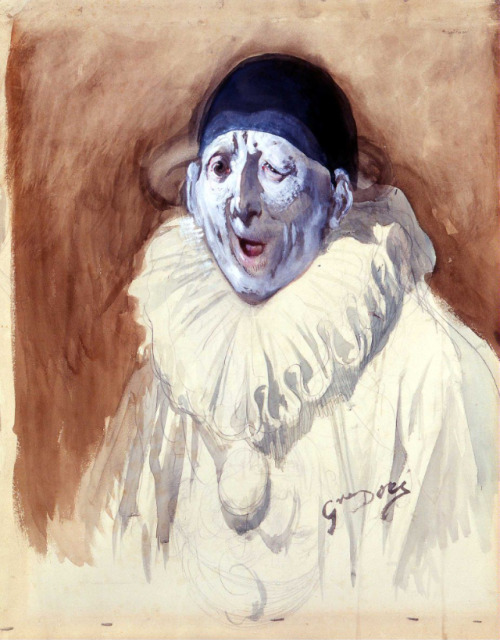
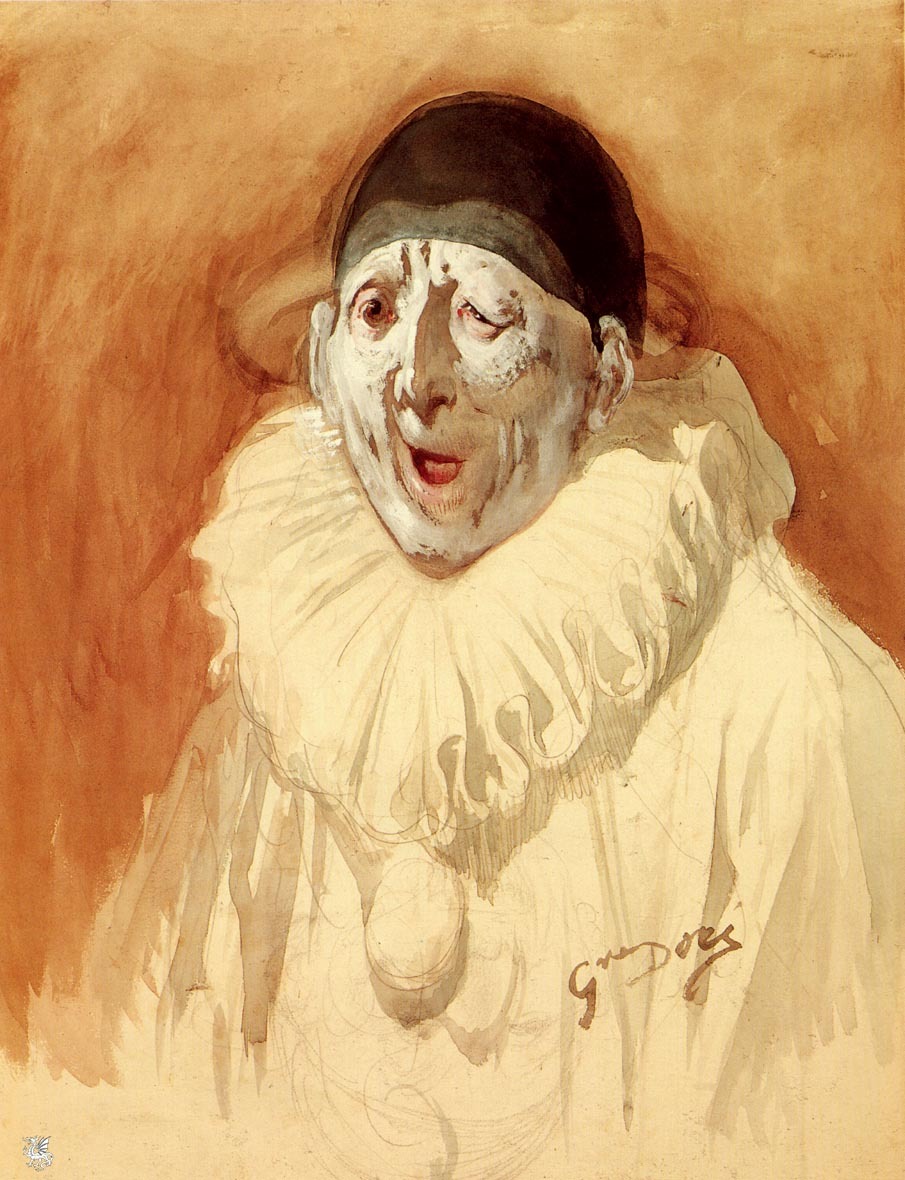
Pierrot grimacing


Here are two images of the painting Pierrot grimaçant (Pierrot Grimacing) by Gustave Doré, located in Strasbourg at the Musée d’Art moderne et contemporain. This undated work is said to be a self-portrait of Doré in clown form, but I don't understand why. Isn't there something beautifully, nauseatingly deformed about this Pierrot? Or perhaps it's a spiritual self-portrait. It is certainly a portrait of some spiritual part of me.

Incidentally (or perhaps not), this painting has been uploaded to WikiArt under the incorrectly translated title, Pierrot Grin. As anyone who is still following this blog after three years of silence will be aware, correcting mistranslated titles is my sole reason for being. So my motivation for posting this here is to hijack searches for Pierrot Grin and correct the misinformation!

I may as well also mention that I have been reposting nice things posted by others on my tumblr, which you can find here: http://putonflesh.tumblr.com. Every time the moon is in Pisces I also post some original poetry or photography there.

Portrait of Gustave Doré on woodburytype, 1870s, unknown phographer. Source.


09 July 2013

The Appetitive Soul


Two pages from The Cardboard Valise by Ben Katchor.  Click to enlarge.
Ben Katchor, from The Cardboard Valise


From Plato's Phaedrus:
Of the nature of the soul, though her true form be ever a theme of large and more than mortal discourse, let me speak briefly, and in a figure. And let the figure be composite--a pair of winged horses and a charioteer. Now the winged horses and the charioteers of the gods are all of them noble and of noble descent, but those of other races are mixed; the human charioteer drives his in a pair; and one of them is noble and of noble breed, and the other is ignoble and of ignoble breed; and the driving of them of necessity gives a great deal of trouble to him. ...The soul in her totality has the care of inanimate being everywhere, and traverses the whole heaven in divers forms appearing--when perfect and fully winged she soars upward, and orders the whole world; whereas the imperfect soul, losing her wings and drooping in her flight at last settles on the solid ground.
...
The chariots of the gods in even poise, obeying the rein, glide rapidly; but the [mortals] labour, for the vicious steed goes heavily, weighing down the charioteer to the earth when his steed has not been thoroughly trained:--and this is the hour of agony and extremest conflict for the soul.
...
The right-hand horse is upright and cleanly made; he has a lofty neck and an aquiline nose; his colour is white, and his eyes dark; he is a lover of honour and modesty and temperance, and the follower of true glory; he needs no touch of the whip, but is guided by word and admonition only. The other is a crooked lumbering animal, put together anyhow; he has a short thick neck; he is flat-faced and of a dark colour, with grey eyes and blood-red complexion; the mate of insolence and pride, shag-eared and deaf, hardly yielding to whip and spur. Now when the charioteer beholds the vision of love, and has his whole soul warmed through sense, and is full of the prickings and ticklings of desire, the obedient steed, then as always under the government of shame, refrains from leaping on the beloved; but the other, heedless of the pricks and of the blows of the whip, plunges and runs away, giving all manner of trouble to his companion and the charioteer, whom he forces to approach the beloved and to remember the joys of love. They at first indignantly oppose him and will not be urged on to do terrible and unlawful deeds; but at last, when he persists in plaguing them, they yield and agree to do as he bids them.

And now they are at the spot and behold the flashing beauty of the beloved; which when the charioteer sees, his memory is carried to the true beauty, whom he beholds in company with Modesty like an image placed upon a holy pedestal. He sees her, but he is afraid and falls backwards in adoration, and by his fall is compelled to pull back the reins with such violence as to bring both the steeds on their haunches, the one willing and unresisting, the unruly one very unwilling; and when they have gone back a little, the one is overcome with shame and wonder, and his whole soul is bathed in perspiration; the other, when the pain is over which the bridle and the fall had given him, having with difficulty taken breath, is full of wrath and reproaches, which he heaps upon the charioteer and his fellow-steed, for want of courage and manhood, declaring that they have been false to their agreement and guilty of desertion. Again they refuse, and again he urges them on, and will scarce yield to their prayer that he would wait until another time. When the appointed hour comes, they make as if they had forgotten, and he reminds them, fighting and neighing and dragging them on, until at length he, on the same thoughts intent, forces them to draw near again. And when they are near he stoops his head and puts up his tail, and takes the bit in his teeth. and pulls shamelessly. Then the charioteer is worse off than ever; he falls back like a racer at the barrier, and with a still more violent wrench drags the bit out of the teeth of the wild steed and covers his abusive tongue and jaws with blood, and forces his legs and haunches to the ground and punishes him sorely. And when this has happened several times and the villain has ceased from his wanton way, he is tamed and humbled, and follows the will of the charioteer, and when he sees the beautiful one he is ready to die of fear. And from that time forward the soul of the lover follows the beloved in modesty and holy fear.

What is beneath the tunic of the charioteer of the gods, who drives two white horses? 


Giulio Romano, Chariot of the Sun, 1527
Palazzo Te, Mantua, Italy

15 April 2013

Infrarealist Manifesto, Mario Santiago Papasquiaro, 1975

In 2009, I published a translation of Roberto Bolaño's "Abandon everything again: First Infrarealist manifesto," written in 1976.  Since then, I have learned that this "first" manifesto was preceded by two others, both written in 1975: one by José Vicente Anaya, and another by Mario Santiago Papasquiaro (see here and here).

What follows is a translation of Mario Santiago's manifesto.  The original can be found, for example, here.  Anaya's manifesto can also easily be found at that site; a translation may be forthcoming on this blog.

Semi-relatedly, there is a recording of Mario Santiago reading one of his poems (in Spanish) here.


Infrarealist Manifesto

WHAT DO WE PROPOSE?

NOT MAKING A JOB OF ART

SHOWING THAT EVERYTHING IS ART AND THAT THE WHOLE WORLD CAN MAKE IT

BEING INTERESTED IN "INSIGNIFICANT" THINGS / WITHOUT INSTITUTIONAL VALUE

/ PLAYING / ART MUST BE UNLIMITED IN QUANTITY, ACCESSIBLE

TO EVERYONE, AND IF POSSIBLE CREATED FOR EVERYONE

¡!!!!!!!!!!!!!!!!!!!!!!!!!!!!!!!!!!!!!!!!!!!!!!!!!!!!!!!!!!!!!!!

CONTRADICTING ART / CONTRADICTING EVERYDAY LIFE (DUCHAMP) IN A

TIME THAT SEEMS ALMOST TOTALLY BLOCKED FOR

PROFESSIONAL OPTIMISTS

TRANSFORMING ART / TRANSFORMING EVERYDAY LIFE (US)

CREATIVITY / LIFE MISALIGNED AT ALL COSTS

(MOVING OUR HIPS TO THE PRESENT WHILE BATTING OUR EYELASHES

FROM THE AIRPORTS OF THE FUTURE)

IN A TIME WHEN MURDERS HAVE BEEN DISGUISING

SUICIDES

$$$$$$$$$$$$$$$$$$$$$$$$$$$$$$$$$$$$$$$$$$

CONVERTING CONFERENCE ROOMS INTO FIRING RANGES1

 (FESTIVAL INSIDE A FESTIVAL / WOULD DEBRAY SAY?2

%%%%%%%%%%%%%%%%%%%%%%%%%

BEETHOVEN, RACINE & MIGUEL ÁNGEL STOP BEING THE MOST USEFUL

THE MOST ADDICTIVE3, THE MOST NOURISHING: THE SOUND

BARRIERS THE SPEED LABYRINTHS (OH JAMES DEAN!4) ARE BEING

BROKEN INTO SOMETHING ELSE

“”””””””””””””””””””””””””””””””””””””””””””””””

 TAKING PEOPLE OUT OF THEIR DEPENDENCE & PASSIVITY

SEARCHING FOR UNPRECEDENTED MODES OF INTERVENING IN & DETERMINING THE WORLD

DEMYSTIFYING / TURNING INTO AGITATORS

NOTHING HUMAN IS FOREIGN TO US (GOOD) NOTHING UTOPIAN IS FOREIGN TO US

(SUPERGOOD)

+++++++++++++++++++++++++++++++++++++++

AT THIS MOMENT MORE THAN EVER BEFORE, THE PROBLEM OF ART

CANNOT BE THOUGHT OF AS AN INTERNAL STRUGGLE BETWEEN CONTINGENTS / 

BUT ABOVE ALL AS A TACIT (ALMOST DECLARED) STRUGGLE BETWEEN

THOSE WHO ARE CONSCIOUSLY OR UNCONSCIOUSLY WITH THE SYSTEM

AND TRY TO CONSERVE IT PROLONG IT / AND THOSE WHO ALSO CONSCIOUSLY

OR UNCONSCIOUSLY MAKE IT EXPLODE

…………………………………………………………

ART IN THIS COUNTRY HAS NOT GONE FURTHER THAN A CURSORY TECHNIQUE

FOR DECORATIVELY EXERCISING MEDIOCRITY

$$$$$$$$$$$$$$$$$$$$$$$$$$$$$$$$$$$$$$$$$$$$

"ONLY FREE MEN OF ANY STRIPE WILL BE ABLE TO CARRY THE FLAME FAR ENOUGH" (ANDRÉ BRETON)5

¡!!!!!!!!!!!!!!!!!!!!!!!!!!!!!!!!!!!!!!!!!!!!!!!!!!!!!!!!!!!!!!!!!!!!!!!!!!!!!!!!!!!!!!!!!!!!!!!!!!!!!!!!!!!!!!!!!

RETURNING TO ART THE NOTION OF A PASSIONATE AND CONVULSIVE LIFE

CULTURE IS NOT IN BOOKS OR IN PAINTINGS OR IN

STATUES IT'S IN THE NERVES / IN THE FREE FLOW OF THE NERVES

A CLEARER STATEMENT: AN EMBODIED CULTURE / A CULTURE IN

FLESH, IN SENSIBILITY (THIS OLD DREAM OF ANTONIN ARTAUD)

555555555555555555555555555555555555555555555555555555555555555555555

EVERYTHING THAT EXISTS:

THE FIELD OF OUR ACTIVITY / AND THE FRENETIC SEARCH FOR

WHAT STILL DOESN'T EXIST

…………………………………………………………………………………………………….

OUR PURPOSE IS (THE TRUTH) PRACTICAL SUBVERSION

&&&&&&&&&&&&&&&&&&&&&&&&&&&&&&&&&&&&&&&&&&&&&&&&&

EXAMPLE OF TOTAL ART

TOTAL SCULPTURE (AND WITH MOVEMENT): A MANIFESTATION OF 10,000

TO 20,000 PEOPLE SUPPORTING THE STRIKE OF THE DEMOCRATIC ELEMENT

OF SUTERM6

TOTAL MUSIC: TRIPPING MUSHROOMS IN THE SIERRA MAZTECA

TOTAL PAINTING: CLAUDIA KERIK BACKWARDS AND FORWARDS / I INSIST:

BACKWARDS AND FORWARDS

TOTAL POETRY: THIS INTERVIEW DISSEMINATED TELEPATHICALLY OR WITH

THE ONLY MOVEMENT OF MY HAIR (AN AFRICAN LION'S) AND ALL ITS

ELECTRIC DISCHARGE

3333333333333333333333333333333333333333333333333333333333333333333333

WORLDS WAVES PEOPLE WHO INTEREST ME:

NICANOR PARRA CATULLUS QUEVEDO LAUTRÉAMONT MAGRITTE CHIRICO ARTAUD

VACHÉ JARRY BRETON BORIS VIAN BURROUGHS GINSBERG KEROUAC KAFKA

BAKUNIN CHAPLIN GODARD FASSBINDER ALAIN TANNER FRANCIS BACON

DUBUFFET GEORGE SEGAL JUAN RAMÍREZ RUÍZ VALLEJO EL CHÉ GUEVARA

ENGELS "THAT MASTER OF SARCASM" THE PARIS COMMUNE THE

SITUATIONIST INTERNATIONAL THE EPIC OF THE CASTAWAYS OF THE GRANMA (THEY FORGOT ME): HEIRONYMUS BOSCH (THE UNMISSABLE)

WILHELM REICH THE APORNOGRAPHIC MYSTICISM OF CHARLES MAGNUS THE 

MULTICOLORED EROTICA OF TOM WESSELMAN JOHN CAGE JULIAN BECK JUDITH

MALINA & HER LEAVING THEATER (AND TO CONCLUDE) THE MARQUIS DE

SADE HECTOR APOLINAR ROBERTO BOLAÑO JOSÉ REVUELTAS (AND HIS

DISCOVERY THAT THE DIALECTIC SOMETIMES WALKS LIKE

A CRAB) JUDITH GARCÍA CLAUDIA SOL (AND EVEN ON CLOUDY DAYS)

CLAUDIA SOL

%%%%%%%%%%%%%%%%%%%%%%%%%%%%%%%%%%%%%%%%%%%%%%

WE CAN SHOOT 2 GUNS AT ONCE / I MEAN MORE THAN ONCE

BUFFALO BILL

STUPIDITY IS NOT OUR STRONG SUIT

(ALFRED JARRY DIXIT)


Notes
1.  "STANS DE TIRO"
2. Jules Régis Debray; missing close parenthesis in the original
3. "LO MÁS ANFETAMÍNICO" - something like "the most like being addicted to meth"
4. In English in the original.
5. Where is this in Breton?  I recognize it but I can't find it.
6. SUTERM was an electrical workers' union.

24 February 2013

Chess

Having become somewhat weary of the curatorial life, I have been preparing something new.  Still, one cannot always resist the impulse to organize and to collate.

The text below comes from John Locke's Essay Concerning Human Understanding, which can be found online in its entirety here.


A company of chess-men, standing on the same squares of the chess-board where we left them, we say they are all in the same place, or unmoved, though perhaps the chess-board hath been in the mean time carried out of one room into another; because we compared them only to the parts of the chess-board, which keep the same distance one with another. The chess-board, we also say, is in the same place it was...

Andy Warhol, Chess Player, 1954

In the chess-board, the use of the designation of the place of each chess-man being determined only within that chequered piece of wood, it would cross that purpose to measure it by anything else; but when these very chess-men are put up in a bag, if any one should ask where the black king is, it would be proper to determine the place by the part of the room it was in, and not by the chess-board.
Max Ernst and Dorothea Tanning Playing Chess
Max Ernst and Dorothea Tanning Playing Chess, 1948 - Source unknown


So if any one should ask, in what place are the verses which report the story of Nisus and Euryalus, it would be very improper to determine this place, by saying, they were in such a part of the earth, or in Bodley's library: but the right designation of the place would be by the parts of Virgil's works; and the proper answer would be, that these verses were about the middle of the ninth book of his AEneids, and that they have been always constantly in the same place ever since Virgil was printed: which is true, though the book itself hath moved a thousand times, the use of the idea of place here being, to know in what part of the book that story is, that so, upon occasion, we may know where to find it, and have recourse to it for use.

 Dorothea Tanning, End Game, 1944

26 April 2012

First Works

WikiPaintings allows visitors to view all works by a given artist in chronological order.  The Salvador Dalí "collection" includes paintings dating from 1910, when the artist was 6 years old.  Moving forward in time, Dalí's predecessors show their faces one after another.  This leads to the invention of a game: begin at the beginning and move forward until you come across a work in which you can perceive nothing but the artist's own style.  Call this the First Work.

Salvador Dalí, The Station at Figueras, 1926
Salvador Dalí, The Station at Figueras, 1926, age 22

(The shadows, the shadowy figures, the desolate landscape of unexplained shapes, the trees obviously preparing for The Persistence of Memory.  If, in the application of paint, there is not yet Dalí, neither is there anyone else in particular [so far as is evident from the picture].)
Of course, there can be no winning this game.  Disputation can only lead further discovery.  If you, readers, decide to play this game, comment here with your findings.  I will perhaps post them, and more of my own, in future posts.

Another suggestion:

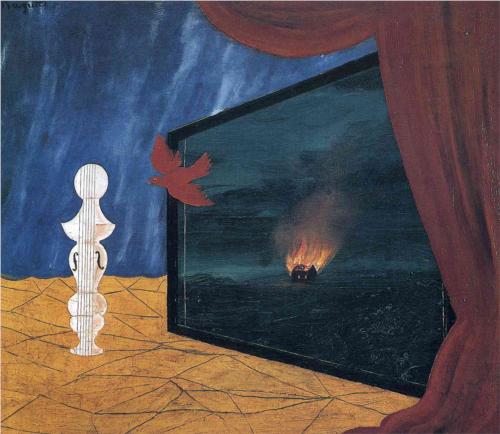
René Magritte, Nocturne, 1925
René Magritte, Nocturne, 1925, age 27

11 February 2012

The Faces of Alexei Korzukhin

Alexei Korzukhin, Russian realist painter, 1835–1894. Wikipedia styles his portraits as "generally accepted as masterpieces of Russian portrait painting." Some highlights from a timeline on rusartnet:

  • Born to a family of gold panners at Uktussky Zavod near Ekaterinburg (1835).
  • One of the rebellious fourteen students who refused to paint the set topic in the competition for a major gold medal and resigned from the Imperial Academy of Arts with the title of second-class artist (1863).
[It isn't clear what the "set topic" was, but it seems the group was protesting the strict guidelines and divisions between high and low art that the Imperial Academy endorsed. They wanted to make art more accessible to the masses, and after leaving the Imperial Academy of Arts founded a collective called the Peredvizhniki, or The Wanderers, which later became the Society for Travelling Art Exhibitions. Evidently Korzukhin was a member of the society but did not participate in the exhibitions. More here, and, of course, here.]
  • Suffered from nervous shock and poor health after witnessing the assassination of Tsar Alexander II on the Ekaterinburg Canal in St Petersburg (1881).
Master of portraiture thought Korzukhin may be, the extent of his mastery is more clearly evident in his portrayal of faces in action. Examples below, with details. Click on the full paintings for large versions.


Separation, 1872


Alexei Korzukhin, Separation, 1872

Alexei Korzukhin, Separation, 1872, detail


Before Confession, 1877


Alexei Korzukhin, Before confession, 1877

Alexei Korzukhin, Before confession, 1877, deatil

Alexei Korzukhin, Before confession, 1877, deatil


Peasant Girls in a Forest, 1878


Alexei Korzukhin, Peasant Girls in a Forest, 1878

Alexei Korzukhin, Peasant Girls in a Forest, 1878, detail


In a Monastic Hotel, 1882


Alexei Korzukhin, In a Monastic Hotel, 1882

Alexei Korzukhin, In a Monastic Hotel, 1882, detail


The Sunday, 1884


Alexei Korzukhin, The Sunday, 1884

Alexei Korzukhin, The Sunday, 1884, detail


There Goes Petrushka, 1888


Alexei Korzukhin, There Goes Petrushka, 1888

Alexei Korzukhin, There Goes Petrushka, 1888, detail

26 January 2012

Fragments II: Symbol


blood flight by Jenny Hval


[The Parnassians] still treat their subjects as the old philosophers and orators did: that is, present things directly, whereas I think that they should be presented allusively. Poetry lies in the contemplation of tings, in the image emanating from the reveries which things arouse in us. They take something in its entirety and simply exhibit it; in so doing, they fall short of mystery; they fail to give our minds that exquisite joy which consists in believing that we are creating something. To name an object is largely to destroy poetic enjoyment, which comes from gradual divination. The ideal is to suggest the object. It is the perfect use of this mystery which constitutes symbol. An object must be gradually evoked in order to show a state of soul; or else, choose an object and from it elicit a state of soul by means of a series of decodings.

Attributed to Stéphane Mallarmé.


bridal veil stinkhorn fungus


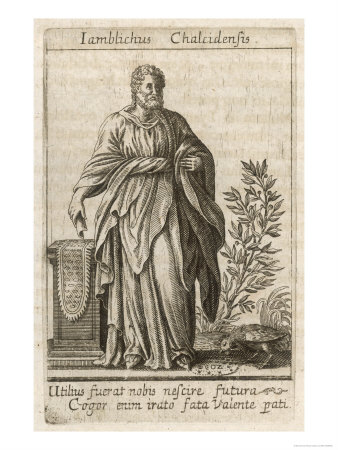
Iamblichus:
Iamblichus Chalcidensis, Neoplatonic philosopher
Granting, then, that ignorance and deception are faulty and impious, it does not follow that the offerings made to the gods and divine works are invalid, for it is not pure thought that unites theurgists to the gods. Indeed, what then would hinder those who are theoretical philosophers from enjoying a theurgic union with the gods? But the situation is not so: it is the accomplishment of acts not to be divulged and beyond all conception, and the power of unutterable symbols, understood solely by the gods that establishes theurgic union. For this reason, we do not bring about these things by thinking alone. If we did, their efficacy would be intellectual, and dependent on us. But neither assumption is true. For even when we are not engaged in thinking, the symbols themselves, by themselves, perform their appropriate work, and the ineffable power of the gods, to whom these symbols relate, itself recognizes the proper images of itself, not through being aroused by our thought.

17 December 2011

New Mario Santiago Papasquiaro translations

I have good news for fans of Mario Santiago Papasquiaro, Infrarealism, Roberto Bolaño, Mexican poetry, DIY publishing, book collecting, good poetry, and everything else under the sun:

La Ratona Cartonera, a small Mexican publishing group, has been working on several translations of poetry by Mario Santiago Papasquiaro. (See my translation of an interview with MSP here.) Their translation of the 538-line poem Advice from a disciple of Marx to a fan of Heidegger is available for $15, which includes shipping and a one-of-a-kind homemade cover:

Mario Santiago Papasquiaro, Advice from a disciple of Marx to a fan of Heidegger, La Ratona Cartonera

The proceeds from these will help fund La Ratona's next MSP translation. If you want one, send me an e-mail () or comment here with your e-mail address. Then I will send you my friend Laura Darling's e-mail address, which you can use to contact her and pay for the book via PayPal.

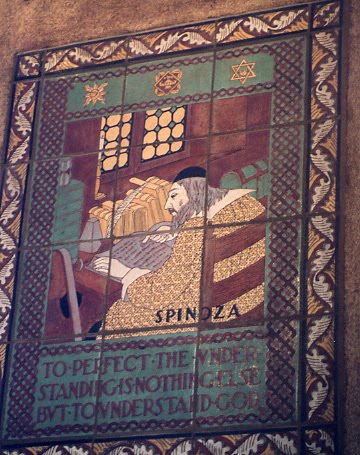
Laura was kind enough to give me permission to post an excerpt from the translation:

Mario Santiago Papasquiaro

Advice from a disciple of Marx to a fan of Heidegger


To Roberto Bolano & Kyra Galvan comrades & poets

                                   for Claudia Kerik & my good fortune  at having known her


"...it's as well at times

To be reminded that nothing is lovely,

Not even in poetry, which is not the case."

W.H. Auden


The world comes to you in fragments / in splinters:

in a melancholy face you glimpse a brushstroke by Dürer

in someone happy the grimace of an amateur clown

in a tree: the tremble of birds sucking on its nape

in a flaming summer you catch pieces of the universe licking their faces

the moment in which an indescribable girl

                   tears her Oaxacan camisole

exactly next to the half-moon sweat of her armpits

& beyond the peel is the pulp / & like a strange gift of the eye

                                                                              the eyelash

Maybe not even carbon dating will be able to reconstruct

   the true facts

These are not the times in which a naturalist painter

ruminates on lunchtime excesses

between Swedish gymnastic movements

& without losing sight of the pinkish-blue hues of flowers he hadn't

    guessed at not even in his sweetest nightmares


We are actors of infinite acts

      & not precisely under the blue tongue

               of cinematographic lights

for instance today / you see how Antonioni passes by

                  with his customary camera

observed by those who prefer to bury their heads in the grass

to get drunk on smog or whatever / so they don't add

                                                               to the scandals

that already make public roads impassable

by those who've been born to be kissed at length by the sun

& its daily ambassadors

by those who speak of fabulous coitus /of females unbelievable

                                      in this geological age

of vibrations that would've made you a tenacious propagandist of Zen

                                                                                              Buddhism

by those who have once been saved

from the kind of accidents that the crime rags call substantial

& who by the way are not--for now--counted among the flowers of the

    Absurd

15 October 2011

Sterility, mental and physical

I apologize to the readers of altarpiece for its state of disrepair. I have begun a Ph.D. program in philosophy, so I spend most of my time thinking about things that are not suitable for presentation here. I'll try to keep posting as I can, but really altarpiece-style posts will probably become more rare (if that's possible).

Yesterday I went to Pittsburgh's Andy Warhol Museum. Here is the only image I've been able to find online of my favorite piece there:

Andy Warhol - Jean-Michel Basquiat, 1984Jean-Michel Basquiat. Andy Warhol, 1984.

In reality it's about 8 feet tall. Each limb section has a different grain, a different texture. The color is reminiscent of x-ray images.

I was captivated by this, and stood looking at it for an embarrassingly long time, from different parts of the room. Basquiat's left arm in two positions gives the impression of a captured movement, is also reminiscent of da Vinci's Vitruvian Man. The pose is Michaelangelo's David.


The x-ray quality combined with the pasted together panels gives the impression of resurrection.

I asked myself whether I would have been so interested in the portrait if it hadn't been Basquiat. The head is the most awkwardly attached limb. The contrast is starker, the seam is more exact and thus more distracting. It's only the head the objects to its positioning. The tension between the head and the body reminds me of the tension between life and self. But it doesn't detract from the beauty of the human body, which doesn't seem to be the least bit disturbed by being cut up and put back together.

28 July 2011

Hogs is hogs

Charles Jacque - Le Retour du BergerLe Retour du Berger, Charles Jacque (1879-1959)
A scene of uncommon hilarity from Cormac McCarthy in Outer Dark:

On a good spring day he paused to rest at the side of the road. He had been walking for a long time and he had been hearing them for a long time before he knew what the sound was, a faint murmurous droning portending multitudes, locusts, the advent of primitive armies. He rose and went on until he reached the gap in the ridge and before long he could see the first of them coming along the road below him and then suddenly the entire valley was filled with hogs, a weltering sea of them that came smoking over the dusty plain and flowed undiminished into the narrows of the cut, fanning on the slopes in ragged shoals like the harried outer guard of schooled fish and here and there upright and cursing among them and laboring with poles the drovers, gaunt and fever-eyed with incredible rag costumes and wild hair.
     Holme left the road and clambered up the rocky slope to give them leeway. The first of the drovers was beating his way obliquely across the herd toward him, the hogs flaring and squealing and closing behind him again like syrup. When he gained the open ground he came along easily, smiling up to where Holme sat on a rock with his feet dangling and looking down with no little wonder at this spectacle. hog drovers
     Howdy neighbor, called out the drover. Sweet day, ain't she?
     It is, he said. Whereabouts are ye headed with them hogs if you don't care for me astin?
     Crost the mountain to Charlestown.
     Holme shook his head reverently. That there is the damndest sight of hogs ever I seen, he said. How many ye got?
     The drover had come about the base of the rock and was now standing looking down with Holme at the passing hogs. God hisself don't know, he said solemnly.
     Well it's a bunch.
     They Lord, said the drover, they just now commencin to come in sight. He passed his stave from the crook of one arm to the other and cocked one foot on the ledge of rock, his sparse whiskers fluttering in the mountain wind, leaning forward and watching the howling polychrome tide of hogs that glutted the valley from wall to wall as might any chance traveler a thing of interest.
     They's more than one mulefoot in that lot, he said.
     What?
     Mulefoot. I calculate they's several hunnerd head of them alone and they ain't no common hog to come upon.
     What's a mulefoot? Holme said.
     The drover squinted professionally. Mountain hog from north of here. You ain't never seen one?
     No.
     Got a foot like a mule.
     You mean they ain't got a split hoof?
     Nary split to it.
     I ain't never seen no such hog as that, Holme said.
     I ain't surprised, the drover said. But ye can see one here if you've a mind to.
     I'd admire to, Holme said.
     The drover shifted his stave again. Seems like that don't agree with the bible, what would you say?
     About what?
     About them hogs. Bein unclean on account of they got a split foot.
     I ain't never heard that, Holme said.
     I heard it preached in a sermon one time. Feller knowed right smart about the subject. Said the devil had a foot like a hog's. He laid claim it was in the bible so I reckon it's so.
     I reckon.
     He said a jew wouldn't eat hogmeat on account of it.
     What's a jew?
     That's one of them old-timey people from in the bible. But that still don't say nothin about a mulefoot hog does it? What about him?
     I don't know, Holme said. What about him?
     Well is he a hog or ain't he? Accordin to the bible.
     I'd say a hog was a hog if he didn't have nary feet a-tall.
     I might do it myself, the drover said, because if he was to have feet you'd look for em to be hog's feet. Like if ye had a hog didn't have no head you'd know it for a hog anyways. But if ye seen one walkin around with a mule's head on him ye might be puzzled.
     That's true, Holme allowed.
     Yessir. Makes ye wonder some about the bible and about hogs too, don't it?
     Yes, Holme said.
     I've studied it a good deal and I cain't come to no conclusions about it one way or the other.
     No.
     The drover stroked his whiskers and nodded his head. Hogs is a mystery by theyselves, he said. What can a feller know about one? Not a whole lot. I've run with hogs since I was just a shirttail and I ain't never come to no real understandin of em. and I don't doubt but what other folks has had the same experience. A hog is a hog. Pure and simple. And that's about all ye can say about him. And smart, don't think they ain't. Smart as the devil. And don't be fooled by one that ain't got nary clove foot cause he's devilish too.
     I guess hogs is hogs, Holme said.
     The drover spat and nodded. That's what I've always maintained, he said.


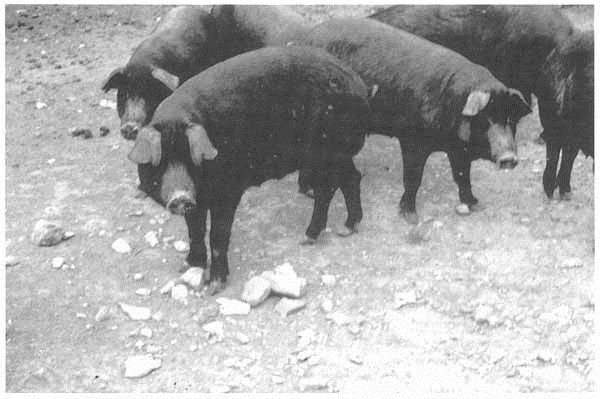
mulefoot hogs “The last remaining herd of Mulefoot Hogs in the USA has been conserved by an individual farmer.” [source]


“Hog Drovers” as sung by Ollie Gilbert, Mountain View, Arkansas on October 28, 1969. [source] [see also]


Charles Joshua Chaplin - Le porcher Le Porcher, Charles Joshua Chaplin (1825-1891)

17 May 2011

Part II: The Sea

The following is the second part of a multi-part post. The post can stand alone, but if you would like to begin at the beginning, click here for Part I.

Socrates: The awe which I always feel, Protarchus, about the names of the gods is more than human--it exceeds all other fears.


&

Roy_Lichtenstein_Drowning_Girl 1963

IV. Death by Water
Phlebas the Phoenician, a fortnight dead,
Forgot the cry of gulls, and the deep sea swell
And the profit and loss.
A current under sea
Picked his bones
in whispers. As he rose and fell
He passes the stages of his age and youth
Entering the whirlpool.
Gentile or Jew
O you who turn the wheel and look windward,
Consider Phlebas, who was once handsome and tall as you.

Roy Lichtenstein, Drowning Girl, 1963

A Reefnetter's Paean to the Sea by Tyree Callahan(source)


Tiresias: If I did not know at least this, I would not be a priest. Take a boy who bathes in the Asopus. It is a summer morning. The boy comes out of the water, goes back in happily, dives and dives again, then he is taken ill and drowns. What do the gods have to do with this? Should he attribute his end to the gods or else the pleasure he enjoyed? Neither the one nor the other. Something happened––which is neither good nor evil, something which has no name––then the gods will give it a name.

Oedipus: And to give a name, to explain things, seems little to you, Tiresias?

Tiresias: You are young, Oedipus, and like the gods who are young you yourself clear up things and name them. You still don’t know that beneath the earth there is stone, and that the bluest sky is the emptiest. For him who like me does not see, all things are a blow, nothing else.

--From “The Blind,” a dialogue by Cesare Pavese


Jacob Isaakszoon van Ruisdael - Rough Sea at a Jetty 1650s Jacob Isaakszoon van Ruisdael, Rough Sea at a Jetty, c. 1650


17 April 2011

Black, white, gangrene


Sara Hayward, "Two Figures I," 2011.

The following is excerpted from "Poetry Black, Poetry White", an essay by René Daumal. When you are done with this post, please read the whole thing: click here!

René Daumal, Mount Analogue cover
The black poet tastes every pleasure, adorns himself in every ornament, exercises every power - in his imagination. The white poet prefers reality, even paltry reality, to these rich lies. His work is an incessant struggle against pride, imagination and laziness. Accepting his gift, even if he suffers from it and suffers from suffering, he seeks to make it serve ends greater than his selfish desires: the as-yet-unknown cause of this gift.

...

Every poem is born of a seed, dark at first, which we must make luminous for it to produce fruits of light. ... To make it shine, one must create silence, for this seed is the Thing-to-be-said itself, the central emotion that seeks to express itself through my whole machine. ... Silence to word games, memorized lines, memories fortuitously assembled; silence to ambition, to the desire to shine - for only light shines by itself; silence to self-flattery and self-pity; silence to the rooster who thinks he makes the sun rise! ... It is very difficult, but each little effort receives a little glimmer of light in reward. The Thing-to-be-said then appears in its most intimate form, as an eternal certainty - a pinpoint of light containing the immensity of the desire for Being.

...

I have said what one must do to become a white poet. As if it were that easy! Even in prose, in ordinary speech and writing (as in all aspects of my daily life), all that I produce is grey, salt-and-pepper, soiled, a mixture of light and darkness. And so I take up the struggle after the fact. I re-read myself. In my sentences, I see words, expressions, interferences that do not serve the Thing-to-be-said: an image that meant to be strange, a pun that thought it was funny, the pedantry of a certain prig who would do better to stay seated at his desk instead of coming to play the fipple flute in my string quartet. And remarkably enough, it is simultaneously a mistake in taste, style, or even syntax. Language itself seems set up in such a way as to detect the intruders for me. Few mistakes are purely technical. Almost all of them are my mistakes. And I cross out, and I correct, with the joy one can have at cutting a gangrenous limb from one's body.


Jean Cocteau:

A true poet does not bother to be poetical. Nor does a nursery gardener scent his roses. What he does is to subject them to treatment which ensures their having the finest colour and the sweetest scent.

and

The poet doesn't invent. He listens.


(The first quote is from, at least, Professional Secrets. I haven't been able to source the second one precisely, but it's mentioned in an interview Cocteau gave for the Paris Review, published in 1964, and Cocteau does not disagree that he said it. The interview can (and must!) be read in its entirety here. As with everything Cocteau touches, it's full of truth and magic.)


Matthias Grünewald, Isenheim Altarpiece, crucifixion, Christ with gangrene
From Matthias Grünewald's "Isenheim Altarpiece", 1506-1515

Holy Sonnet IV.

O, my black soul, now thou art summoned
By sickness, Death's herald and champion ;
Thou'rt like a pilgrim, which abroad hath done
Treason, and durst not turn to whence he's fled ;
Or like a thief, which till death's doom be read,
Wisheth himself deliver'd from prison,
But damn'd and haled to execution,
Wisheth that still he might be imprisoned.
Yet grace, if thou repent, thou canst not lack ;
But who shall give thee that grace to begin ?
O, make thyself with holy mourning black,
And red with blushing, as thou art with sin ;
Or wash thee in Christ's blood, which hath this might,
That being red, it dyes red souls to white.

--John Donne

Matthias Grünewald, Isenheim Altarpiece, crucifixion, detail
Detail from Isenheim Altarpiece. Click for enlarged version. Incidentally, the filename is failureisnotanoption.jpg. That's how I found it; I thought it was funny so I left it that way.

27 January 2011

Mario Santiago Papasquiaro interview, English

Update: if you are interested in English translations of Mario Santiago Papasquiaro's poetry, see this post.

Beso Eterno, Mario Santiago Papasquiaro, Al Este del Paraíso

The following is a translation of a 1995 interview with Mario Santiago Papasquiaro, co-founder of the Mexican Infrarealist poetry movement. The original can be found here, among other places.

The dash-underlined bits of text in the interview are not links, but hovering over them for a moment with the mouse will result in additional information appearing. I have chosen this method in lieu of footnotes, which can be difficult to deal with online.

With regard to punctuation, it has mostly been preserved as it was given in the original linked above, except in cases where clarity was seriously lacking. There are a few mysterious quotations and line breaks that appeared in the original which are preserved here.


By: Oscar Enrique Ornellas
Published in El Financiero, cultural section, 29 March 1995.

He wasn't born on Guerrillera Street in Colonia Aurora, nor on Ché Guevara Street in Benito Juárez. He assures me that he first saw light "in a clinic that doesn’t exist anymore, in Rafael Guillén Alley in Mixcoac." Mario Santiago Papasquiaro (Mexico, 1953) doesn't care that this alley is really called Guillain. Details. He is better than Bukowski, the true poet of Mixcoac, and will put anyone in his place, starting with Octavio Paz. "Víctor Roura is garbage (and Musacchio too)." Founder of Infrarealism, Santiago Papasquiaro is the author of "Advice from a disciple of Marx to a Heidegger fanatic" (in the volume Muchachos desnudos bajo el arcoíris de fuego [Boys Naked under the Rainbow of Fire], published by Editorial Extemporáneos). For Santiago, what's really important is friendship and, confirming this, he has now published Beso eterno [Eternal Kiss] (published by Al Este del Paraíso), a book of poems that will appear tonight at 7:30 at the Confederación de Educadores Americanos. In a strange pandemonium of words, Papasquiaro met with the cultural section in some place in Tlatelolco.

Why is your book called Beso eterno?
Read the book and then ask me questions.

But you wrote—
It's called Beso eterno in honor of my two year-old daughter, Nadja. That poem was written before she was born. I have three children… but, look, this isn't a psychiatry session… Nadja Clítoris was born years after I had decided to call it that. It's a prophetic poem. Back then I lived in Pensil. That was was when I started to work at El Financiero. There I met Marco [Lara Klahr], [Víctor] Roura, Mike... Then they fired me from this newspaper you work for.

Why did you take so long to publish again?
I'm 41. My first public reading was in 1973, when I was 19. I've been writing since I was a kid, but the first time I presented my writing publicly was after my grandmother died. I started in March of 1971 at the the poetry workshop at the University [Universidad Nacional Autónoma de México], which was coordinated by Juan Bañuelos on the tenth floor of the rectory, and in December of the same year, I don't know why, Oscar Olivia (who was then like director of literature in the School of Fine Arts) invited me to participate in the Manuel Acuña Centennial in the Fine Arts building. It was my first public reading... I've always lived outside the world and didn't understand why they invited me to do a reading in Fine Arts and on top of that paid me 300 pesos, which, for me, seemed absurd. I didn't get that they would pay someone to read a poem. And, besides, it was my first commissioned poem. Oscar Olivia told me: You have fifteen days, can you do it? And he was dangling the 300 pesos in front of only me and I told him hell yes, and I wrote a poem about 60 pages long. It was my first long-winded poem. My first solo reading was in the Museo de San Carlos on May 3rd of 1974. I wasn't born yesterday. And in 1975 I founded the Mexican Infrarealist movement. Around then they started to get sick of me, because I was confronting Pacheco, Monsiváis, everyone I know of. No one wants to give me a job. For four years I have no income. Sergio Mondragón has refused to give me a job because I'm an Infrarealist. They say I sabotage readings. They say the Infrarealists beat people up. And those idiots allege that I don't know how to write. Motherfuckers. I am l’ecrivain. But that's not important. Better if I read you some things...

What does Infrarealist mean.
Uh, no, you better find out yourself.

You are the founder...
Me and my friends. What happened is that I was a student leader, I founded the high school protest committee in San Ildefonso. I know all the history of guerrilla warfare and the Dirty War... I was Marxist-Leninist... At 19, I had the opportunity to meet José Revueltas and Efraín Huerta in their respective houses. I am their son. That's where I got my pseudonym, Santiago Papasquiaro, the village in Durango where the Revueltas brothers were born... For me, there are two fundamental clans, Revueltas and Flores Magón. I also have training in anarchy, a teacher in middle school told me to investigate the Flores Magón brothers and I liked it. I think they are the most illustrious families that have ever existed in Mexico. But all that doesn't mean shit...

So, would you like to talk about your work?
No, well, ask, ask... Do your job...

Last night this poem to Felipe was brought to my attention. Who was Felipe?
They killed Felipe Rojas 7 years ago. They put him on a farm for alcoholics in Puebla. Felipe is the best actor I have known in my life. And I didn't see it on stage or anything. Felipe is one of my dead, because I have many dead, I've written to some of them...
"In my 23 years of writing without stopping because I dedicated myself to it (putting up with all the bumps) I have published, at a guess, seventy-something poems, scattered all over the place... I lived in Barcelona, in Paris, in Vienna, and have published in Argentina, in Spain, in the United States, in Paris I gave readings. But with Beso eterno is the first time I decide the order of the poems. Often they've been published without my permission. I've never charged for publication, because they never made any money. Here, for example, you have an anthology Roberto [Bolaño] and I made in 1975, with a prologue by Efraín Huerta where he names me "Mario on the way to Santiago"... If anyone knows about Efraín Huerta it's me...

You haven't written poems against them like those that you did for Octavio Paz, Elenita Poniatowska, or Monsiváis and that nobody wanted to publish, right?
No, no, the poem for Efraín Huerta is a love poem. It's his biography. If we meet again someday I'll show it to you. It was published in El Financiero. It's a love poem. About what I know of his life because he told it to me. It's one of my most fantastic poems. Why haven't I published it in a book? Because I haven't had the chance. Why these ten poems in Beso eterno and no others, if I have these mountains of poems? Well, because that's how things went. I respected the idea that Marco Lara suggested to me. He's my amigo and everything else. And we're going to make some noise! I know how to respect a structure. And if you read the book carefully you'll notice that it's made up entirely of tributes to people. They're apparitions of beings...
"I have another, bigger book [Aullido de cisne (Swan's Howl)] that I've risked with CONACULTA. But I think they're going to reject me, because I'm on the black list. Although, also, the best thing is to publish these books underground..."

Getting back to your homages in the book, "Want to dance / baby?" is dedicated to "the nurturing memory of Miles Davis." What nourishment did the trumpeter contribute?
I heard about Miles Davis in Paris with my friend Elías Durán, a poet of the Hora Zero movement in Peru, which is another of my inspirations. In reality I am a Peruvian poet born in Mexico. Peru's Hora Zero is the most radical Latin American poetic movement of this century; and we founded the Infrarealist movement (as kids less than 20) immediately when we heard about those guys... In Paris I lived in poverty. When I returned to Mexico I weighed 40 kilos [80 lbs.]. But I wasn't weak, because I had always walked a lot, there and in this damn whore city... And Elías Durán was a friend, we stole tapes from Fnacs, these huge stores they have in Paris. We were a couple of badasses. We understood each other with one look. They never caught us, but what was the question?

Miles Davis.
Because of Elías Durán. In the tiny room where he lived I heard Miles Davis for the first time. I don't know shit about the club. It's the nurturing memory. It was the stealing and all that. Otherwise, you're not alive, you can fuck off.

Are you The Poet, as the painter Rodolfo Zanabria called you?
Zanabria's... But no, I'm not going to talk about Rodolfo's life because right now I'm writing the introduction to his catalog. He's going to have an exposition in the Carrillo Gil [Museum]... He's the one who gave me this title of Le poète. One day when I was in New York he sent me a postcard of the skyscrapers, and on the envelope, on the outside, instead of putting "señor" and all that shit, he put "to the poet," in French, because he's very Frenchy. My reply is in this poem... but, it didn't really come out well in Marco Lara's edition [of the poem book], did it? He's pissed that I didn't think he could become an editor, least of all an editor of underground poetry. Because that's what we are...

Your friends, your daughter... the punk rebel, the love of your life, who has the most distinguished place in your life?
My wife, Rebeca. We met on the 29th of August, 1987 at a reading that I gave in the cafeteria of the Fine Arts building. Lots of my friends have died because they didn't have anyone tying them down. I've been lucky enough to have some women who believed in me. Otherwise, I would have already been gone, too.


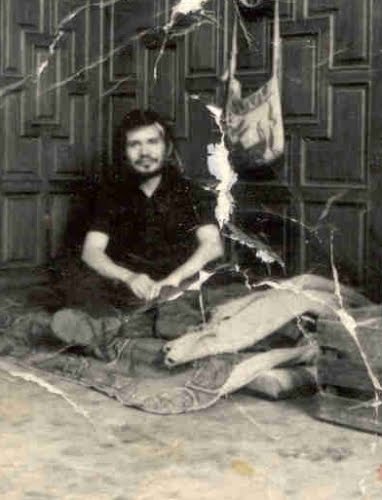
Mario Santiago Papasquiaro
Picture from here, a site with lots of other MSP pictures and some poems (in Spanish).

See also the First Infrarealist Manifesto.

My attention was drawn to this interview by this post at another blog, which contains some other links to things about Bolaño and Infrarealism.

23 January 2011

REMAINDER


I remembered that my windscreen washer reservoir was empty and I asked him for some fill-up. [...] Before I drove off I pushed the windscreen spurter button to make sure it worked. Liquid should have squired out onto the glass, but nothing happened. I pushed it some more. Still nothing. I got out, opened the bonnet again and checked the reservoir. It was empty.

"It's all gone!" I said.

The boys peered in. The oldest one got down on his knees and looked under the car.

"There's no patch," he said. "It hasn't leaked. It should be there." He turned to the middling boy and said: "Go get another bottle."

Another bottle was brought out and poured into the reservoir. Once more I climbed inside the car and pressed the spurter button. Once more nothing happened--and once more, when we looked inside the reservoir, we found it empty.

"Two litres!" I said. "Where has it all gone?"

They'd vaporized, evaporated. And do you know what? It felt wonderful. Don't ask me why: it just did. It was as though I'd just witnessed a miracle: matter--these two litres of liquid--becoming un-matter--not surplus matter, mess or clutter, but pure, bodiless blueness. Transubstantiated. I looked up at the sky: it was blue and endless. I looked back at the boy. His overalls and face were covered in smears. He'd taken on these smears so that the miracle could happen, like a Christian martyr being flagellated, crucified, scrawled over with stigmata. I felt elated--elated and inspired.

"If only..." I started, but paused.

"What?" he asked.

"If only everything could..."

I trailed off again. I knew what I meant. I stood there looking at his grubby face and told him:

"Thank you."

Then I got into the car and turned the ignition key in its slot. The engine caught--and as it did, a torrent of blue liquid burst out of the dashboard and cascaded down. It gushed from the radio, the heating panel, the hazard-lights switch and the speedometer and mileage counter. It gushed all over me: my shirt, my legs, my groin.


The brilliance of Tom McCarthy's Remainder lies not in the way it is written, but in the way it writes the reader. One must usually come upon books at the right time in life in order to get the most out of them. How this typically happens is a mysterious combination of instinct, guesswork, and rereading. Remainder, however, manages to create a perfect space for itself, and by the time one has finished reading it, one's life has become right for the book. Reality has become one with fiction, realizing the book's theme in a way that many of Tom McCarthy's predecessors did not, uncovering the sublime where once there was only gimmick.

They're like bunnies in headlights: frozen. You step in and move them gently away from the counters, get them to lie down. You use their shock to create a... bridge, a... a suspension in which you can operate. A little enclave, a defile.
Gun
One of the images that appeared in an image search for "scale model of London".